One Wrong Notice Resets the Clock by Months
You have a legitimate reason to end the tenancy — selling the property, moving back in, or dealing with breaches that have gone on long enough. You expect the process to be straightforward. It is not. The ACT abolished every form of no-cause termination on 1 April 2023, and the rules that most landlords remember or find through a search no longer exist. Serve the wrong notice form, miscalculate the 56-day minimum by a single day, or send it by email without prior written consent, and ACAT will dismiss your application outright. You start the entire notice period again — eight weeks lost, and for a landlord selling a property or trying to move home, those eight weeks can mean temporary accommodation, a missed settlement date, or a buyer who walks away.
Meanwhile, Legal Aid ACT funds the Tenants' Advice Service. Canberra Community Law provides free legal advocacy for tenants. Neither organisation will speak to a private landlord. You are expected to navigate Division 4.4 of the Residential Tenancies Act 1997 on your own — or hire a solicitor.
The ACT Notice Compliance System
This is the guide that puts every ACT tenancy termination rule, notice form, and deadline into one step-by-step workflow — the ACT Notice Compliance System. Instead of cross-referencing the legislation register, the Access Canberra notice forms, and the ACAT fees schedule across six different government portals, you follow one sequence from identifying your lawful ground through to enforcing a possession order.
It is not a generic Australian landlord pack or a recycled NSW template. It is a 45-page, 13-chapter operational manual written exclusively for the Residential Tenancies Act 1997, verified to the rules as at October 2026, and built for the private landlord who manages one or two properties in the Territory without an agent.
What's Inside
- Complete grounds matrix — every lawful termination ground under Division 4.4 linked to its exact statutory section, minimum notice period, eligible tenancy type, required evidence, and the mandatory notice form. Includes the two-stage breach process (14-day remedy plus 14-day vacate), the one-week unsafe premises notice, and the posting clause rules for ADF and APS personnel — with the October 2025 extension to domestic partners.
- Owner move-in and property sale deep dive — the full eight-week notice procedure for selling a property or moving back in, what evidentiary attachments the notice must include (statutory declarations, executed contracts of sale), the re-letting prohibition and the penalty regime if you do not genuinely carry through on the stated ground.
- Notice form validity checklist — the exact requirements for a valid notice under the RTA: the correct form, the mandatory content, the ground-specific attachments. A worked example of the three most common errors that get notices thrown out at ACAT: wrong form selection, notice period miscalculation, and defective service.
- Service calculation method — a step-by-step process for counting clear statutory days, adding postal handling allowances for registered post, adjusting for ACT public holidays, and documenting proof of delivery. Covers personal delivery, registered post, and the strict rules around electronic service — email is not a default method in the ACT unless the tenant has provided explicit prior written consent.
- ACAT escalation process — the complete two-stage pathway when the tenant does not leave: Stage 1 (filing a Termination and Possession Order application, current fees of $195 for natural persons with bond held), Stage 2 (enforcing the order through the ACT Magistrates Court Sheriff's Office). Includes the Section 51A mandatory warning procedure for threatening or abusive conduct cases — 14-day written warning before filing, then a 21-day waiting period before ACAT holds the hearing.
- Tenant rights you must respect — the access notice rules, the retaliatory action protections, and the limits on what a landlord may do during the notice period. Getting these wrong does not just delay your termination — it gives the tenant a counter-claim.
- Abandonment and uncollected goods procedure — the statutory process for dealing with a property left vacant and belongings left behind after the tenant departs, including the perishable goods exception, the notification requirements, and the storage obligations.
- Five fillable worksheets — Notice Date Calculator Worksheet, Proof-of-Service Audit Log, Pre-ACAT Evidence Checklist, Compliance Precondition Audit, and Counter-Notice and Timeline Tracker — each a print-and-write tool named in the guide.
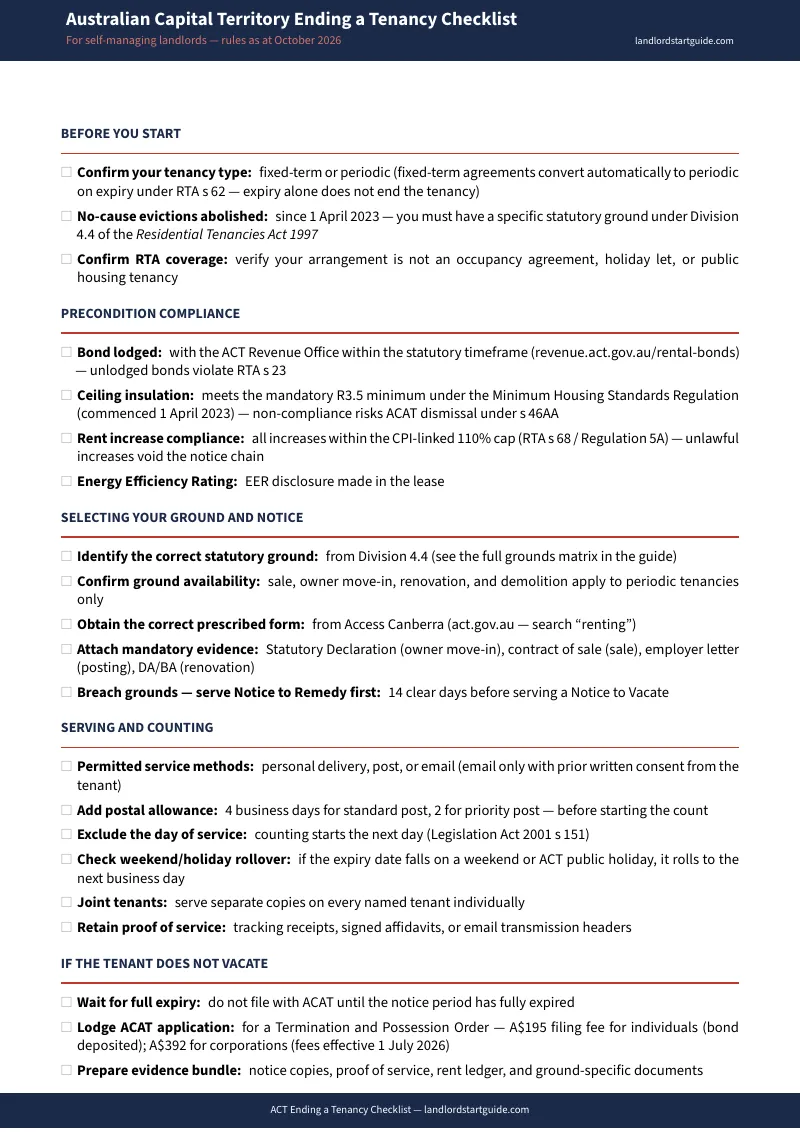
- Dated compliance checklist — 25 action items across the full termination sequence in a two-page printable for the property binder, covering every step from identifying your ground through to the sheriff executing a warrant.
Who This Is For
This guide is built for private landlords who self-manage in the ACT — whether you own a former home in Woden that you let out while posted interstate, or an investment unit in Gungahlin that you manage yourself.
It is especially useful if you are:
- An ADF member or public servant posted back to Canberra who needs to regain possession of your primary residence under the posting clause
- Selling a rental property and need to align the eight-week notice period with your real estate sales campaign
- Dealing with persistent minor breaches — rent arrears, property damage, or neighbour complaints — and unsure whether you are at the "notice to remedy" stage or the "notice to vacate" stage
- Managing the transition from a fixed-term lease to a periodic tenancy and uncertain what rights you have after the expiry date passes
- A landlord who has been relying on NSW or Victorian guidance without realising the ACT's notice periods, forms, and service rules are different
Why Not Just Use the Government Website?
You absolutely should. The ACT Government, Access Canberra, and ACAT all publish free information — and this guide links to every one of their pages.
The problem is that the information is scattered across separate departmental portals with no unified sequence. Access Canberra publishes the notice forms but does not explain which form applies to which ground. The legislation register has the full text of Division 4.4 but requires you to translate dense statutory language into calendar dates. The ACAT fees page lists the filing costs but does not walk you through the evidence bundle your application needs, or the Section 51A pre-filing warning that applies to threatening conduct cases. And nowhere on any government page will you find a single document that connects your grounds to the right form, calculates the notice period with postal handling days, logs proof of service, and maps the ACAT escalation from filing through to warrant enforcement.
Meanwhile, tenants have free access to Legal Aid ACT, the Tenants' Advice Service, and Canberra Community Law — organisations that advise tenants on challenging defective notices the moment they arrive. An invalid notice is not just a delay; it is the starting gun for a counter-claim.
The ACT Notice Compliance System puts every step in order, in one place, with the forms, deadlines, and penalty consequences at each stage. It replaces the guesswork with a workflow you can follow from the day you decide to end the tenancy through to vacant possession.
Satisfaction Guarantee
Full refund, no time limit. If the guide does not help you, email [email protected] and we will process your refund — no questions, no expiry.
Get Started
Download the free checklist to see every step, deadline, and key contact at a glance. When you are ready for the full step-by-step workflow — including the grounds matrix, the service calculation method, and the ACAT escalation process — the complete guide is available for .
One purchase. One reference. Every ACT tenancy termination rule in the order you meet it.
Frequently Asked Questions
What if the rules change after I buy?
We update the guide when the rules change. Email us any time, even years later, and we'll send you the current edition free.