One Missed Deadline Can Cost You the Entire Bond
You collected the bond from your tenant. You meant to lodge it with the ACT Revenue Office. Two and a half weeks later you remember — and you have already committed a strict liability offence under Section 23 of the Residential Tenancies Act 1997. The penalty: up to 20 penalty units. The defence available to you: none. Strict liability means the offence is complete the moment day 15 arrives, regardless of your intentions.
That deadline is just the first trap. The ACT Revenue Office portal requires single-session completion with no draft saving — if your browser times out or you entered the wrong bank reference, you cannot correct the submission online. At the end of the tenancy, your tenant can lodge a single-party bond release application, and if you do not file a formal notice of dispute within 14 calendar days, the full bond is released automatically. The system is designed for licensed property managers who do this every week. A self-managing landlord doing it once every few years walks in blind.
The ACT Bond Compliance System
This is the guide that puts every ACT bond rule, deadline, and form into a single chronological workflow — the ACT Bond Compliance System. Instead of piecing together fragments from the Revenue Office, Access Canberra, and ACAT, you follow one sequence from the day you calculate the bond through to the final payout or tribunal hearing.
It is not a generic Australian landlord pack or a recycled NSW template. It is a step-by-step operational manual written exclusively for the Residential Tenancies Act 1997, verified to the rules as at October 2026, and built for the private landlord who manages one or two properties in the Territory without an agent.
What's Inside
- Bond cap calculator and prohibition list — the four-week cap formula with worked examples for monthly and fortnightly rent, plus the explicit list of charges the ACT prohibits on top: pet bonds, carpet deposits, key deposits, and rent-increase bond top-ups. Getting the cap wrong is a penalty-unit offence before your tenant even moves in.
- 14-day lodgement walkthrough — the exact sequence from receiving the bond money through to confirmed lodgement with the ACT Revenue Office, including the portal's single-session rules, the pre-login document checklist you need open before you start, and what to do when the portal rejects your bank transfer reference or a tenant declines digital lodging and you need the paper form.
- Condition report evidence system — how to complete the statutory entry report, enforce the two-week tenant return window, and build a room-by-room photo file with timestamps and location data that meets ACAT's evidentiary standards. Includes the depreciation schedules for carpet, paint, window coverings, and appliances that determine whether your damage claim holds up or gets dismissed as normal wear and tear.
- Mid-tenancy change procedures — the co-tenant change request form when one housemate leaves, the transfer of rental premises form when you sell the property mid-lease, and the Bond Help Scheme provisions — with the 14-day statutory payout window for departing co-tenants that most landlords only discover when they have already missed it.
- End-of-tenancy deduction framework — the legal categories of deduction (unpaid rent, damage beyond fair wear, cleaning above the condition at entry), the evidence standard for each, and the depreciation principles ACAT actually applies when it assesses your claim. Includes the mutual consent refund path and what happens when your tenant refuses to sign.
- ACAT dispute timeline and preparation — the 14-day window to file after a Notice of Application, current filing fees ($93 for disputes up to $3,000, $195 for disputes up to $15,000), and how to assemble a tabbed evidence bundle that survives a directions hearing, using the ACAT Evidence Checklist included in the kit.
- Penalty matrix — every bond-related offence, its trigger, and its maximum penalty in one table, from failure to lodge through to demanding a prohibited charge.
- Insulation compliance integration — the mandatory R5 ceiling insulation upgrade deadline of 30 November 2026 for existing leases, the three-month compliance window for new leases signed from 1 December 2026, and how insulation status connects to your condition report and lease disclosure obligations.
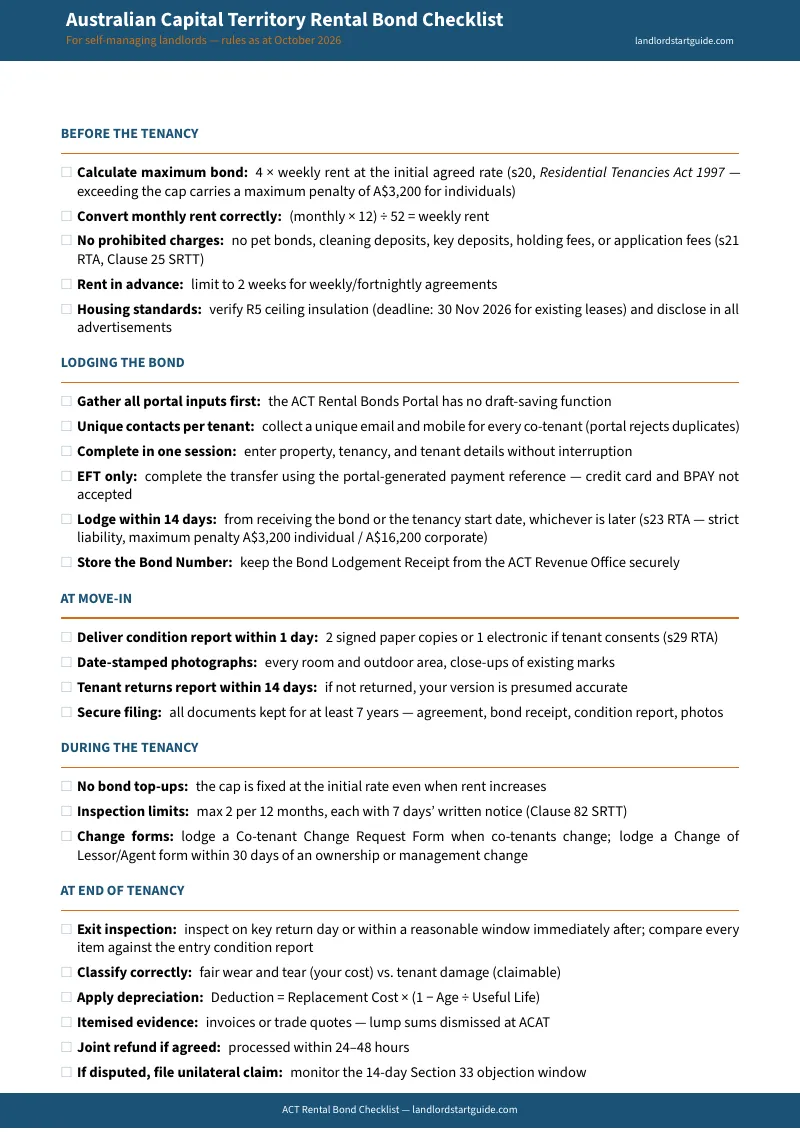
- Dated compliance checklist — 25 action items across five phases (before the tenancy, lodgement, move-in, during, and end of tenancy) in a two-page printable for the property binder.
- Seven fillable worksheets — Bond Calculation Worksheet, Pre-Lodgement Checklist, Condition Report Photo Index, Tenancy Document Register, Bond Deduction Worksheet, 14-Day Response Tracker, and ACAT Evidence Checklist — each a one-page print-and-write tool named in the guide.
Who This Is For
This guide is built for private landlords who self-manage in the ACT — whether you own one former home in Belconnen or two investment units in Gungahlin. If you handle the bond yourself instead of paying an agent 7–10% of your annual rent, this is your operational manual.
It is especially useful if you are:
- Self-managing for the first time after leaving a property manager
- An accidental landlord who inherited a property or kept a former home as a rental
- Managing a co-tenant change — one housemate leaving, another arriving — and unsure how the bond splits
- Approaching your first end-of-tenancy and uncertain whether your deductions will hold up at ACAT
- A landlord who has been relying on NSW guidance without realising the ACT deadlines are shorter and the portals are different
Why Not Just Use the Government Website?
You absolutely can. The ACT Revenue Office, Access Canberra, and ACAT all publish free information — and this guide links to every one of their pages.
The problem is that the information is scattered across separate departmental portals with no unified sequence. The Revenue Office publishes blank forms but does not explain what happens when the portal rejects your bank transfer reference. The condition report template is a downloadable PDF with no guidance on the photo evidence ACAT expects alongside it. The dispute escalation timeline is buried in a fee determination document. And nowhere on any government page will you find a single document that connects the entry condition report to the depreciation principles that ACAT applies when you actually try to claim for tenant damage.
Meanwhile, tenants have free access to Legal Aid ACT, the Tenants' Union, and Canberra Community Law — organisations that coach them to lodge single-party bond releases the day they hand back keys, triggering the 14-day countdown clock before many landlords even know it has started.
The ACT Bond Compliance System puts every step in order, in one place, with the forms, deadlines, and penalty consequences at each stage. It replaces the guesswork with a workflow you can follow from bond collection through to final payout.
Satisfaction Guarantee
Full refund, no time limit. If the guide does not help you, email [email protected] and we will process your refund — no questions, no expiry.
Get Started
Download the free checklist to see the deadlines and key contacts at a glance. When you're ready for the full step-by-step workflow — including the portal walkthrough, the evidence system, and the ACAT dispute timeline — the complete guide is available for .
One purchase. One reference. Every ACT bond rule in the order you meet it.
Frequently Asked Questions
What if the rules change after I buy?
We update the guide when the rules change. Email us any time, even years later, and we'll send you the current edition free.