
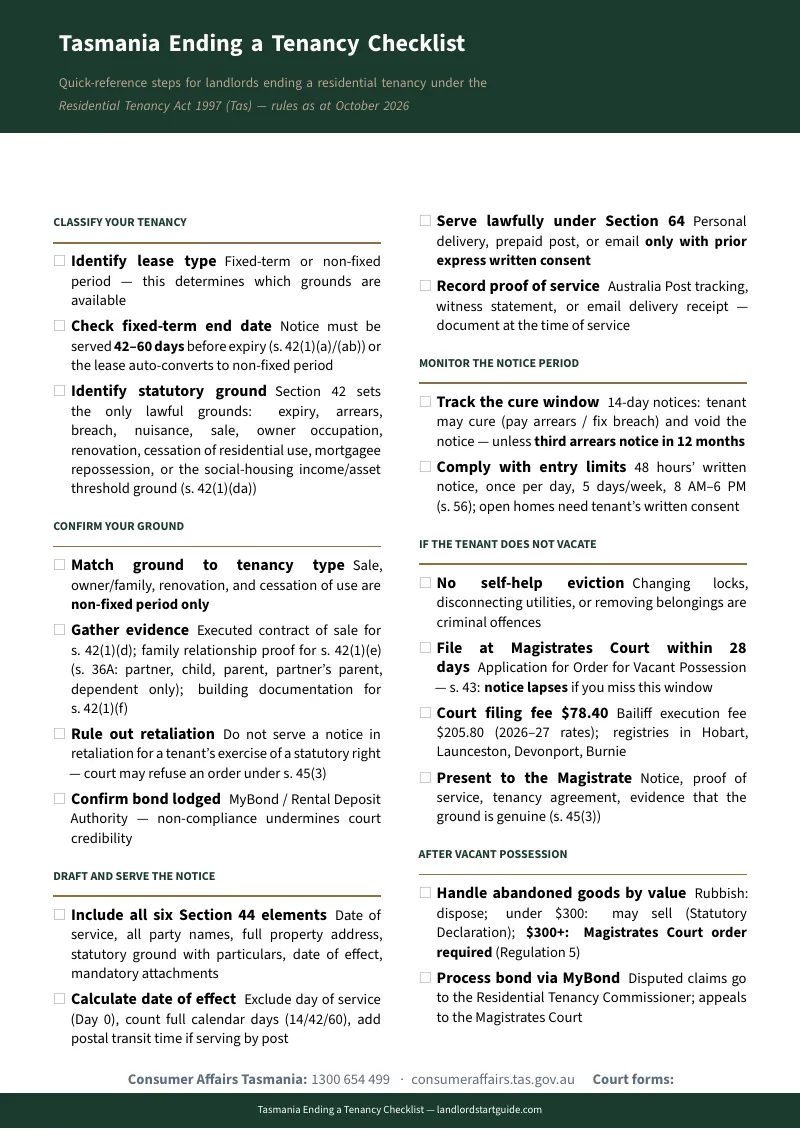
One defective notice costs you months. This guide makes sure you get it right the first time.
In Tasmania, every tenancy termination runs through the Residential Tenancy Act 1997. You need the right ground under Section 42, the right notice period, the right form, and a service method the Act recognises. Get any of those wrong and your notice is void — not delayed, void. The tenant stays. You start again. And you carry the holding costs for every week you lost.
The rules are public. Consumer Affairs Tasmania publishes fact sheets, and the Magistrates Court hosts downloadable notice forms. But the grounds are on one page, the notice periods on another, the service rules somewhere else, and the court process in a separate section. A self-managing landlord piecing this together is one miscounted day or one missing prerequisite away from a notice that gets dismissed.
The Tasmania Termination Compliance System
This guide is not a summary of the law. It is a structured execution manual — 14 chapters, 43 pages, dated to the rules as at October 2026 — that takes you from "I need to end this tenancy" to a valid notice, correctly served, with every requirement met. If the tenant does not leave, it walks you through the Magistrates Court application and enforcement process step by step.
The system works because it addresses the three errors that get self-managing landlords dismissed at court: choosing the wrong ground, miscounting the notice period, and failing to prove service.
What's Inside
- Every lawful ground under Section 42, mapped to your situation — fixed-term expiry, rent arrears, breach, substantial nuisance, property sale, owner or family occupation, significant renovation, cessation of residential use, and mortgagee repossession. Each ground has its notice period, prerequisites, and the evidence you need. The Grounds Table in Chapter 2 tells you which ground applies before you touch a notice form.
- The 42-to-60-day window explained with worked examples — miss this window on a fixed-term lease and the tenancy converts to non-fixed period by operation of law. You lose the expiry ground permanently. The guide calculates the dates for you so you never serve one day too late.
- The three-strike arrears rule — a rent arrears notice gives the tenant 14 days to pay. If they pay, the notice is void. But after two cured notices in a rolling 12-month period, the third notice sticks even if the tenant pays. The guide tracks the timeline so you know exactly where you stand.
- Service method rules and proof-of-service log — personal delivery, prepaid post, and electronic service (only with prior written consent). Each method has specific requirements under Section 64. A notice served by email without consent is defective. The printable log records the method, date, witnesses, and tracking details so you have proof the Magistrates Court will accept.
- The 28-day court application window — if the tenant stays past the vacate date, you must apply to the Magistrates Court for an Order for Vacant Possession within 28 days. Miss that window and the notice lapses entirely. The guide walks you through the Form 2 application, filing fees, what to expect at the hearing, and the enforcement process if the tenant still does not leave.
- Property sale and owner occupation specifics — selling requires an executed, de-identified contract for sale attached to the notice. Moving back in is limited to the owner and a narrow class of statutory family members (domestic partner, child, parent, partner's parent, or dependent relative). Extended family does not qualify. The guide sets out the evidence you need for each.
- Abandoned goods obligations — what happens to property left behind after the tenant moves out, the time limits, and the steps that protect you from a damage claim.
- Printable worksheets that sit beside the guide — a notice-period calculator, proof-of-service log, rent-arrears tracker for the three-strike rule, Magistrates Court filing checklist, and abandoned-goods record. Print them, write on them, take them to the registry.
- Rules dated to October 2026 — every section states the date of the rules it describes, including the Residential Tenancy Regulations 2025 (S.R. 2025, No. 14) and the Residential Tenancy Amendment Regulations 2025 (S.R. 2025, No. 44).
Who This Is For
- Self-managing landlords in Tasmania who need to end a tenancy for a specific reason — selling, moving back in, lease expiry, arrears, or another lawful ground
- Landlords approaching a fixed-term lease expiry who cannot afford to miss the 42-to-60-day notice window
- Accidental landlords who inherited a property or kept a former home and now need it back
- Agent-managed owners who want to verify their property manager is following the correct process
Why Not Just Use the Government Website?
Consumer Affairs Tasmania and the Magistrates Court are free, authoritative, and the starting point for anyone dealing with tenancy law. What they do not provide is a single workflow. The grounds are on one page, the notice periods on another, the service rules in a different section, and the court process in a separate portal. The prescribed notice form is a blank Word document with no instructions on which ground to cite, how to count the days, or what evidence to attach.
This guide puts every step in one dated document, in the order you meet them, with a 20-item printable checklist and five fillable worksheets. It saves the hours of cross-referencing — and the risk of missing something that only surfaces when the Magistrates Court dismisses your application.
Your Satisfaction, Guaranteed
If the guide does not help you understand the process, email [email protected] for a full refund, no time limit. We read every message.
The free checklist covers the key steps, prescribed forms and deadlines on two dated pages — download it from this page, no payment required. When you need the full ground-by-ground detail, worked examples, service rules and the Magistrates Court process, the complete guide is an instant download at .
Frequently Asked Questions
What if the rules change after I buy?
We update the guide when the rules change. Email us any time, even years later, and we'll send you the current edition free.