Seven standards, three repair deadlines, and a Commissioner who can fine you $10,650. This puts the whole system in order.
You know your Tasmanian rental has to meet minimum standards. But when you sit down to work out exactly what those standards require, the information is scattered across CBOS housing pages, the downloadable Rental Guide PDF, Tenants' Union factsheets, and the raw text of the Residential Tenancy Act 1997.
Some of it is written for tenants. Some of it is written for professional property management agencies running software platforms. The legacy CBOS Rental Guide from 2019 still turns up in search results, creating confusion between outdated references and current law. And none of it tells a self-managing landlord: start here, check this room, record it like this, move to the next standard.
Meanwhile, generic Australian landlord templates from national platforms routinely misapply Victorian or New South Wales rules to Tasmania. Victoria requires mandatory two-yearly gas and electrical safety certificates — Tasmania has no such scheme. If you've purchased an interstate compliance template or followed advice that references annual safety inspections, you've been solving a problem that doesn't exist in your jurisdiction.
That's the gap this guide fills.
The Pre-Letting Compliance System
The guide is built around one idea: turn the scattered statutory rules into a standard-by-standard audit you can walk through with a clipboard and complete in a single property visit — then keep the records organised for every repair, inspection and lease renewal that follows.
It covers all seven minimum standards under Part 3B of the Residential Tenancy Act 1997 (Sections 36I through 36O) — weatherproofing and structural soundness, cleanliness and good repair, bathroom and toilet facilities, cooking facilities, electricity and fixed heating, window coverings, and ventilation — plus the smoke alarm regime under Part 3A, the three-tiered repair framework with its 24-hour, 14-day and 28-day statutory deadlines, trade licence verification through the CBOS register, the pre-tenancy disclosure pack, condition report protocols, and the penalties that apply when something falls short.
Each standard is mapped to physical checks, pass/fail criteria, the records to keep, and the statutory section reference so you can verify every requirement on the Tasmanian Legislation website. The guide separates what is legally required right now from proposed reforms, so you're not over-spending on upgrades that haven't commenced and not under-spending on duties that carry fines today.
What's inside
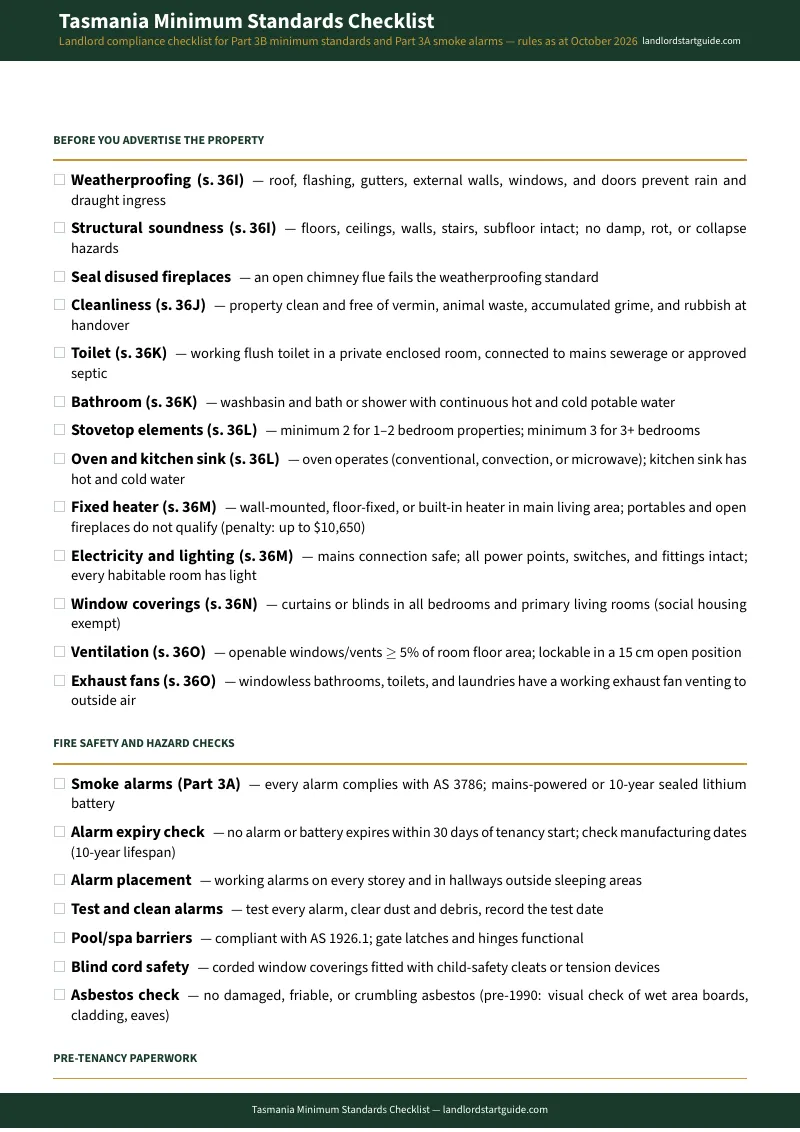
- Pre-Letting Minimum Standards Audit Checklist — every Part 3B standard mapped to room-by-room physical checks, pass/fail criteria, and the statutory section reference so you can verify each one directly
- Three-Tiered Repair Clock — a one-page worksheet per defect: which failures trigger the 24-hour essential-service window, the 14-day stove element deadline, and the 28-day general maintenance clock, plus the tenant's statutory self-help right when you miss a deadline
- Trade Verification Record — fields to record CBOS licence number, class, register date, work done, and CEC/GFN certificate numbers for every electrician, gas fitter or plumber you engage
- Pre-Tenancy Disclosure Pack — the chronological document assembly sequence, the two-business-day condition report return window, and the MyBond lodgement timeline (maximum 4 weeks' rent, 3 business days)
- Condition Report Photography Guide — a room-by-room shot list so date-stamped photos actually carry a bond claim
- Tasmanian Winter Readiness Checklist — fixed heating under Section 36M (heat pump, electric, gas or wood heater — open fireplaces prohibited), window covering mandates under Section 36N, and the 5% ventilation ratio under Section 36O
- Mould and Dampness Inspection — the inspection rule for distinguishing structural causes (your obligation) from occupant-caused condensation (tenant's responsibility), with space to log the independent report the RTC expects
- Exemption Application Worksheet — the three grounds under Section 36P, the pack to lodge with the RTC, and the heritage-property misconceptions the Commissioner routinely rejects
- Repair and Access Log and Document Retention Schedule — dated logs for every repair request, entry notice, and the keep-until dates for condition reports (2 years), smoke-alarm logs (7 years), and trade certificates (10 years)
Who this is for
- Self-managing landlords letting a property in Tasmania who want to handle compliance without a property manager
- Accidental landlords who inherited a property or kept a former home as a rental and have no agency safety net
- Owners who recently stopped using a property management agency and need the administrative frameworks the agency used to handle
- Older self-managers and self-funded retirees whose properties may have passed a decade ago but face questions under current standards
- Landlords preparing a property for a new tenancy who need to verify every standard is met before key handover
Why not just use the free government sites?
You absolutely can. Every regulation, every register and every portal the guide references is publicly available. The guide links to each one.
What CBOS doesn't provide is a sequential compliance workflow. The official Rental Guide tells you that a property must be weatherproof, heated and ventilated. It doesn't supply a printable room-by-room audit checklist, a date-stamped photo evidence archiving system, a trade verification logging sheet, or a standardised record framework designed to protect you in a bond dispute before the Residential Tenancy Commissioner.
And the compliance subscription packages that property management SaaS platforms push — Rental360, ConditionHQ, and similar services — are built for professional agency portfolios, not a private owner with one or two properties. Full-service property management in Tasmania costs 7–10% of gross annual rental revenue. The guide gives you the operational framework agencies use, as a single reference you own permanently.
What this guide is not
It is not legal advice. It is not a dispute guide, an eviction manual or a tool for tactics against tenants. It does not replace a solicitor, a licensed building inspector or an emergency tradesperson. Landlord Start Guide is an independent publisher with no connection to CBOS, the Residential Tenancy Commissioner, the Rental Deposit Authority or any government body.
Every section states the date of the rules it describes. Where a regulation has been amended or a reform proposed, the guide says so clearly and gives you the official source to monitor.
Full refund, no time limit
If the guide doesn't add value beyond what you can find on the free government sites, email [email protected] for a full refund. No time limit, no questions.
Your download includes
- guide.pdf — 47 pages covering all 7 Part 3B minimum standards, smoke alarms and safety obligations, mould and dampness liability, the heating standard, the three-tiered repair framework, trade licensing, the pre-tenancy disclosure pack, property access rules, exemptions, penalties and dispute resolution, worksheets and key contacts
- checklist.pdf — a 2-page dated compliance checklist (25 items across 3 sections: before you advertise, fire safety and hazard checks, pre-tenancy paperwork)
- pre-letting-minimum-standards-audit.pdf — 2-page room-by-room pass/fail audit for every Part 3B standard plus Part 3A smoke alarms
- three-tiered-repair-clock.pdf — 1-page classify-and-dispatch worksheet (one per defect)
- repair-and-access-log.pdf — landscape log of every request, deadline, trade, and entry notice
- trade-verification-record.pdf — landscape CBOS licence and CEC/GFN register
- pre-tenancy-disclosure-pack.pdf — handover and MyBond tick-sheet
- condition-report-photography-guide.pdf — room-by-room shot list
- document-retention-schedule.pdf — landscape keep-until register
- tasmanian-winter-readiness-checklist.pdf — heating, coverings, and ventilation before the first cold snap
- mould-and-dampness-inspection.pdf — cause-classification worksheet
- exemption-application-worksheet.pdf — s. 36P pack for the RTC
PDF files you download immediately after purchase. They're yours to keep, print and reuse across tenancies.
Start with the free checklist to see the structure and scope. When you're ready for the full step-by-step system, the guide has everything in one place — for less than the cost of a single trade call-out.
Get the full guide →
Frequently Asked Questions
What if the rules change after I buy?
We update the guide when the rules change. Email us any time, even years later, and we'll send you the current edition free.