
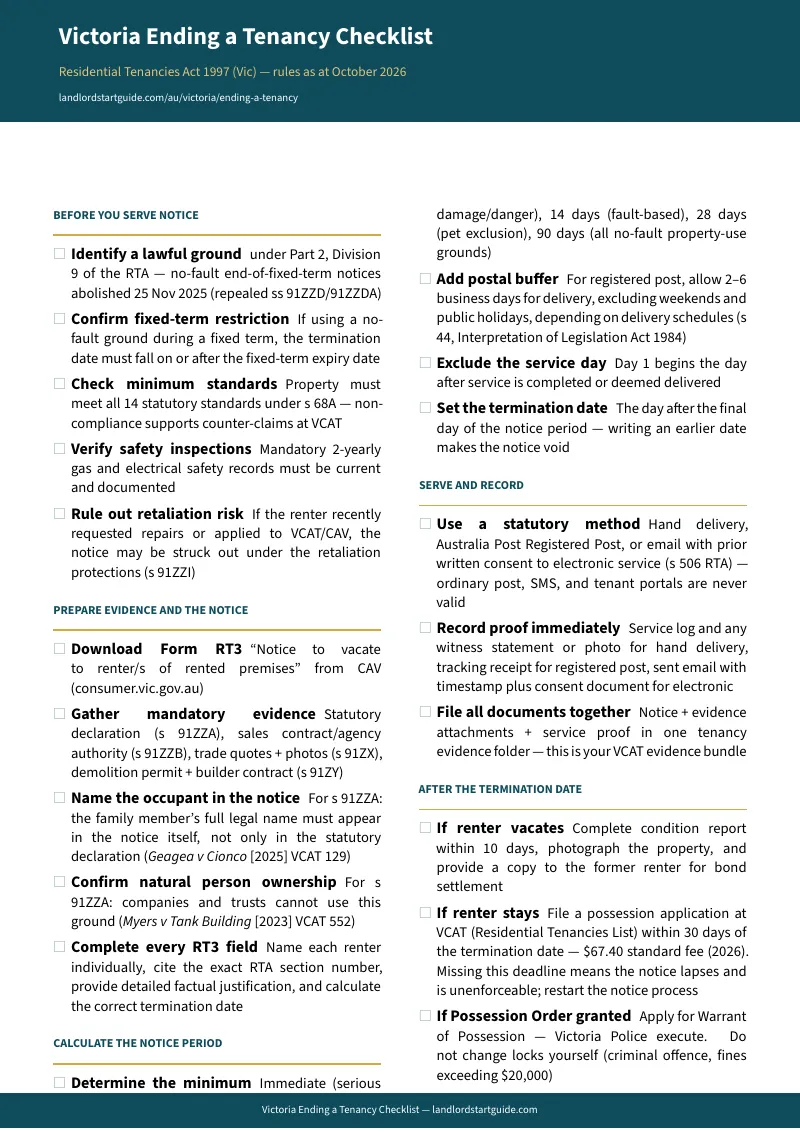
One wrong date, one missing declaration, and your notice is void. This puts the whole process in order.
You've decided to end the tenancy. Maybe you're selling the property, maybe you're moving back in, maybe the fixed term is ending and things aren't working. Whatever the reason, you need to serve a legally valid notice to vacate — and in Victoria, that means getting the right statutory ground, the right prescribed form, the right evidence attached, and the right number of days calculated correctly.
Get any of that wrong and the notice is void. Not challengeable. Not fixable. Void. You start the whole notice period again from day zero, and if the tenant has already dug in, that means a VCAT hearing — currently averaging twelve weeks for non-urgent possession orders — before you can even think about recovering the property.
The rules are scattered across Consumer Affairs Victoria's website, VCAT practice notes, the Residential Tenancies Act 1997, and a dozen forum threads where half the advice is from New South Wales. None of it tells a self-managing landlord: here's your ground, here's the form, here's the evidence you need, here's how to count the days, here's what to do if the tenant stays.
That's the gap this guide fills.
The Notice Compliance System
The guide is built around one sequential workflow: identify your lawful ground, prepare the evidence, fill the prescribed CAV form, calculate the service date correctly (including postal buffers), serve the notice using an approved method, and — if the tenant doesn't vacate — navigate the VCAT possession application and warrant process.
Every lawful ground under the Residential Tenancies Act 1997 is mapped to its notice period, prescribed form, and mandatory evidence requirements under Section 91ZZO. Victoria banned no-reason notices in 2024, so every notice must now cite a specific statutory ground and attach the right documentation — a witnessed statutory declaration for owner-occupation, a signed contract of sale for property sale, building permits and trade quotes for major renovation, or a council demolition permit for demolition.
The guide separates active October 2026 rules from future changes (such as the March 2027 minimum energy efficiency standards) so you know exactly what applies to a notice you're serving today.
What's inside
- Lawful Grounds and Evidence Matrix — every no-fault and fault-based ground mapped to its RTA section, prescribed notice period, required CAV form and mandatory evidence attachments under Section 91ZZO
- Service Day Calculation Worksheet — step-by-step fields for calculating the effective termination date: registered post buffers (3–5 business days), electronic service consent verification, hand delivery and the earliest valid vacate date
- Proof-of-Service Log — a dated record of how and when you served the notice, including postal receipt references, electronic consent documentation and hand delivery witness details
- VCAT Possession Application Walkthrough — the 30-day filing window after notice expiry, the application process, the hearing, the possession order and police warrant enforcement
- Counter-Notice and Re-Letting Rules — the renter's 14-day counter-notice right on sale notices, the 6-month re-letting restriction after owner-occupation possession, and the retaliation and family violence protections that can override a notice entirely
- RTBA End-of-Tenancy Checklist — the October 2026 rules requiring advance notice and digital evidence uploads to the RTBA portal before claiming against the bond, with hand-off to the separate bond guide
- Worked Date-Calculation Examples — two complete examples walking through the postal buffer arithmetic and statutory notice period so you can verify your own calculations
Who this is for
- Self-managing landlords in Victoria ending a tenancy for any lawful reason — sale, owner-occupation, renovation, fixed-term expiry or a breach
- Accidental landlords who kept a former home as a rental and now need to sell or move back in
- Owners coordinating notice timing with settlement dates, bridging finance or renovation schedules
- Agency-represented landlords who want to verify whether a notice prepared by their property manager meets statutory requirements
- Experienced landlords who want a dated reference for the current notice rules as at October 2026
Why not just use the free government sites?
You absolutely can. Every statutory ground, every form and every portal the guide references is publicly available. The guide links to each one.
What Consumer Affairs Victoria doesn't provide is an integrated notice workflow. CAV publishes the lawful grounds on one page, the prescribed form on another, the evidence rules across the Act, and the VCAT process on a separate portal entirely. There is no combined date-calculation worksheet, no service-day buffer calculator, and no step-by-step sequence that takes you from "I need to end this tenancy" through to "the notice has been validly served and the VCAT filing window is open."
Meanwhile, real estate agencies charge $250 to $550 to prepare and serve a single notice — and many use that service as a lead generator for ongoing property management contracts at 6–8% plus GST of your rental income. If you prefer to manage the process yourself, the guide gives you the same statutory workflow at a fraction of the cost.
What this guide is not
It is not legal advice. It is not an eviction strategy, a tool for tactics against tenants, or a guide to winning a contested VCAT hearing. It does not promise faster tenant removal or guaranteed outcomes. Landlord Start Guide is an independent publisher with no connection to Consumer Affairs Victoria, VCAT, RDRV, the RTBA or any government body.
The guide explains what the law requires and how the process works — lawful grounds, prescribed forms, notice periods, service rules and the formal steps if the tenant stays. If your situation involves a complex dispute, tenant resistance at a VCAT hearing, or a family violence intervention order, you need legal advice — the guide points you to the available services.
Full refund, no time limit
If the guide doesn't add value beyond what you can find on the free government sites, email [email protected] for a full refund. No time limit, no questions.
Your download includes
- guide.pdf — 46 pages covering every lawful ground, prescribed notice form, evidence requirement, service method, date calculation, VCAT possession process, counter-notice rules, re-letting restrictions, RTBA end-of-tenancy duties, retaliation protections and worked examples
- checklist.pdf — a 2-page dated checklist (24 items across 6 sections: before you serve notice, prepare evidence and the notice, calculate the notice period, serve and record, after the termination date, key restrictions)
- notice-period-calculator.pdf — a fillable worksheet for calculating the correct termination date: lawful ground, service method, postal buffer, date arithmetic and pre-service checks
- proof-of-service-log.pdf — a dated record template for documenting how and when you served the notice, with fields for postal receipts, electronic consent and hand delivery witness details
- rent-arrears-tracker.pdf — a running log for tracking each arrears occasion under the Section 91ZM five-strike pathway
- vcat-preparation-checklist.pdf — a checkbox list of every document, fee and filing step required for a VCAT possession application within the 30-day window
- end-of-tenancy-compliance.pdf — a post-possession checklist covering the condition report, left-behind goods protocol, RTBA bond settlement and re-letting restrictions
PDF files you download immediately after purchase. They're yours to keep, print and reuse.
Start with the free checklist to see the structure and scope. When you're ready for the full step-by-step system, the guide has everything in one place — for less than the cost of a single agent notice-preparation fee.
Get the full guide →
Frequently Asked Questions
What if the rules change after I buy?
We update the guide when the rules change. Email us any time, even years later, and we'll send you the current edition free.