Fifteen standards, five regulators, and a deadline that just landed. This puts it all in order.
You know your Victorian rental needs to meet minimum standards. But when you sit down to work out exactly which standards apply, the information is spread across Consumer Affairs Victoria fact sheets, Energy Safe Victoria licence registers, VBA building codes, VCAT guidance notes, and the raw text of the Residential Tenancies Act 1997 and the Residential Tenancies Regulations 2021.
Some of it is written for tenants. Some of it is written for property management agencies running software platforms. None of it tells a self-managing landlord: start here, do this check, record it like this, move to the next one.
And since 13 October 2026, there's a new layer: two-yearly gas and electrical safety checks now apply to every active tenancy — including legacy leases that started before 29 March 2021 and were previously grandfathered. The record retention rules under Sections 65C–65F mean Consumer Affairs Victoria can ask for proof of compliance at any time, and you need to produce it.
That's the gap this guide fills.
The Schedule 4 Compliance System
The guide is built around a single idea: turn the scattered statutory rules into a standard-by-standard audit you can walk through with a clipboard and complete in one visit — then keep the records organised for every inspection, safety check and lease renewal that follows.
It covers all 15 minimum standards under Schedule 4 of the Residential Tenancies Regulations 2021 — locks, window security, window coverings, cord safety, structural soundness, dampness and mould, kitchens, bathrooms, laundry, sanitation, ventilation, lighting, electrical switchboard safety, heating, and waste disposal — plus the obligations that sit around them: two-yearly electrical and gas safety checks, annual smoke alarm servicing, pool and spa barrier registration, the pre-advertising compliance sequence under Section 65B, the 17-point mandatory disclosure statement, trade licence verification, urgent repairs, and the penalties that apply when something falls short.
Each standard is mapped to the physical checks involved, the records to keep, the forms to use, and the deadlines that apply. The guide separates what is legally required right now from what is coming (such as the March 2027 Minimum Energy Efficiency Standards), so you're not over-spending on upgrades you don't need yet and not under-spending on duties that carry penalties today.
What's inside
- 15-Category Minimum Standards Audit Sheet — every Schedule 4 standard mapped to physical checks, pass/fail criteria, and the regulation clause so you can verify each one on the Victorian Legislation site
- October 2026 Safety Check Expansion — which tenancies are now caught by the two-yearly gas and electrical check rules, the deadlines for legacy leases, and how to organise the first round of checks
- Trade Qualification Verification Sheet — step-by-step fields for checking any contractor on the Energy Safe Victoria or VBA public register, recording licence number and class, and filing the COES or gas safety report
- Pre-Advertising Compliance Sequence — the chronological steps required under Section 65B before you can lawfully advertise a property, with the record retention format that satisfies Sections 65C and 65E
- Mandatory Disclosure Handover Checklist — every mandatory pre-agreement disclosure (mould repair history, safety-check dates, criminal-activity history, building notices, heritage status) compiled into a 17-point tick-off packet
- Multi-Year Compliance Calendar — annual smoke alarms, biennial gas checks, biennial electrical verification, the 6-month pre-draughtproofing gas check, and 4-yearly pool barrier recertification mapped across five years
- Urgent Repair Decision Framework — which failures trigger the Section 72 urgent repair rules, the $2,500 cap, the Rent Special Account under Section 77, and the RDRV and VCAT pathways
- Penalties and Enforcement Reference — fines per standard, VCAT compensation orders, CAV inspection powers, and what the Renting Taskforce can demand under Section 65F
Who this is for
- Self-managing landlords letting a property in Victoria who want to handle compliance without a property manager
- Accidental landlords who inherited a property or kept a former home as a rental
- Agency-represented owners who want to verify whether their property manager's compliance recommendations reflect legal requirements or commercial upsells
- Owners whose legacy pre-2021 tenancies are now caught by the October 2026 safety check expansion
- Experienced landlords who want a single dated reference for the current rules as at October 2026
Why not just use the free government sites?
You absolutely can. Every regulation, every register and every portal the guide references is publicly available. The guide links to each one.
What the government portals don't provide is a sequential compliance workflow. Consumer Affairs Victoria explains what the law says. This guide shows you how to check each standard, what to record, and where to file it — in one document, in the order you'll actually do the work.
It also separates Victorian law from the NSW, Queensland and New Zealand rules that routinely contaminate search results. If you've ever Googled "rental minimum standards" and ended up reading about NSW's Section 52 framework or New Zealand's Healthy Homes Standards, you know the problem.
And the compliance inspection subscription packages that property management agencies push — typically $150 to $400 a year per property — are recurring trade services, not self-management tools. Engaging a licensed electrician and gasfitter directly for the biennial checks costs roughly $150 per trade every two years. The guide gives you the framework to manage those appointments yourself and keep the records that satisfy CAV.
What this guide is not
It is not legal advice. It is not a dispute guide, an eviction manual or a tool for tactics against tenants. It does not replace a solicitor, a licensed building inspector or an emergency tradesperson. Landlord Start Guide is an independent publisher with no connection to Consumer Affairs Victoria, Energy Safe Victoria, VCAT, RDRV or any government body.
Every section states the date of the rules it describes. Where a reform has been enacted but not yet commenced (such as the Minimum Energy Efficiency Standards from 1 March 2027), the guide says so clearly and gives you the official source to monitor.
Full refund, no time limit
If the guide doesn't add value beyond what you can find on the free government sites, email [email protected] for a full refund. No time limit, no questions.
Your download includes
- guide.pdf — 45 pages covering all 15 Schedule 4 standards, electrical and gas safety checks, smoke alarms, pool barriers, heating and energy efficiency, the pre-advertising compliance sequence, mandatory disclosures, record-keeping, urgent repairs, penalties, worksheets and key contacts
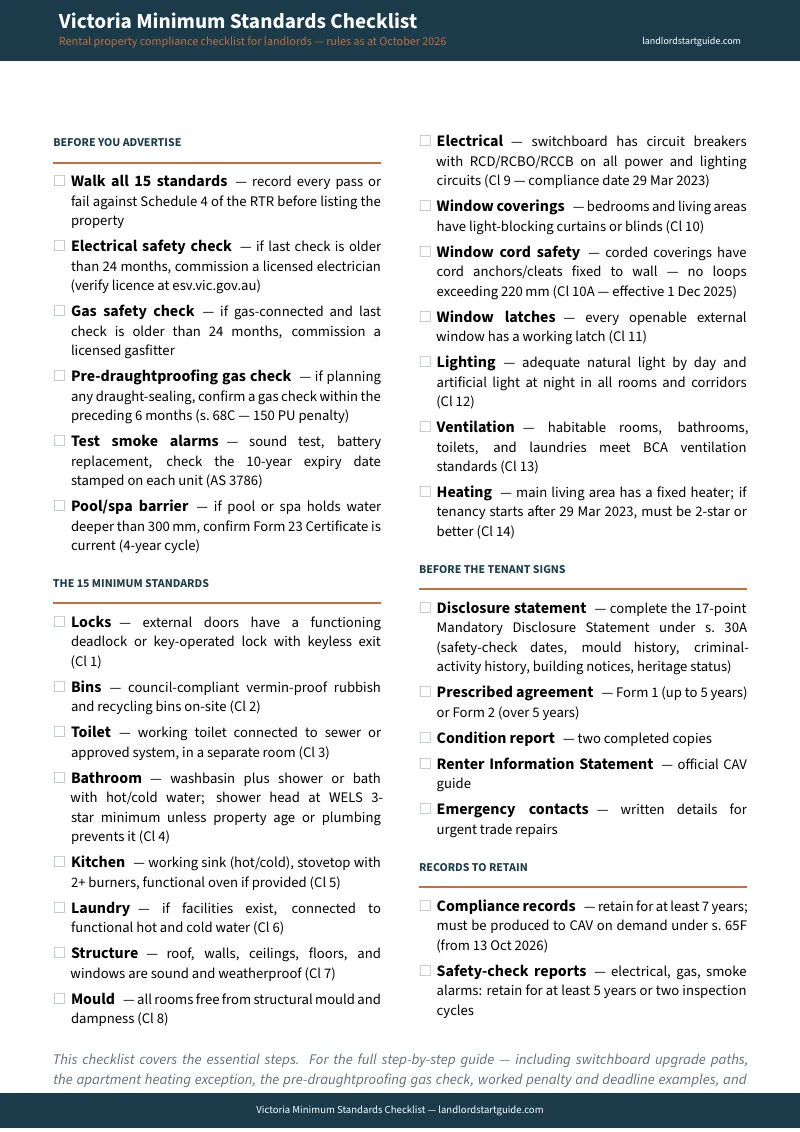
- checklist.pdf — a 2-page dated compliance checklist (28 items across 4 sections: before you advertise, the 15 standards, before the tenant signs, records to retain)
- 15-category-minimum-standards-audit-sheet.pdf — fillable walk-through of every Schedule 4 standard with pass/fail, contractor and photo-reference columns
- mandatory-disclosure-handover-checklist.pdf — the 17-point Section 30A disclosure packet plus lease-execution documents, ticked off before the renter signs
- multi-year-compliance-calendar.pdf — electrical, gas, smoke-alarm and pool-barrier cycles plus the pre-advertising audit across five years
- defect-rectification-log.pdf — one line per repair from report to close, including the $2,500 urgent-repair cap and 7-day reimbursement clock
- trade-qualification-verification-sheet.pdf — ESV and VBA licence checks for electrician, gasfitter, plumber and building surveyor before they attend
PDF files you download immediately after purchase. They're yours to keep, print and reuse across tenancies.
Start with the free checklist to see the structure and scope. When you're ready for the full step-by-step system, the guide has everything in one place — for less than the cost of a single trade compliance service call.
Get the full guide →
Frequently Asked Questions
What if the rules change after I buy?
We update the guide when the rules change. Email us any time, even years later, and we'll send you the current edition free.