One Wrong Date. One Missing Element. Your Entire Rent Increase Is Void.
Alberta doesn't cap how much you can raise the rent — but it has some of the strictest timing and notice rules in Canada. Serve your notice one day too early, omit a single mandatory element, or deliver it by text instead of in writing, and the Residential Tenancies Act voids the entire increase. The old rent stays. You start over. And the 365-day clock resets.
Most private landlords learn this the hard way. They search the Service Alberta website for an official rent increase form — and discover it doesn't exist. They calculate "12 months" instead of 365 days. They serve notice mid-month, not realising that "three months' notice" means three full tenancy months measured from the first day of the next rental period. One wrong assumption, and the carefully planned increase evaporates.
The Alberta Rent Increase Compliance System
This guide replaces the guesswork with a structured system: every calculation, every form, every service method, every dispute scenario — in one place, in the order you need it. It is built around the three pillars the RTA demands for every lawful increase: the 365-day frequency rule, the full-period notice requirement, and the written-notice content standard.
Where Service Alberta publishes rules, this guide gives you the tools to execute them without error. Where the government is silent — on form design, on service logs, on dispute preparation — this guide fills the gap with ready-to-use templates built from the statute, the Ministerial Regulation, and RTDRS adjudication patterns.
What's Inside
- 365-Day Frequency Worksheet — stop calculating "12 months" and getting it wrong. This worksheet counts the exact days from your tenancy commencement or last increase to the earliest lawful effective date, with separate tracks for periodic tenancies, fixed-term renewals, and the mid-term prohibition that catches landlords with consecutive short leases.
- Full Tenancy Month Calendar — the three-month notice period for monthly tenancies runs on calendar-month boundaries, not 90 days. The calendar shows you the exact deadline for serving notice, including the common trap of serving on the 15th and pushing your effective date a full month later.
- Fillable Notice Template — because Service Alberta does not publish a standard rent increase form, landlords draft their own and routinely omit mandatory elements. This template includes every element required under RTA s. 14: the date signed, the exact new rent in Canadian dollars, the effective date, the premises address, and the signature line — pre-formatted so nothing is missed.
- Proof-of-Service Protocol and Log — a tenant who denies receiving notice can void your increase at the RTDRS. This log documents personal delivery, registered mail, adult hand-off, and door posting with dates, witness details, and tracking references — the same evidence trail adjudicators examine in a dispute hearing.
- Tenancy Classification Route Map — the rules for periodic tenancies and fixed-term leases are fundamentally different, and confusing them is the second-most-common compliance failure. The route map guides you from your tenancy type to the exact legal pathway, including what happens when a fixed-term lease rolls into a periodic tenancy.
- RTDRS Dispute Defence Framework — if a tenant challenges your increase, you need to know the current filing fees (updated for the April 2026 tiered schedule), what evidence to prepare, how an economic-eviction challenge unfolds, and what the adjudicator is actually looking for. This section gives you the framework before you need it.
- Economic Eviction Safeguard Checklist — Alberta has no rent cap, but the RTDRS can void an increase it deems an economic eviction. This checklist shows you how to document market comparables and expense increases so your adjustment stands up to scrutiny.
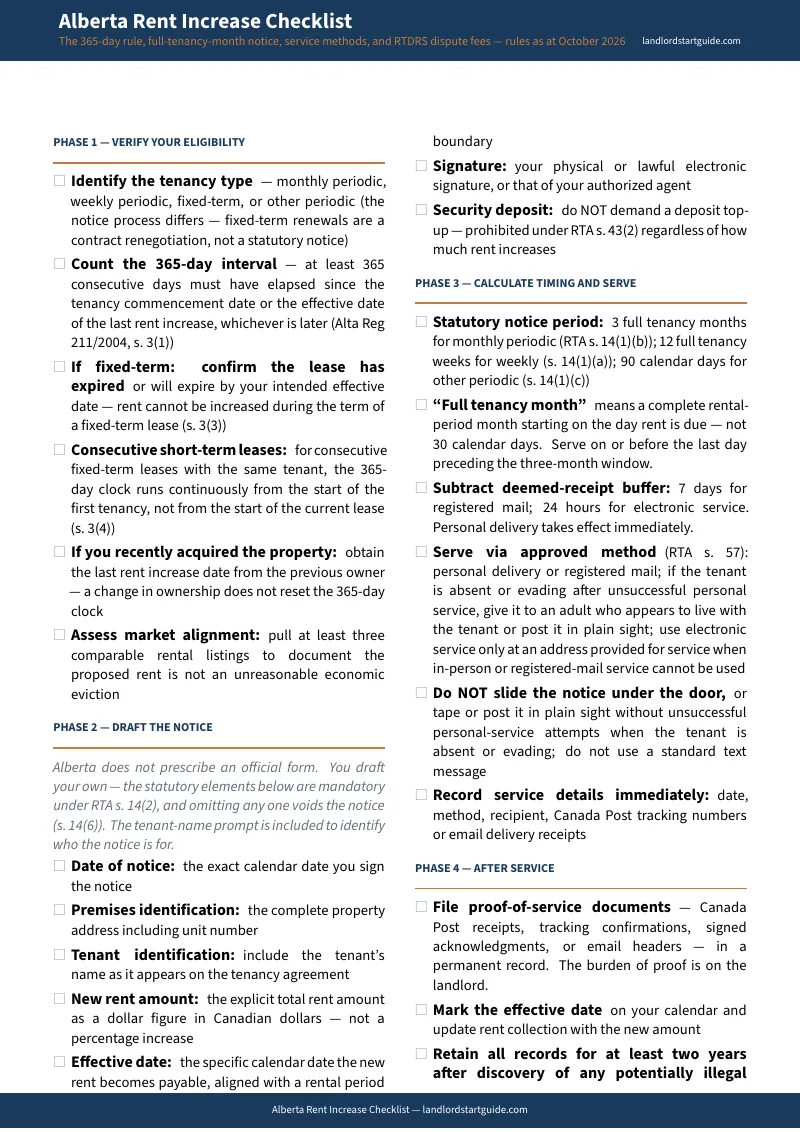
- Dated Compliance Checklist — a printable two-page reference of every step, every deadline, and every form, dated to the rules as at October 2026. The free version gives you the checklist alone; the full guide gives you the tools to execute every line on it.
Who This Is For
- Private landlords in Alberta managing one to a few residential properties — houses, apartments, condos, secondary suites, or rented rooms under the RTA
- Self-managing owners who handle their own notices without a property management company — and need to get it right without paying $200+ per transaction for an agent to do it
- Landlords approaching a renewal or anniversary who want to increase the rent and need a clear, dated workflow for the notice, the timing, and the service
- Anyone who has had a notice rejected by a tenant or voided by the RTDRS, and wants to understand exactly what went wrong and how to prevent it
Why Not Just Use the Free Government Resources?
Service Alberta's RTA tip sheets tell you the rules. The Centre for Public Legal Education Alberta (CPLEA) explains the law clearly. Both are excellent — and both are free. This guide does not sell secret laws.
What neither provides is a fillable notice template (Service Alberta explicitly does not publish one), a 365-day calculation worksheet, a proof-of-service log, or a dispute-preparation framework. The government tells you what the rules require. This guide gives you the tools to execute them without error — in one document, in the order you need them, with the worked examples that turn rules into actions.
If you've already read the RTA and you're confident in your calculations, service method, and notice format, you may not need this. But if you want every step calculated, templated, and documented so that a dispute challenge finds nothing to void, this is the fastest path from decision to compliant notice.
Satisfaction Guarantee
Full refund, no time limit. If the guide doesn't save you time or prevent a compliance mistake, email [email protected] and we'll refund you in full. No questions, no deadline.
Get Started
Download the free Alberta Rent Increase Checklist for a dated overview of every step. When you're ready for the calculations, the templates, and the dispute framework, the full guide is — one purchase, no subscription, yours to keep.
Frequently Asked Questions
What if the rules change after I buy?
We update the guide when the rules change. Email us any time, even years later, and we'll send you the current edition free.