Your mortgage just renewed at double the rate. The province says you can raise rent by 2.3%.
You've done the math. Insurance is up. Property tax is up. Your mortgage payment jumped by hundreds a month when the fixed rate rolled over. The annual rent increase — capped at 2.3% for 2026 and 2.2% for 2027 — barely covers the insurance increase alone.
But here's the part that actually costs you: a single timing mistake on your rent increase notice voids it entirely and resets the clock by a full year. Not a penalty. Not a fine. Just silence — your tenant keeps paying the old rate, and you eat the shortfall for another twelve months.
The Compliance Sequence Method
The Rent Increases in British Columbia guide gives you every step of the rent increase process in the exact order you need to execute it — from confirming your 12-month eligibility window through to building a proof-of-service file that survives an RTB dispute hearing.
This isn't a summary of the Residential Tenancy Act. It's a chronological execution workflow built for the landlord who manages their own property: one path through the rules, with the calendar math worked out and the decision points flagged before you reach them.
What's Inside the Guide
- The annual cap system explained — how the cap is calculated from BC CPI, which properties it covers, and the critical manufactured home park distinction that catches landlords who own mixed assets
- The 12-month clock — when it starts, why vacancy resets work differently than most landlords assume, and why automatic escalation clauses written into your lease are void under the RTA
- Exact calculation math with rounding rules — the formula the RTB uses, the rounding-down requirement, which year's cap applies to your effective date, and a worked example showing how the one-cent trap works
- Form RTB-7 field-by-field walkthrough — every mandatory field on the August 2024 revision, what happens when a notice contains an error, and where landlords most commonly leave a field blank or enter the wrong figure
- Service method decision matrix — the five approved methods (hand delivery, posting, registered mail, regular mail, email with consent), the deemed-receipt days for each, and a side-by-side comparison showing which method protects you best in a dispute
- Three-full-month calendar math — worked examples showing exactly when a September notice produces a January effective date versus a February one, the cross-year timing trap, and how to reverse-calculate the latest safe service date for your target month
- Above-cap route (RTB-52 applications) — the capital expenditure recovery process, the $300 + $10/unit application fee, phase limits, extraordinary operating losses, and why voluntary written agreements are almost never the right tool
- Prohibited practices — unbundling included services, adding fixed operating fees, pressure tactics, and the penalties under the RTA that apply when a landlord crosses these lines
- When the tenant disputes — what triggers a dispute, how the RTB hearing works, what evidence an arbitrator expects, and the specific records that determine whether your increase stands
Who This Is For
You're a private landlord in British Columbia. You own a basement suite, a condo unit, or a former family home that you rent out. You manage the property yourself — no property management company, no legal team on retainer. You want to raise the rent, and you want to do it correctly the first time so you're not explaining to an arbitrator why your notice was void.
This guide is not for institutional investors with compliance departments, not for tenants looking for their rights (the Tenant Resource and Advisory Centre handles that), and not for manufactured home park owners (who follow different legislation entirely).
Why Not Just Use the Government Website?
You should. The RTB portal has Form RTB-7, an online rent increase calculator, and the full text of the Residential Tenancy Act. All free, all official.
What the government site does not give you is a single path through the process. To execute a rent increase correctly, you currently need to cross-reference Section 42 (the annual cap), Section 44 (the notice period), Section 88 (approved service methods), and Section 90 (deemed delivery timelines) — across four separate pages and two PDF forms. The guide connects these rules into one chronological workflow with calendar examples, so the timing interactions are visible before you serve the notice, not after a tenant files a dispute.
The free checklist covers what to do. The guide covers how — with the calculation math, the service-method decision points, and the evidence standards the RTB expects.
What's Included
- 45-page guide (PDF) — 13 chapters covering the full process from cap confirmation through dispute preparation
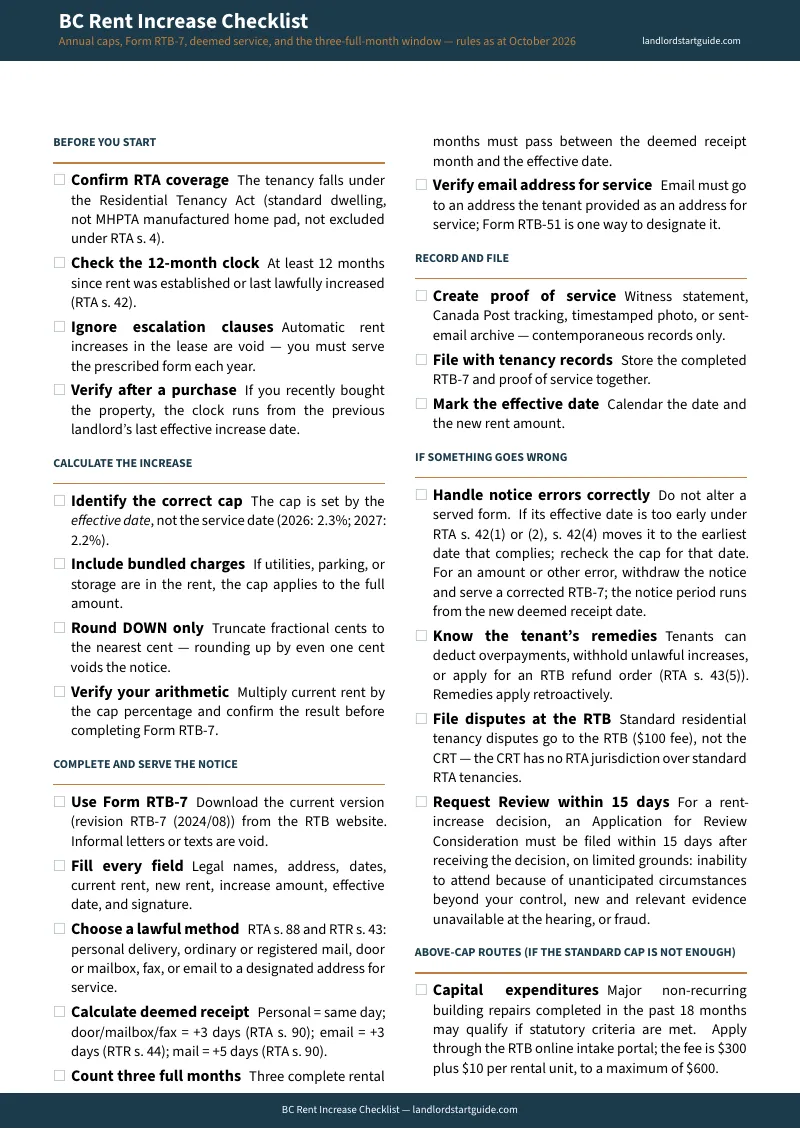
- Printable checklist (PDF) — every step, form, fee, and deadline on a dated two-page reference
- Rent increase calculation worksheet (PDF) — a step-by-step form for computing the maximum allowable increase, with arithmetic verification before you transfer figures to Form RTB-7
- Notice timeline calculator (PDF) — work backward from your target effective date to the latest lawful service date for each delivery method
- Proof-of-service log (PDF) — a dated record template for documenting how, when, and to whom you served the notice
All five are yours permanently — download, print, and use them whenever you need to serve a rent increase notice.
Satisfaction Guarantee
Full refund, no time limit. If the guide doesn't help you serve a valid rent increase notice, email [email protected] and we'll refund the full purchase price. No forms, no waiting period.
Rules as at October 2026. Covers the in-force 2026 cap (2.3%) and the announced 2027 cap (2.2%). Landlord Start Guide is an independent publisher — not affiliated with the Residential Tenancy Branch or the Government of British Columbia.
Frequently Asked Questions
What if the rules change after I buy?
We update the guide when the rules change. Email us any time, even years later, and we'll send you the current edition free.