One wrong form or one miscounted day restarts the entire process
You need to end a tenancy in New Brunswick. Maybe rent is months overdue. Maybe you are selling the property and the buyer wants to move in. Maybe you need the unit back for family. Whatever the reason, the Residential Tenancies Act gives you a lawful path — but that path has prescribed forms, statutory notice periods aligned to your rent-due cycle, and a Residential Tenancies Officer who will set aside a notice that uses the wrong form, arrives one day late, or was served by a method the Act does not recognise.
The government forms are free. The instructions are scattered across separate portals — one for the forms, another for the statutory text, another for the 2023 amendments, another for the 2025 rent-control reforms. Piecing them together under deadline pressure, with a tenant who may not leave voluntarily, is where landlords make the mistakes that cost them months of lost rent and a second run through the process from the beginning.
The New Brunswick Tenancy Notice System — every ground, form and deadline in one sequence
This guide maps the full termination process into a single document: from identifying your lawful ground, through choosing the correct prescribed form, counting the notice period under the Act's alignment rules, serving and proving service, to filing the application and — if the tenant stays — applying for a Form 9 eviction order through the Residential Tenancies Tribunal.
It is not a template store and it is not legal advice. It is an administrative compliance system that explains what the law requires, dated to the rules it describes (including the 2023 c. 27 amendments and the February 2025 c. 29 reforms), so you can follow the correct sequence the first time.
What is inside the guide
- Every statutory ground mapped to its form and notice period — nonpayment of rent (Notice to Vacate with 7-day cure), material breach and damage (Form 4 served by the RTO after your complaint), landlord or family personal occupation (six months for periodic, three for fixed-term), property sale with buyer move-in, non-residential conversion, demolition, and the Regulation 17.3 renovation route with its five mandatory preconditions
- The day-counting and alignment system explained step by step — why a notice served on January 15 cannot take effect until August 1 for a month-to-month tenancy, how the effective date must fall on the last day of a rental period, and two worked examples that walk through real calendar dates from the day you serve to the day possession becomes lawful
- Service rules and proof — the lawful delivery methods under Section 27 of the Act (personal delivery, registered mail, delivery to an adult occupant), what disqualifies a notice, and a printable service proof log recording date, time, method, and recipient so your application is not dismissed on a technicality
- The five-year long-term tenant rule — what changes after five consecutive years of occupancy (the available grounds narrow, the minimum notice period extends to three months, and the tenancy is deemed month-to-month regardless of any fixed-term contract), with a clear list of the grounds that remain available and the ones that do not
- The Regulation 17.3 renovation checklist — the five-part compliance test the Residential Tenancies Officer must verify before a renovation notice can be served: permits obtained, good-faith intention, vacant possession required, work necessary to prolong the building, and no reasonable alternative to termination
- The formal process when a tenant stays — applying for a Form 9 eviction order through a Residential Tenancies Officer, the $75 application fee, the dispute hearing pathway, what happens after an order is issued, and the seven-day window for Court of King's Bench review
- Property sales and Form 8 — the obligation to serve Form 8 (Notice of Transfer) on both the tenant and the Tribunal within seven days of title transfer, what the purchaser inherits, and when the buyer qualifies for a personal-occupation notice
- Security deposits at termination — the statutory cap, the 15-day remittance deadline after vacancy, deductions the Act permits, and what happens to the deposit when a termination is disputed
- Rent cap intersection — how the 3% annual rent increase cap (February 2025–2027) affects your options when the real motivation for ending the tenancy is a below-market rent, and the specific circumstances that are not affected by the cap
Who this guide is for
- Private landlords in New Brunswick who need to end a residential tenancy and want to follow the correct legal process the first time
- Self-managing property owners handling one or a few units without a property manager or solicitor on retainer
- Family members managing a tenancy on behalf of an older property owner
- Landlords who have already served a notice and want to verify it was done correctly before the deadline passes
- Landlords selling a tenanted property who need to understand the buyer's options and the Form 8 obligation
Why the free government forms are not enough on their own
Service New Brunswick publishes every prescribed form — Form 3, Form 4, Form 8, Form 9, the Notice to Vacate, the Standard Form of Lease — and they are free. The gap is not the forms themselves. It is the sequence: knowing which form matches your ground, counting the notice period so it aligns with the rent-due cycle under the Act's rules, choosing a lawful service method and completing the proof, understanding when you must apply to the RTO first (breach and renovation cases) versus when you serve directly (nonpayment and personal occupation), and knowing the formal steps if the tenant stays past the deadline. The government publishes each piece on a separate page or regulation; this guide puts them in order.
What this guide does not do
This is not legal advice and not a tactics manual. It does not tell you how to pressure a tenant, find loopholes, or argue a particular case. It explains the administrative requirements — the forms, the deadlines, the service rules, the application process — so that your notices are procedurally valid under current law. If you need advice on a specific dispute, the guide includes contact information for the Residential Tenancies Tribunal, the Tenant and Landlord Relations Office, and PLEIS-NB.
Covered by a full refund with no time limit
If the guide does not help you, email [email protected] for a full refund. No time limit, no questions.
Start with the free checklist or get the full guide
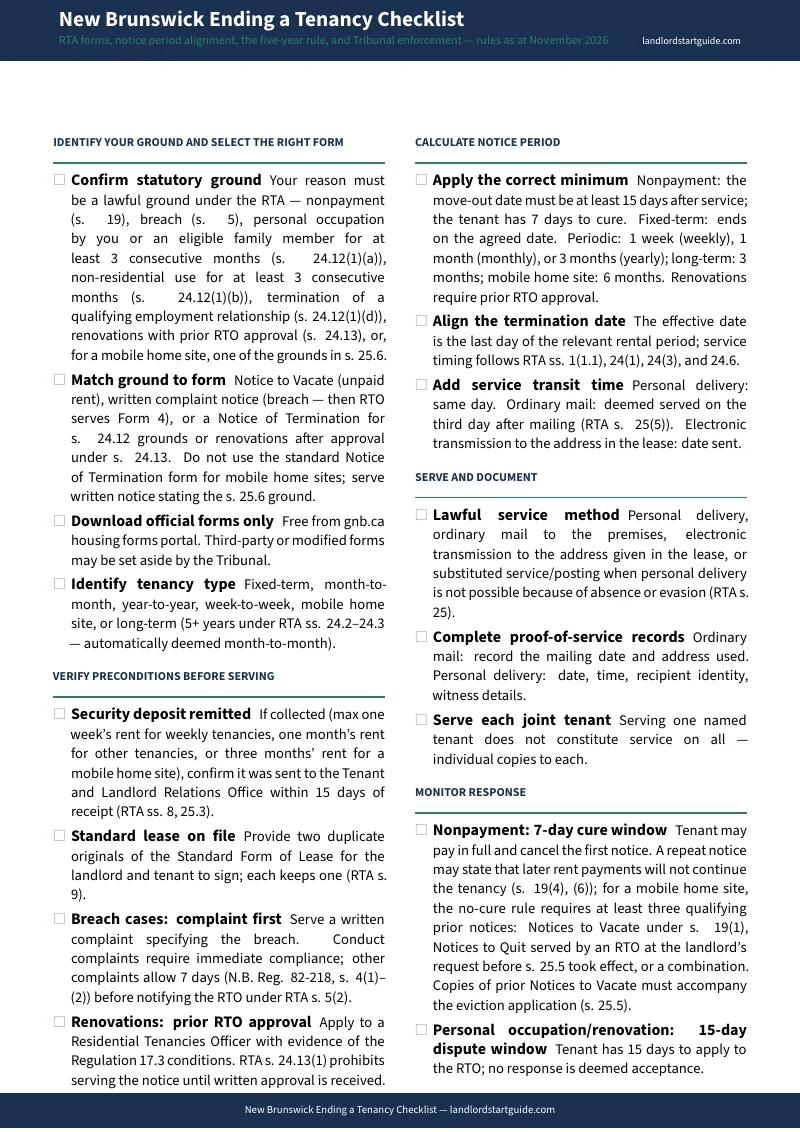
Download the free New Brunswick Ending a Tenancy Checklist — a dated two-page overview of the steps, forms, fees and deadlines. If you need the full system with worked day-counting examples, every ground mapped to its form and notice period, the service proof log, the Regulation 17.3 renovation checklist, and the formal escalation pathway, the complete guide has it all.
Frequently Asked Questions
What if the rules change after I buy?
We update the guide when the rules change. Email us any time, even years later, and we'll send you the current edition free.