Wrong Section. Wrong Form. Your Notice Is Invalid Before the Tenant Even Reads It.
You need to end a tenancy in Newfoundland and Labrador — maybe you are selling, maybe you need the unit back for family, maybe the tenancy has broken down. You know there is a legal process. You know Digital Government and Service NL has prescribed forms. But when you sit down to work out the steps, you find two different termination forms (RT-2018-00039 and RT-2018-00040), notice periods that depend on your tenancy type and termination ground, a two-step breach process that most landlords skip entirely, deemed service rules with a 5-day postal delay and a 4:00 PM electronic cutoff, and a Tribunal application process that nobody has put in one place.
In Application 2025-0235-NL, a landlord tried to terminate a tenancy over an unapproved dog. Adjudicator Seren Cahill dismissed the claim — not because the breach was minor, but because the landlord served Form RT-2018-00040 without first issuing the mandatory preliminary written notice under section 20 giving the tenant reasonable time to remedy the breach. The notice was invalid before the tenant even read it. The landlord had to start over.
That is what this guide exists to prevent.
The NL Notice Compliance System
The Ending a Tenancy in Newfoundland and Labrador guide is a single, dated compliance manual that takes you from "I need to end this tenancy" to "the notice is served and documented" without missing a form, a precondition, or a deadline.
It is not a collection of government forms — those are free on the Digital Government and Service NL portal. It is the operational workflow that connects the forms into a sequence you can follow step by step: which statutory ground, which prescribed form, which notice period, which service method, how to count the days correctly, and what happens if the tenant stays past the effective date.
What's Inside
- Statutory Ground and Form Matching Matrix — a structured walkthrough that matches your specific situation (rent arrears, material breach, uninhabitable unit, property damage, interference with peaceful enjoyment, standard no-cause termination, fixed-term expiry) to the correct statutory section and prescribed form: RT-2018-00039 for standard or RT-2018-00040 for cause
- Deemed Service and Notice Date Calculation Worksheet — worked examples showing exactly how rental payment periods and section 35 deemed service rules (5-day postal delay, 4:00 PM electronic cutoff) interact to set the earliest lawful effective date for your notice, so you stop counting raw calendar days and start counting full rental periods
- Section 20 Two-Step Breach Workflow — the mandatory preliminary written breach notice, what constitutes a "reasonable time" to remedy, and only then the termination notice under Form RT-2018-00040, because skipping the first step is the single most common reason landlords lose at the Tribunal
- Section 34 Notice Validity Checklist — the four statutory requirements that every termination notice must meet (recipient's name, address, premises identification, and the specific statutory section), with a pre-service audit so your notice cannot be dismissed on a technicality
- Proof of Service Log — a printable record of how, when, and to whom you served the notice (date, time, method, witness details, email headers if electronic), ready for the Tribunal if the tenant disputes service
- Post-Notice Tribunal Escalation Map — the complete path from notice expiry through the Application for Dispute Resolution (RT-2018-00053), the $20 filing fee, the hearing, and enforcement via the Director's order, including deemed service of the hearing notice at least 10 clear days before the hearing
- Security Deposit and Move-Out Procedure — the 3/4 month cap, the trust account requirement, the 10-day return window after the tenant vacates, and the Application to Director process for claiming against the deposit
- Abandonment Procedure — what the law requires when a tenant leaves belongings behind, including the notice and waiting period before you can dispose of property
Every chapter states the date of the rules it describes (November 2026 edition) and links to the official source, so you can verify anything and track future changes.
Who This Guide Is For
- Private landlords in Newfoundland and Labrador who self-manage one or a few rental properties
- Accidental landlords — inherited a property, kept a former home, or have a basement apartment
- Landlords selling a tenanted property who need the correct notice to deliver vacant possession
- Landlords reclaiming a unit for personal or family occupancy
- Anyone managing a tenancy breach (unpaid rent, damage, unauthorized occupants, interference with peaceful enjoyment) who needs the correct notice process
- Adult children or co-owners helping an older family member navigate the termination paperwork
Why Not Just Use the Government Website?
Digital Government and Service NL provides free forms and information pages — and you should use them. Form RT-2018-00039 and Form RT-2018-00040 are the official prescribed documents for ending a tenancy.
What the government does not provide is a single document that connects those pieces into an operational workflow. The forms are blank PDFs on separate portal pages. The notice period rules depend on your tenancy type and termination ground, spread across multiple sections of the Residential Tenancies Act, 2018. The section 20 two-step breach process is in the statute but not on the forms. The deemed service rules — the 5-day postal delay, the 4:00 PM electronic cutoff — are in section 35, which most landlords never find. And none of it tells you what to do when the tenant stays past the effective date — how to file an Application for Dispute Resolution, what happens at the hearing, or how the Director's order is enforced.
Meanwhile, third-party websites routinely import Ontario terminology or misstated notice periods into Newfoundland and Labrador advice. One popular guide claims a 90-day notice for a month-to-month lease while the tenant gives 30 days — neither figure is correct under the Residential Tenancies Act, 2018.
This guide does one job: it puts the entire process in the right order, with the calculations, the checklists, and the decision points, so you can work through it without toggling between browser tabs and hoping you have not missed a step.
What This Guide Is Not
This guide is not a law firm, not affiliated with Digital Government and Service NL, the Residential Tenancies Tribunal, or the Government of Newfoundland and Labrador, and does not give legal advice. It explains what the law requires and how the process works. It never suggests tactics against tenants, guarantees any outcome at the Tribunal, or advocates for eviction. If you need legal advice on a specific dispute, the guide lists free and low-cost legal resources, including the Public Legal Information Association of NL (PLIAN), NL Legal Aid, and the Law Society Referral Service.
Full Refund, No Time Limit
If the guide is not useful, email [email protected] for a full refund. No time limit, no conditions.
Start With the Free Checklist
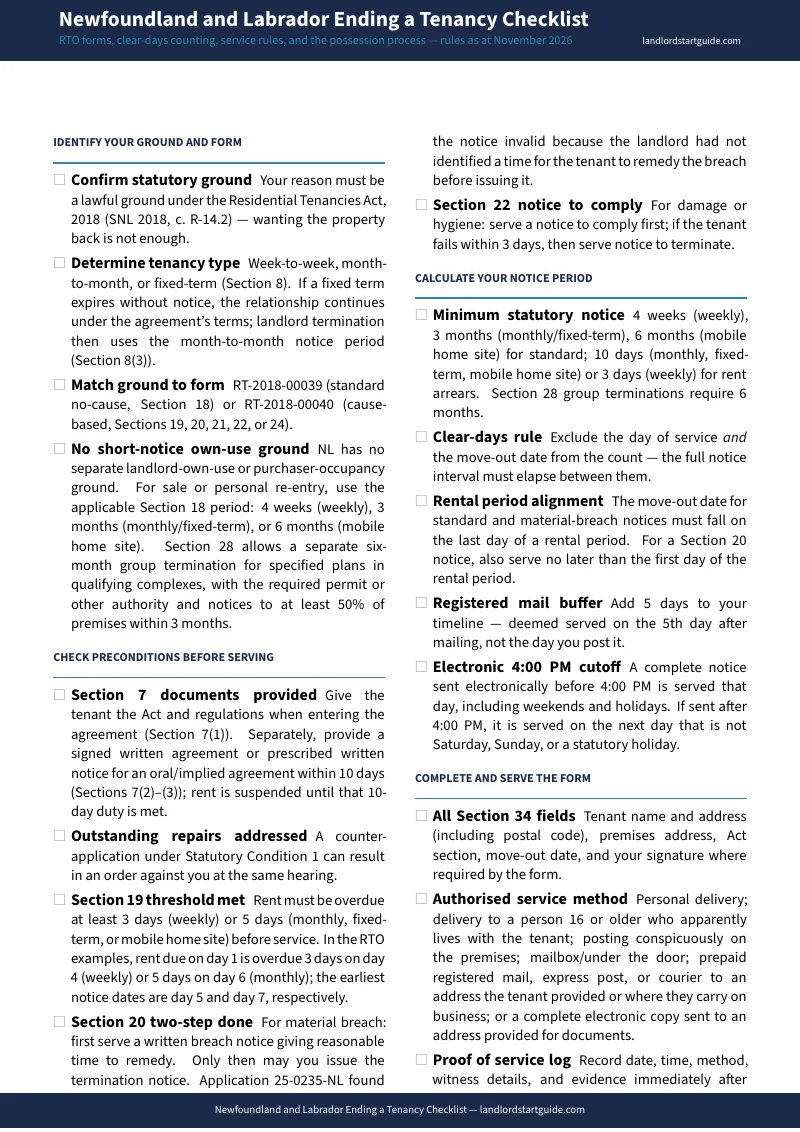
Not sure yet? Download the free Newfoundland and Labrador Ending a Tenancy Checklist — it gives you the high-level steps, forms, fees, and deadlines. If you want the full execution detail — the Statutory Ground and Form Matching Matrix, the Deemed Service and Notice Date Calculation Worksheet, the Section 20 Breach Workflow, the Proof of Service Log — the complete guide is and yours to keep.
Frequently Asked Questions
What if the rules change after I buy?
We update the guide when the rules change. Email us any time, even years later, and we'll send you the current edition free.