One miscounted day restarts the entire process
You need to end a tenancy in Nova Scotia. Maybe rent is overdue. Maybe you are selling the property, or you need the unit for family. Whatever the reason, the Residential Tenancies Act gives you a lawful path — but that path has exact forms, exact notice periods, and a day-counting policy that treats a single miscalculation the same way it treats a missing form: your application fails, and you start again from the beginning.
The government's forms are free. The instructions are spread across separate PDFs — one for Form D, another for counting days, another for service rules, another for the hearing process. Piecing them together under deadline pressure, with a tenant who may not leave voluntarily, is where landlords make the mistakes that cost them weeks.
The Nova Scotia Tenancy Notice System — every ground, form and deadline in one sequence
This guide consolidates the full termination process into a single document: from identifying your lawful ground, through choosing the correct prescribed form, counting the notice period under Policy 38, serving and proving service, to filing the application and — if needed — enforcing a Director's Order through the courts and Sheriff.
It is not a template store and it is not legal advice. It is an administrative compliance system that explains what the law requires, dated to the rules it describes, so you can follow the correct sequence the first time.
What is inside the guide
- Every lawful ground mapped to its form — rental arrears (Form D → Form K), breach of statutory conditions (Form E), property sale (Form DR2 with purchaser affidavit), owner or family move-in (Form F), demolition and renovations (Form DR5 / Form J), and the grounds that do not exist under the Act
- The counting-days system explained step by step — Policy 38's clear-days rule, the 4:00 PM cutoff, next-business-day deeming for weekends and holidays, and a worked example for the Form D arrears timeline from rent due date through Form K eligibility
- Service rules and proof — the four lawful service methods, what disqualifies a notice (text messages and door-taping are not among them), how to complete Form L/L1 as your Certificate of Service, and why proof of service determines whether your application proceeds
- The non-hearing and hearing routes — when Form K (non-hearing application) is available, when a tenant's Form J counter-application blocks it, how to prepare evidence under the 5-day disclosure rule, and what happens at a Form J hearing
- Enforcement after a Director's Order — the 10-day appeal window, registering the order at Small Claims Court, and engaging Sheriff Services for physical execution
- Fixed-term leases — automatic expiry without notice, the month-to-month conversion trap, and year-to-year lease rules that catch landlords off guard
- Security deposits at termination — the statutory cap and trust requirement, claiming against the deposit with Form R, and deposit disputes during ongoing proceedings
- Halifax Rental Registry (By-law R-400) — what it requires, what it does not do (it has no authority over terminations), and why it matters only within HRM
- Worksheets and planning tools — a notice timeline calculator, service proof log, hearing evidence organizer, and tenancy termination decision flowchart
Who this guide is for
- Private landlords in Nova Scotia who need to end a residential tenancy and want to follow the correct legal process
- Self-managing property owners handling one or a few units without a property manager or solicitor on retainer
- Family members managing a tenancy on behalf of an older property owner
- Landlords who have already received a tenant's Form J application and need to understand the hearing process
Why the free government forms are not enough on their own
The Residential Tenancies Program publishes every prescribed form — Form D, Form K, Form J, Form DR2, Form L — and they are free. The gap is not the forms themselves. It is the sequence: knowing which form matches your ground, counting the notice period correctly under Policy 38 so your application is not dismissed on a technicality, choosing a lawful service method and completing the proof, and understanding the hearing or non-hearing route before you file. The government publishes each piece in a separate document; this guide puts them in order.
What this guide does not do
This is not legal advice and not a tactics manual. It does not tell you how to pressure a tenant, find loopholes, or argue a particular case. It explains the administrative requirements — the forms, the deadlines, the service rules, the application process — so that your notices are procedurally valid under current law. If you need advice on a specific dispute, the guide includes contact information for the Residential Tenancies Program, Legal Information Society of Nova Scotia, and other resources.
Covered by a full refund with no time limit
If the guide does not help you, email [email protected] for a full refund. No time limit, no questions.
Start with the free checklist or get the full guide
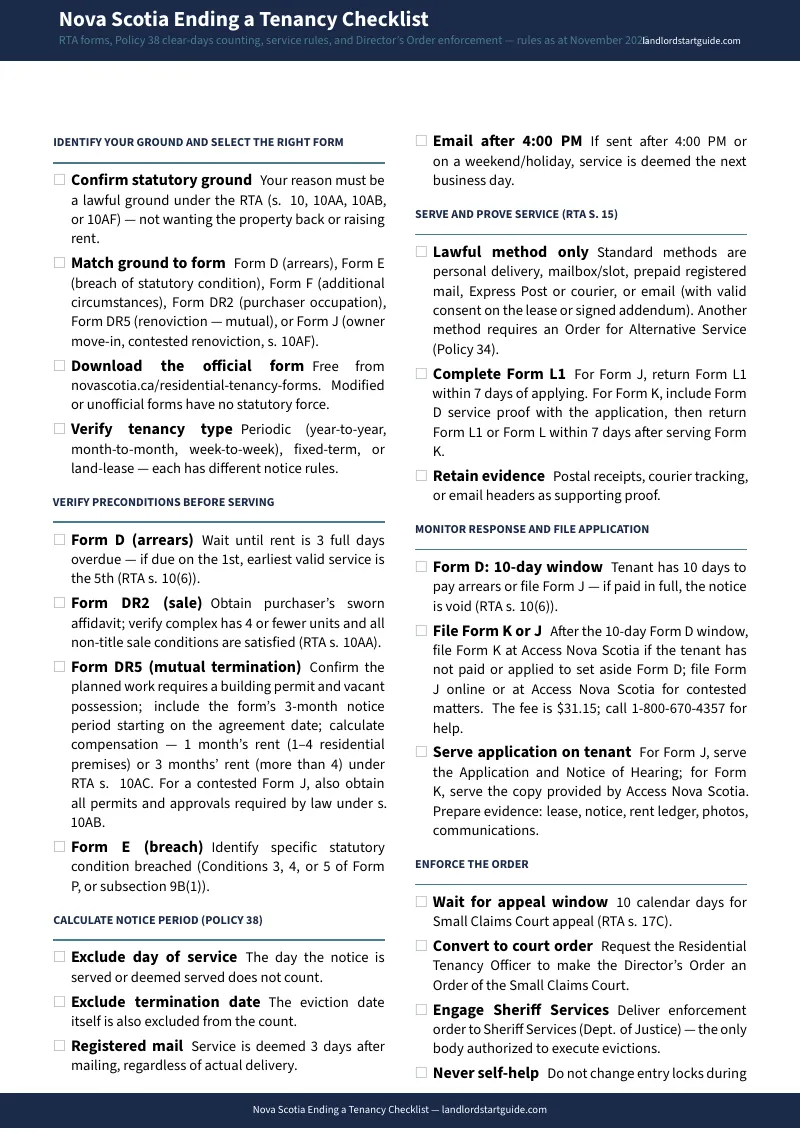
Download the free Nova Scotia Ending a Tenancy Checklist — a dated overview of the steps, forms, fees and deadlines. If you need the full system with worked examples, every form mapped to its ground, the counting-days calculator, the service proof log, and the enforcement pathway, the complete guide has it all.
Frequently Asked Questions
What if the rules change after I buy?
We update the guide when the rules change. Email us any time, even years later, and we'll send you the current edition free.