You know the rent needs to go up. You're not sure the notice will hold up.
Your mortgage renewed higher, your property taxes climbed, and the 5% cap means every dollar of that increase matters. But the Residential Tenancies Act doesn't just limit how much you can raise the rent — it dictates exactly how, when, and in what form you deliver the notice. Get any of it wrong and the notice is void. Your tenant keeps paying the old rent. You wait another four months to try again.
The government website lists the rules, but it doesn't connect them. The four-month notice period, the 12-month frequency clock, the decoupling from lease anniversaries, the fixed-term renewal trap, the proof-of-service requirements — these interact in ways that a bullet-point summary doesn't explain. And Form M, the first result when you search for a rent increase form, is for manufactured home parks. If you use it for a standard residential unit, you've already made your first procedural mistake.
The Notice Compliance Engine
This guide gives you a single structured system for every residential rent increase in Nova Scotia: standard tenancies under the 5% cap, fixed-term renewals for existing tenants, and land-lease communities under the AARIA formula. You work through the steps in order — confirm your tenancy type, check the 12-month clock, calculate the earliest effective date, draft the notice with the right content, serve it by a legally valid method, and log your proof of service. Each step has a worksheet or checklist so you can verify compliance before the notice leaves your hands.
What's Inside
- Date-calculation worksheet — the four-month notice window is counted in calendar months, not days. This worksheet factors in the decoupling rule (you no longer need to wait for the lease anniversary), the 12-month frequency limit, and the payment-date alignment rule from Policy 38, so you can identify the earliest lawful effective date for your situation.
- Fixed-term renewal audit — if you're offering a new lease to the same tenant in the same unit, the 5% cap still applies. The audit walks you through confirming tenant continuity, calculating the capped amount, and documenting the renewal so you don't face an overcharge claim that can be pursued through 2028.
- Proof-of-service log — a void notice usually fails on service, not arithmetic. The log covers in-person hand delivery, registered mail, and email service (which requires prior written consent from the tenant). You record the method, date, and evidence so you have a defensible file if the tenant files a Form J application.
- Service and utility adjustment calculator — removing a previously included service (parking, storage, utilities) counts as a rent increase under the RTA. This calculator helps you value the removed service and integrate it into the 5% cap so the total increase stays lawful.
- Land-lease AARIA process — if you own a manufactured home space, the rules are different: a CPI-based cap (5.8% in 2025, 3.2% in 2026, 2.2% in 2027), Form M with seven months' notice, and a separate above-AARIA application through Form N and Form O. The guide covers the full process, including the application timeline.
- Form J pre-hearing compliance audit — if your tenant contests the increase, you need to demonstrate proper notice, the 12-month gap, and cap compliance at the Residential Tenancies hearing. This audit lets you check your paperwork before the hearing date, not during it.
- HRM municipal boundary separator — Halifax landlords must register under By-law R-400 and maintain a five-year maintenance plan under By-law M-200, but the municipal registry has no authority over rent levels. The guide separates the two sets of obligations so you handle both without confusing one for the other.
Who This Guide Is For
- Private landlords in Nova Scotia who self-manage one or a few rental units and need to raise the rent within the statutory cap
- Landlords renewing a fixed-term lease with an existing tenant who want to confirm the 5% cap applies and document the renewal correctly
- Landlords in Halifax who need clarity on what the municipal rental registry requires versus what the provincial rent increase process requires
- Owners of manufactured home spaces in land-lease communities who need to follow the AARIA formula and the Form M/N/O process
- Any Nova Scotia landlord facing a Form J challenge from a tenant who wants to audit their compliance before the hearing
Why Not the Free Resources?
The government website lists the 5% cap and the four-month notice period — but it doesn't give you a date calculator that accounts for the decoupling rule and the 12-month frequency clock working together. It publishes Form M for land-lease communities without prominently disclosing that standard residential tenancies have no prescribed form, so landlords download the wrong document. It hosts the Form J application guide but provides no compliance audit for the landlord who needs to defend the increase. And free legal aid in Nova Scotia is structurally tenant-focused — Dalhousie Legal Aid and Nova Scotia Legal Aid serve renters, not landlords.
Document generators like LawDepot will produce a rent increase letter, but they don't verify your 12-month timing, don't log your proof of service, and can roll into a recurring monthly subscription. The landlord association (RHPNS) serves larger portfolio owners through annual memberships — useful if you manage dozens of units, expensive if you manage one basement suite.
This guide is a one-time purchase. It covers what you need to serve a valid notice and defend it if challenged, with worksheets you fill in for your specific tenancy. No subscription, no membership, no recurring fee.
Satisfaction Guarantee
Full refund, no time limit. If the guide isn't what you expected, email [email protected] and we'll refund you — no questions, no deadline.
Get Started
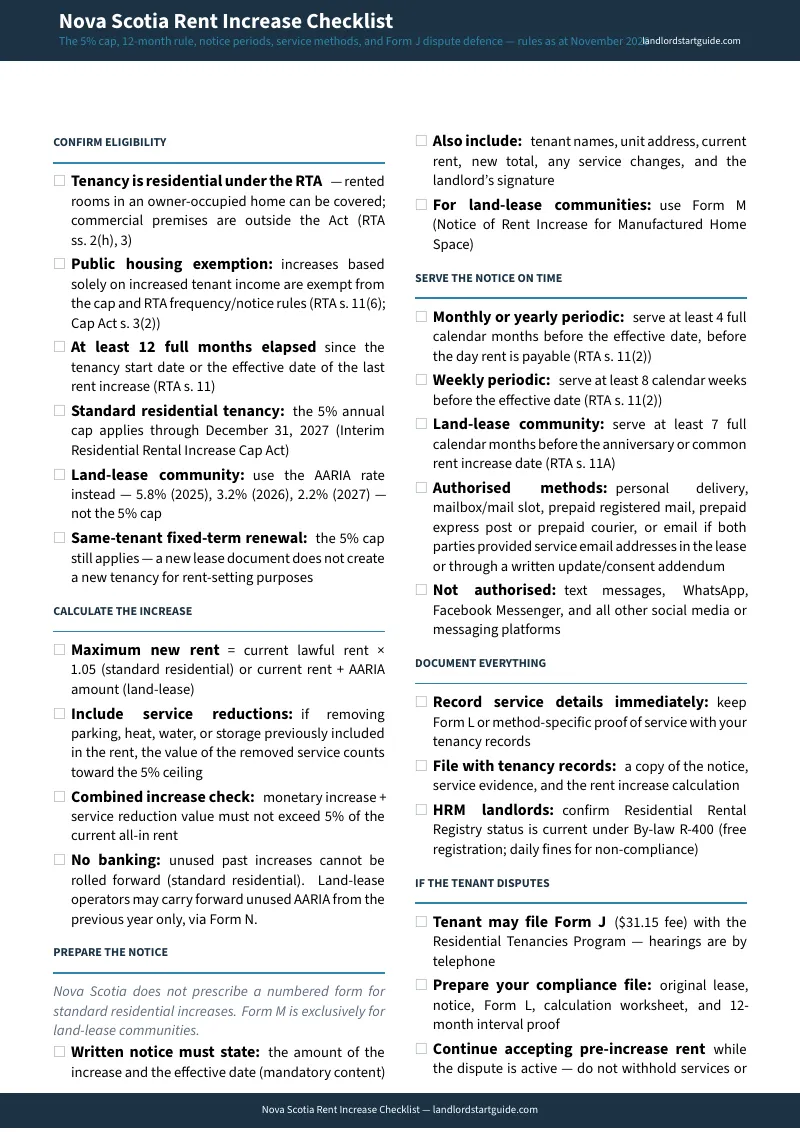
Download the free Nova Scotia Rent Increase Checklist — a two-page dated summary of the steps, forms, notice periods and deadlines. Ready for the full system? Get the complete guide for and serve a notice that holds up the first time.
Frequently Asked Questions
What if the rules change after I buy?
We update the guide when the rules change. Email us any time, even years later, and we'll send you the current edition free.