
You've decided to end the tenancy. The question is whether your notice survives the TAL.
A blank repossession form (TAL-809-E) is free on the Tribunal administratif du logement website. What isn't free is the knowledge to use it correctly — the right legal path (repossession, eviction, or résiliation), the exact notice period tied to your lease expiry, the proof of service the tribunal will accept, and the compensation you owe under Bill 31's post-2024 rules. One missed deadline, one wrong procedure, one assumption about tenant silence, and the TAL refuses your application. You lose your repossession right for the entire lease cycle — and wait another year.
The Quebec Tenancy Notice Compliance System is a 47-page guide built around the only question that matters: does your notice meet every statutory requirement the TAL checks before it will authorise a repossession or lease ending? It covers every lawful ground the Civil Code of Québec allows — from personal repossession (reprise de logement) through fault-based termination (résiliation) — dated to the rules in force as at October 2026, incorporating every Bill 31 reform and the current TAL fee schedule.
What's Inside
- Route Selection Matrix — because the wrong legal path invalidates everything that follows. The guide maps your situation (selling, moving back in, family member, non-payment, property damage, major renovations) to the correct procedure under the Civil Code — repossession, eviction, or résiliation — with the specific C.c.Q. articles, TAL form identifiers, and eligibility rules for each. Corporate landlords barred from repossession? Covered. The eviction moratorium on subdivision and enlargement? Covered.
- Bill 31 Reversed Silence Rule — the single most dangerous change for landlords who haven't served a notice since 2024. Before Bill 31, a tenant who didn't respond to a repossession notice was deemed to accept. Now silence equals refusal. You have exactly one month from the tenant's non-response to file an application with the TAL, or you forfeit your repossession right for that lease cycle. The guide builds this deadline into every timeline it gives you.
- Statutory Deadline Worksheet — a printable log that tracks three critical dates in one place: your notice delivery date, the one-month tenant response window, and the TAL filing deadline if the tenant refuses or stays silent. The six-month pre-expiry notice window for standard July 1 leases is calculated automatically.
- Bill 31 Compensation Calculator — mandatory tenant compensation is no longer optional guesswork. The guide implements the statutory formula: three months' rent for tenants with three years of occupancy or less, rising to one month per year of occupancy (capped at 24 months) for longer tenancies, plus reasonable moving expenses. Enter the tenant's years in the unit and the monthly rent, and the worksheet gives you the amount you owe before the notice is valid.
- Proof of Service Protocol — TAL applications are routinely dismissed because the landlord cannot prove the tenant received the notice. The guide covers every acceptable service method (registered mail, bailiff, hand delivery with signed receipt) with a printable evidence log for recording exact dates, times, methods, tracking numbers, and server identification.
- TAL Application and Hearing Process — from filing the application ($92 standard fee as at 2025–2026 indexation) to what happens at the hearing: good faith requirements, documentary evidence the adjudicator expects (moving quotes, personal affidavits, change-of-address records), and the fact that only a bailiff can enforce an order — never the landlord.
- Protected Tenant Screening — a tenant or spouse aged 65 or older, with 10+ years of occupancy and income at or below 125% of the HLM ceiling, may be shielded from repossession. The guide includes a screening checklist so you know before you serve, not after the TAL refuses.
- Montréal and Québec City Municipal Controls — Montréal demolition committees, Québec City's vacancy-rate conversion restriction (Bylaw R.V.Q. 2860), and heritage demolition rules add requirements on top of the provincial process. The guide separates these municipal steps from the C.c.Q. baseline so you know which rules apply where.
Who This Guide Is For
This guide is written for private landlords in Quebec who self-manage one or two residential units — the owner of a duplex or triplex who handles the paperwork personally and doesn't have an attorney on retainer. Whether you're selling a property and the buyer needs vacant possession, moving back into a unit, accommodating a family member, or dealing with a tenancy that has broken down, the guide covers the lawful process and the formal steps.
It is not for landlords looking for eviction tactics, possession shortcuts, or advice on a particular dispute. The guide explains what the Civil Code requires and how the process works. It never advises on any individual case, and it explicitly directs readers to licensed attorneys, bailiffs, and the Centres de justice de proximité when professional help is needed.
Why Not the Free Forms and Forum Advice?
The TAL forms are free, and they should be — they're government documents. The problem is what the forms don't tell you. The repossession notice (TAL-809-E) doesn't explain that tenant silence now means refusal and triggers a one-month filing deadline you can't miss. The tenant response form (TAL-811-E) doesn't calculate the compensation you owe under Bill 31's occupancy-based formula. Forum threads on r/QuebecFinance and r/montreal mix accurate advice with persistent misconceptions — that a property sale ends the lease (it doesn't), that any family member qualifies for repossession (only first-degree relatives and dependents), or that you can repossess through a corporation (you can't).
A lawyer or property management firm will handle the paperwork correctly — for $500 to $1,500+ per transaction, before any tribunal representation fees. For landlords who aren't yet in a contested hearing, that's a significant expense for administrative organisation that a well-structured compliance guide can handle.
Full Refund, No Time Limit
If the guide doesn't help, email [email protected] for a full refund. No time limit, no questions.
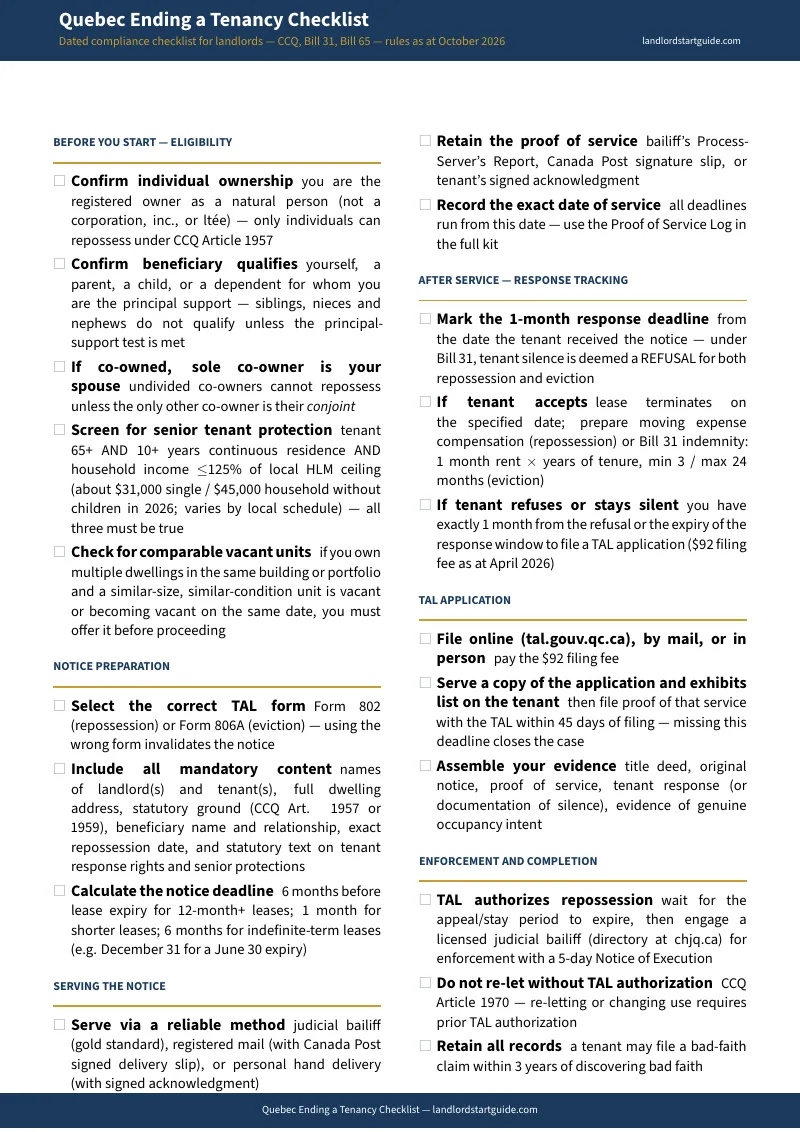
The guide includes a separate free checklist — a printable two-page summary of the steps, forms, fees and deadlines — so you can see the structure before you buy.
Download the free checklist to see the process at a glance, or get the full guide for the chapter-by-chapter compliance system, the Bill 31 calculators, and the worksheets that catch the errors the blank TAL forms don't.
The guide is priced at less than a single hour with a Quebec attorney. For a one-time purchase, you get a system you can reuse for every notice you serve — not just this one.
Frequently Asked Questions
What if the rules change after I buy?
We update the guide when the rules change. Email us any time, even years later, and we'll send you the current edition free.