
One Wrong Date. One Outdated Form. The Entire Timeline Resets.
You need to end a tenancy in Saskatchewan — maybe you're selling the property, maybe you or a family member needs the unit back, maybe the tenancy has broken down with unpaid rent or damage. You know there's a legal process. You've looked at the government pages. And now you're staring at a maze of statutory text, scattered ORT portal instructions, and forum posts referencing "Form 7" and "Form 8" that no longer match anything on the current system.
Saskatchewan landlords on Reddit describe the same pattern: they send what they believe is a valid notice — sometimes just an email — the tenant stays past the date, they try to file with the ORT, and the application stalls because the notice used the wrong effective date, or an impermissible service method, or a legacy form name the portal no longer recognises. Every failed notice resets the timeline by weeks or months. The tenant stays. The rent may stop. The sale may fall through.
That is what this guide exists to prevent.
The Saskatchewan Notice Compliance System
The Ending a Tenancy in Saskatchewan guide is a single, dated compliance manual that takes you from "I need to end this tenancy" to "the notice is served and documented" without missing a form, a calculation, or a deadline.
It is not a reprint of ORT forms — those are free and you should use them. It is the operational workflow that connects the forms into a sequence: which ground, which ORT portal notice, how to calculate the effective date using full calendar months, which service method under Section 82, what proof to keep, and what to file if the tenant disputes or stays past the termination date.
What's Inside
- Ground-to-Notice Decision Map — a structured walkthrough that matches your specific situation (rent arrears, utility arrears, property damage, personal occupancy, purchaser occupancy, demolition, renovation, fixed-term expiry) to the correct notice type, notice period, and mandatory content requirements under the Act
- ORT Portal Form Cross-Reference — a table mapping every legacy paper form number (Form 7, 7a, 8, 8d, 8e, 15, 9a) to its current ORT online portal name, so you can find the right notice without confusion from outdated forum posts or older guides
- Date Calculation Worksheets — standalone fill-in sheets for working through effective termination dates using full calendar months, including worked examples for mid-month service, the 15-day arrears window, and registered mail deeming provisions
- Service and Certificate of Service Guide — the three lawful service methods under Section 82 (personal delivery, posted on the door plus regular mail, registered mail, or ORT portal), with the Certificate of Service requirements that act as mandatory evidentiary proof at hearings
- Fixed-Term Expiry and Intention Notice Rules — the two-month Form 15 window for managing lease expiry, what happens if you miss it, and the tenant's options for renewal, non-renewal, or conversion to month-to-month
- Purchaser Occupancy Workflow — the full sequence from listing to vacant possession, including the requirement for an unconditional purchase agreement, the buyer's written occupancy confirmation, and the one-month notice period for periodic tenancies
- ORT Application and Hearing Roadmap — step-by-step instructions for filing a possession application through the ORT portal when the tenant stays, including the $50 non-refundable application fee, the evidence and hearing process, and the Order of Possession that follows
- Enforcement Chain — Orders of Possession, the Writ of Possession, Court of King's Bench Sheriff execution, and what to do if the tenant still does not leave
- Security Deposit Obligations — the maximum deposit, the 7-business-day claim window after termination, the ORT portal claim process, and the consequences of missing the deadline
- Abandoned Property Procedure — what the law requires after the tenant leaves belongings behind, the prescribed notice, and the storage and disposal rules
- Worked Scenarios — two realistic situations (selling a tenanted property with purchaser occupancy, and rent arrears with the 15-day trigger) walked through from trigger event to resolution
Every chapter states the date of the rules it describes (November 2026 edition) and links to the official source, so you can verify anything and track future changes.
Who This Guide Is For
- Private landlords in Saskatchewan who self-manage one or a few rental properties
- Accidental landlords — inherited a property, kept a former home, or rent out a basement suite
- Landlords selling a tenanted property who need vacant possession for the buyer
- Landlords reclaiming a unit for personal or family occupancy under a periodic tenancy
- Anyone managing a tenancy breach (unpaid rent, utility arrears, damage, significant disturbance) who needs the correct notice and filing process
Why Not Just Use the Government Website?
The Government of Saskatchewan and the ORT provide free information — and you should use them. The government portal publishes statutory summaries. PLEA provides plain-language overviews. The ORT portal lets you generate the correct notice forms online.
What none of them provides is a single document that connects those pieces into an operational workflow. The notice requirements are spread across multiple nested government sub-pages. The date-calculation rules are on a different page from the service methods. Forum posts and older guides still reference legacy paper form numbers (Form 7, Form 8) that no longer match the ORT portal names. And none of it tells you — in order — what to do when you sit down to end a tenancy and need to get every step right the first time.
This guide does one job: it puts the entire process in the right order, with the calculations, the cross-references, and the decision points, so you can work through it without toggling between browser tabs and hoping you haven't missed a step.
What This Guide Is Not
This guide is not a law firm, not affiliated with the Office of Residential Tenancies, the Government of Saskatchewan, or any provincial body, and does not give legal advice. It explains what the law requires and how the process works. It never suggests tactics against tenants, guarantees any tribunal outcome, or advocates for eviction. If you need legal advice on a specific dispute, the guide lists free resources in Saskatchewan including PLEA and the ORT inquiry line.
Full Refund, No Time Limit
If the guide isn't useful, email [email protected] for a full refund. No time limit, no conditions.
Start With the Free Checklist
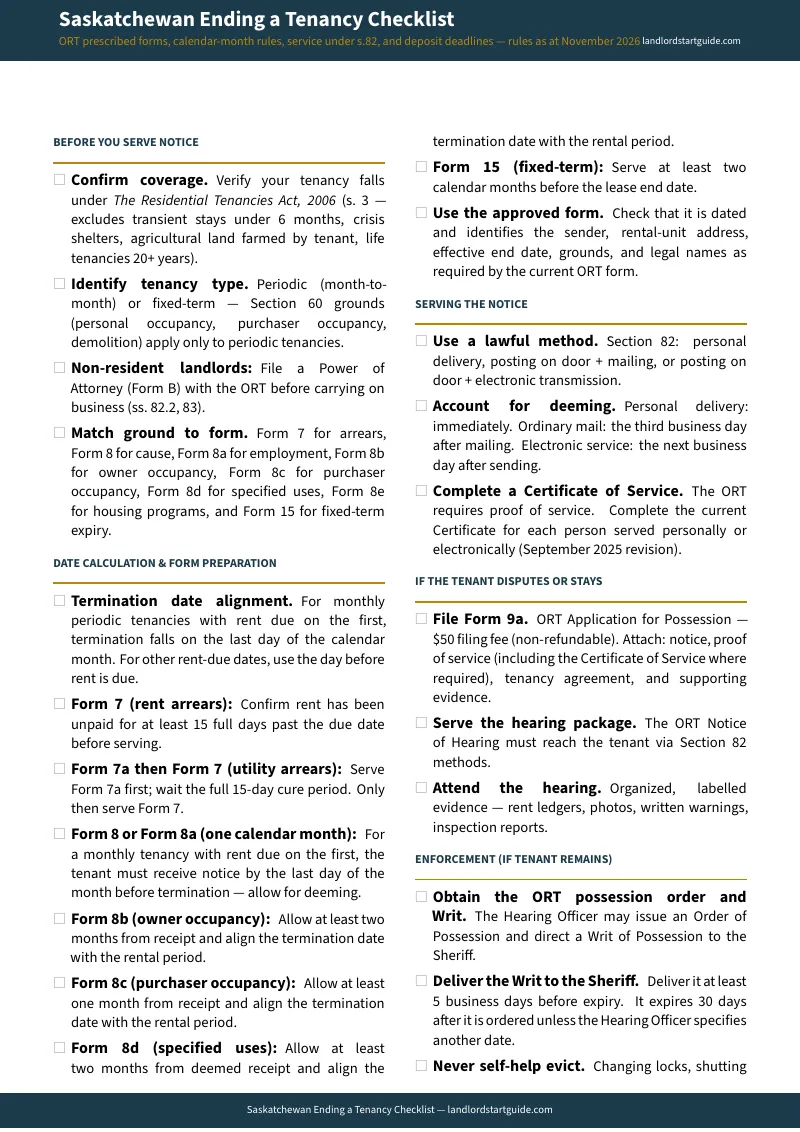
Not sure yet? Download the free Saskatchewan Ending a Tenancy Checklist — it gives you the high-level steps, forms, fees, and deadlines. It covers what you need to do. The full paid guide covers how — with the Ground-to-Notice Decision Map, the Date Calculation Worksheets, the ORT Portal Form Cross-Reference, and step-by-step post-notice application instructions. The complete guide is and yours to keep.
Frequently Asked Questions
What if the rules change after I buy?
We update the guide when the rules change. Email us any time, even years later, and we'll send you the current edition free.