
No Cap on the Amount. No Margin for Error on the Timing.
Saskatchewan is one of the few Canadian provinces with no rent increase cap — no annual guideline, no percentage ceiling, no above-guideline application. You can raise the rent by whatever the market supports. But the province controls timing with surgical precision, and one procedural mistake voids the entire increase. The old rent continues. The clock resets. And the lost income from a twelve-month restart is money no subsequent notice can recover.
Most private landlords discover the complexity after they've already served a notice. They confuse the notice lead time (12 months) with the initial waiting period (18 months). They serve a periodic tenancy form on a fixed-term lease. They email the notice on a Friday evening and count the weekend as business days. They let their SKLA membership lapse during an active six-month notice period. Each of these errors produces the same result: the increase fails, the tenant owes nothing, and the landlord starts over.
The Saskatchewan Rent Increase Compliance System
This guide replaces scattered government pages and forum guesswork with a single, structured compliance system: every calculation, every form, every service method, every dispute scenario — in one document, in the order a Saskatchewan landlord needs it. It is built around the three procedural controls that replace a cap — the waiting period, the notice lead time, and the frequency limit — and it covers both the standard 12-month track and the prescribed association 6-month track, with a separate workflow for fixed-term lease renewals.
Where the Office of Residential Tenancies (ORT) publishes rules, this guide gives you the tools to execute them without error. Where the government is silent — on dual-clock coordination, on deemed service date calculations, on dispute preparation — this guide fills the gap with worked examples built from the RTA statute, the Regulations, and ORT adjudication patterns.
What's Inside
- Dual-Clock Timing System — the most common compliance failure in Saskatchewan is confusing the Notice Lead-Time Clock (12 or 6 months of advance notice) with the Tenancy Duration Waiting Clock (18 or 12 months before the first increase can take effect). This guide walks you through both clocks independently and shows you the exact calendar date when your increase can lawfully take effect, with separate worked examples for non-members, SKLA members, and landlords mid-way through a tenancy.
- Two-Track Notice Decision Map — the standard 12-month regime and the prescribed association 6-month regime use different ORT portal forms, different waiting periods, and different frequency limits. The decision map routes you to the correct track based on your current association status and tenancy type, with explicit warnings about what happens if membership lapses during an active notice period.
- Fixed-Term Lease Renewal Workflow — periodic and fixed-term tenancies follow entirely different procedures for rent increases, and confusing them is a fatal error. This section covers the Term Lease, Two Month Notice of Intention Form, the tenant's 30-day response window, and the transition to periodic tenancy if neither party acts — a scenario the government pages mention but don't walk you through.
- Deemed Service Date Calculator — under Section 82 of the RTA, the date a notice is "served" depends on how you deliver it: personal delivery is immediate, email is deemed received on the next business day, and ordinary mail adds three business days. A notice mailed on a Thursday has a different deemed date than one mailed on a Monday. This section calculates the exact deemed date for each method so your notice period starts when you think it does.
- ORT Notice Form Walkthrough — the ORT online portal generates three distinct rent increase forms, and using the wrong one is a fatal defect that Section 54(4)'s auto-correction cannot save. This section walks you through each form field by field: the standard Notice of Rent Increase, the Prescribed Association Member form, and the Term Lease Two Month Notice of Intention Form.
- Service Unbundling and Utility Rules — increasing rent while simultaneously unbundling utilities (charging separately for water, heat, or electricity that was previously included) triggers specific regulatory obligations under Section 56. This section explains when unbundling is lawful, the notice requirements, and how it interacts with the timing rules.
- ORT Dispute Preparation Framework — if a tenant challenges your increase through the ORT, you need to know the $50 filing fee, the teleconference hearing format, what evidence the Hearing Officer examines, and the difference between a correctable timing error and a fatal defect. This section gives you the preparation framework before you need it.
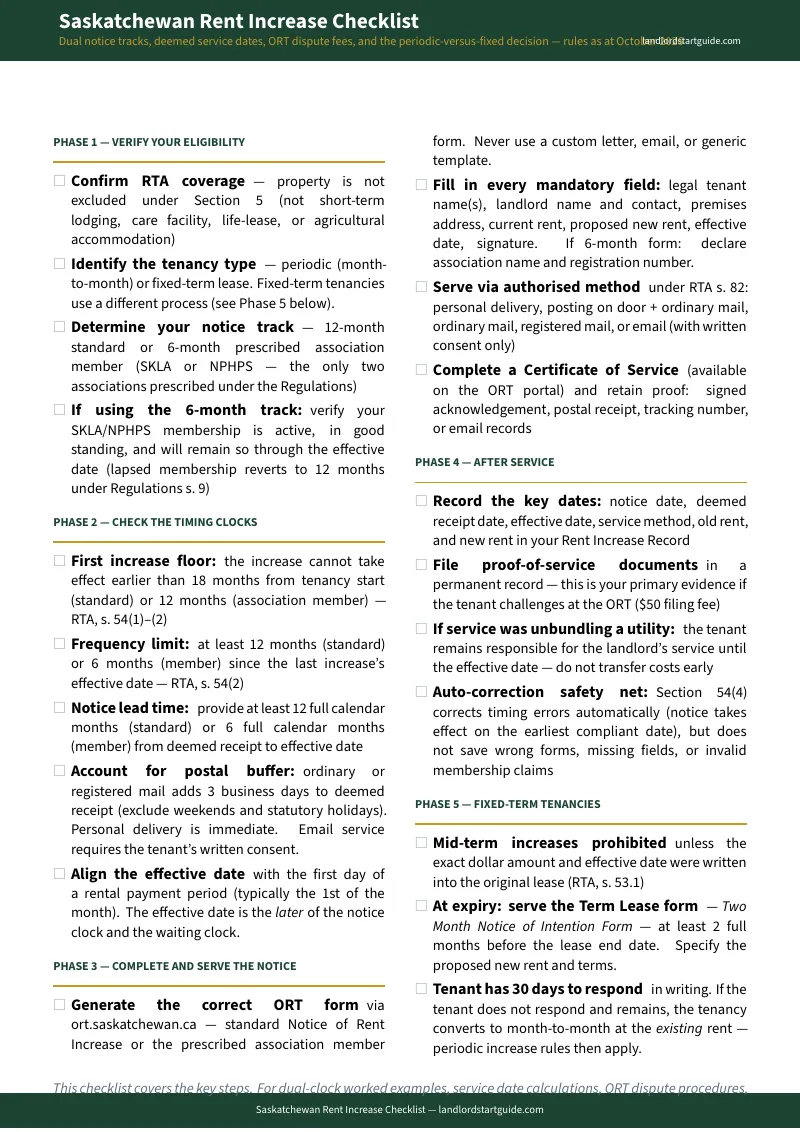
- Dated Compliance Checklist — a printable reference of every step, form, fee, and deadline, dated to the rules as at October 2026. The free version gives you the checklist alone; the full guide gives you the tools to execute every line on it.
- 5 Fillable Planning Tools — a notice timeline calculator, deemed service date worksheet, service proof log, pre-notice compliance checklist, and rent increase record. Print them, fill them in by hand, and file them with your tenancy paperwork. Each tool is a standalone PDF you can use independently.
Who This Is For
- Private landlords in Saskatchewan managing one to a few residential properties — houses, apartments, condos, townhouses, or rented rooms under the RTA
- Self-managing owners who handle their own notices without a property management company — and want to get it right without paying $150–$300 per filing for an agent to do it
- Landlords approaching a renewal or anniversary who need a clear, dated workflow for the correct notice, the timing, and the service method
- SKLA or NPHPS members who want to use the accelerated 6-month track correctly and avoid the membership-lapse trap that reverts their notice to the 12-month timeline
- Anyone confused by cross-provincial rules — Ontario's percentage cap, BC's annual guideline, and Alberta's 365-day calculation work differently from Saskatchewan's uncapped, timing-regulated system
Why Not Just Use the Free Government Resources?
The ORT's information pages explain the rules clearly. The Public Legal Education Association of Saskatchewan (PLEA) publishes excellent plain-language summaries. Both are free, and both are worth reading. This guide does not sell secret laws.
What neither provides is a dual-clock coordination tool, a deemed service date calculator, a field-by-field form walkthrough, or a dispute preparation framework. The ORT portal generates the official notice forms — but it does not validate the dates you enter. A notice with an incorrect effective date passes through the portal and produces a professional-looking PDF that fails at the first challenge. The government tells you what the rules require. This guide gives you the tools to execute them without error — in one document, in the order you need them.
If you've already read the RTA and you're confident in your clock calculations, service method, and form selection, you may not need this. But if you want every step calculated, documented, and verified so that a dispute challenge finds nothing to void, this is the fastest path from decision to compliant notice.
Satisfaction Guarantee
Full refund, no time limit. If the guide doesn't save you time or prevent a compliance mistake, email [email protected] and we'll refund you in full. No questions, no deadline.
Get Started
Download the free Saskatchewan Rent Increase Checklist for a dated overview of every step. When you're ready for the calculations, the form walkthroughs, and the dispute framework, the full guide is — one purchase, no subscription, yours to keep.
Frequently Asked Questions
What if the rules change after I buy?
We update the guide when the rules change. Email us any time, even years later, and we'll send you the current edition free.