Your EPC Expired, Your Rating Is an F, and the Council Just Wrote to You. What Now?
You know your rental property needs an Energy Performance Certificate. You probably know the minimum rating is Band E. What you may not know is that an unexpired EPC rated F or G does not just mean a bad score — it means you are currently breaking the law unless you have registered a formal exemption on the government's PRS Exemptions Register. Not applied for one. Not emailed the council about one. Registered one, with the evidence the regulations specify, on the GOV.UK portal.
Miss that step and your local council can issue a civil penalty up to £5,000. And with the confirmed move to Band C by October 2030, a new £10,000 cost cap, and a three-metric assessment system replacing the current single-score EPC, the compliance landscape for landlords in England is about to get considerably more complicated.
The EPC Compliance System: From Certificate to Audit-Ready Evidence
This guide is not a summary of the MEES regulations. GOV.UK already does that, across half a dozen different pages that do not link to each other. This is an operational compliance system — a single document that takes you from understanding which certificate you need, through preparing for the assessment, verifying your rating, gathering exemption evidence if you need it, and building the audit-ready file that protects you if the council asks questions.
We call it the EPC Compliance System because that is what it replaces: the scattered government pages, the forum threads with five contradictory answers, and the nagging uncertainty about whether you have actually done everything the law requires or just most of it.
What Is Inside
- The Scope and Certificate Decision Matrix — because "do I need an EPC?" has different answers depending on whether you have a sitting tenant, a new let, or a property you are about to market. One reference table covers every scenario with the exact legal trigger and what to do next.
- The Pre-Assessment Preparation Checklist — because EPC assessors enter default worst-case assumptions for anything they cannot see or verify. If your loft insulation is hidden under boarding, your LED lighting is not documented, or your heating controls are not labelled, your rating drops — sometimes by a full band. This checklist ensures the assessor records what is actually there, not what they assume.
- The Work and Exemption Evidence Matrix — because an exemption only exists once it is formally registered on the PRS Exemptions Register with the right evidence. This matrix maps every exemption route (high cost, all improvements made, third-party consent refused, property devaluation, new landlord, wall insulation) to the exact documents you need, the format they must be in, and how long each exemption lasts.
- The Installer Quote Comparison Sheet — because the high-cost exemption requires three formal quotes, and "three quotes" means three written quotes from qualified installers that include VAT, measure specifications, and installer credentials. The comparison sheet structures the data so your evidence is defensible on first submission.
- The Accrued Spend Tracker — because energy efficiency expenditure incurred on or after 1 October 2025 counts toward the upcoming £10,000 cost cap. Every receipt, invoice, and contractor payment needs to be logged with dates, VAT amounts, and measure descriptions. This tracker gives you the ledger before the government publishes a standard format.
- The Current Law versus 2030 Reform Comparison — because half the panic in landlord forums comes from confusing what you must do today (Band E, £3,500 cap) with what is confirmed for 2030 (Band C, £10,000 cap, three-metric system). Side-by-side tables separate the two so you can plan without overreacting.
- The Grant Funding Decision Framework — because the Warm Homes: Local Grant (April 2025 to March 2028) offers up to 100% funding for single-property landlords with eligible tenants, but 50% co-contribution for additional properties, and the eligibility rules are buried in council-level guidance. The framework walks you through the criteria before you apply.
- The Enforcement and Appeals Roadmap — because a compliance notice from the council is not a fine. There is a statutory review process, specific grounds for appeal, and a route to the First-tier Tribunal (General Regulatory Chamber). The roadmap explains each step and the evidence you need at each stage.
Who This Is For
- Private landlords in England who self-manage their rental properties and want to handle EPC and MEES compliance without a letting agent
- Accidental landlords who inherited or kept a property — particularly older homes where the EPC rating is likely to be D, E, F or G
- Landlords whose five-year exemptions registered in 2020 or 2021 are about to expire and need to reassess
- Landlords with properties rated Band D or E who want to plan for the 2030 Band C requirement without spending money they do not need to spend yet
- Self-managing landlords who use a letting agent for some tasks but want to verify that exemption registrations and evidence are actually complete and defensible
- Portfolio landlords with two to four properties who need to track spend across multiple cost caps simultaneously
Why Not Just Use the Free Information?
You absolutely can. GOV.UK publishes the statutory guidance. The PRS Exemptions Register is free to use. Council websites list the penalties. Every piece of information in this guide exists somewhere in the public domain.
The problem is that "somewhere" means six different government pages that do not cross-reference each other, local council enforcement policies that vary in format and detail, consultation response documents running to fifty pages, and landlord forums where English MEES rules are routinely confused with Scottish EPC reform regulations. Citizens Advice found that only one in five landlords can correctly identify the minimum standard — and that was before the 2030 reform was confirmed.
This guide pulls every step into one document, in the order you meet them, with the tools to actually execute each one. The information is not secret. The system is what saves you 8 to 12 hours of cross-referencing — and what protects you when a council officer asks to see your evidence file.
What This Guide Is Not
This is an independent compliance tool published by Landlord Start Guide. It is not legal advice, not an EPC assessment, not a council or government publication, and not endorsed by or affiliated with DESNZ, GOV.UK, any local housing authority, the First-tier Tribunal, or any assessor accreditation body. It explains the requirements and gives you the tools to follow them. For advice on a specific dispute, enforcement action, or property assessment, consult a qualified professional.
Satisfaction Guarantee
Full refund, no time limit. If the guide does not help you manage your EPC and MEES compliance, email [email protected] and we will refund you in full. No forms, no waiting period.
Get Started
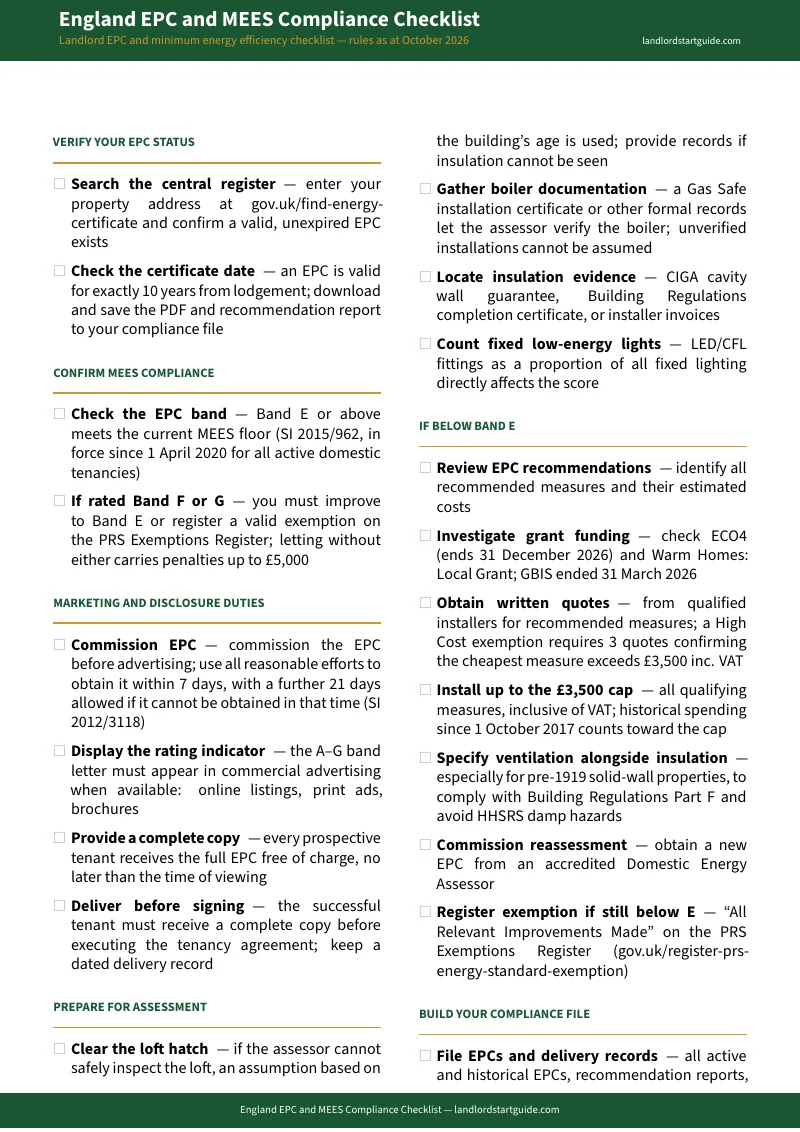
Download the free checklist for the deadlines, exemption routes and key steps. When you are ready for the full compliance system — the evidence matrices, the spend tracker, the pre-assessment checklist, the installer quote comparison sheet and the grant funding framework — get the complete guide for and have everything in one place.
Frequently Asked Questions
What if the rules change after I buy?
We update the guide when the rules change. Email us any time, even years later, and we'll send you the current edition free.