You know the licence is overdue. The council portal is the part you're stuck on.
You've heard about the five-person rule. You've seen the penalties — up to £40,000 per offence, Rent Repayment Orders covering 24 months of gross rent, possession notices that a court won't enforce. The question isn't whether you need a mandatory HMO licence. The question is how to get through the application without a rejected submission, a forfeited Part A fee, or a missed certificate that sends you back to the start.
Council portals don't walk you through it. GOV.UK explains the thresholds in legal prose but says nothing about how to draw a floor plan, which documents to digitise first, or why the fee arrives in two instalments. Letting agents will handle the submission for £300+ VAT — on top of the council fee — and you still have to supply every certificate yourself.
The HMO Compliance Execution System
This guide replaces the scattered tabs, the confusing fee schedule and the uncertain checklist with a single, dated workflow that runs from "do I actually need this licence?" to "licence issued, renewal date in the calendar." It is built around four operational tools that no free resource or generic template provides:
- Local Authority Confirmation Worksheet — a structured set of questions to ask your council's housing team, covering Additional HMO schemes, Selective Licensing overlays, Section 257 designations and local room-size standards that exceed the national minimums. You fill it in before you touch the portal, so nothing surfaces mid-application.
- Two-Stage Fee and Document Upload Tracker — a sequential checklist that tells you exactly which certificates to obtain first (Gas Safety, EICR, Fire Risk Assessment, EPC, PAT records, dimensioned floor plan), in which order to digitise them, and when Part A and Part B payments are due. One omitted document can forfeit a non-refundable Part A fee of £400 to £865 depending on your council.
- Condition Reading and 5-Year Renewal Calendar — a printable tracker for every mandatory licence condition (annual gas checks, waste storage, electrical re-tests) plus a renewal timeline that starts alerting you 90 days before the five-year expiry. An HMO licence cannot be transferred — a sale, a change of manager, or a lapsed renewal means a brand-new application and fee.
- Pre-Inspection Property Audit — a room-by-room walkthrough of the HHSRS hazard categories the council checks during inspection: damp and ventilation, fire safety, electrical and gas, structural condition, sanitary facilities, and room standards. Complete it before you submit the application so a post-application inspection cannot delay or prevent the grant.
What's inside the guide
- Occupancy calculation walkthrough — worked scenarios showing exactly when five people and two households cross the threshold, including the mid-tenancy trap (a partner moves in, a baby is born, a friend stays indefinitely) that catches more landlords than any other trigger.
- Room measurement framework — the national statutory minimums (6.51 m² single adult, 10.22 m² two adults, 4.64 m² child under 10) with instructions for measuring wall to wall, handling alcoves and sloping ceilings, and checking your council's local addendums.
- Two-part fee breakdown — how the Hemming legal framework splits every council's fee into Part A (administration, paid on submission) and Part B (enforcement and grant, paid before the licence is issued), with example fees from Manchester (£1,321), Leeds (£975), Newham (£1,400) and Kensington & Chelsea (£1,493).
- Fit-and-proper person declaration — what the council checks, what triggers a refusal, and how unspent convictions, banning orders and previous management failures are assessed.
- Planning vs. licensing clarification — why holding an HMO licence does not grant planning consent, what Article 4 directions mean for your property, and how to check whether you need separate C4 planning permission.
- Licence conditions and management regulations — the mandatory conditions every council must attach, the discretionary conditions they may add, and the Management of Houses in Multiple Occupation Regulations that apply whether or not you hold a licence.
- Renewal, variation and appeals — the timeline for renewing before the five-year expiry, the process for varying conditions, and the 28-day window for appealing to the First-tier Tribunal.
Who this guide is for
- Private landlords in England with a shared house that may need a mandatory HMO licence — especially self-managing landlords with one or two properties.
- Accidental landlords who inherited a property, moved out of a former home, or bought a single buy-to-let and are now letting to multiple tenants.
- Landlords whose letting agent has refused to manage without proof of a licence or a validated application reference.
- Landlords approaching the five-year renewal date on an existing licence who need to prepare the application again.
Why the free checklist isn't enough on its own
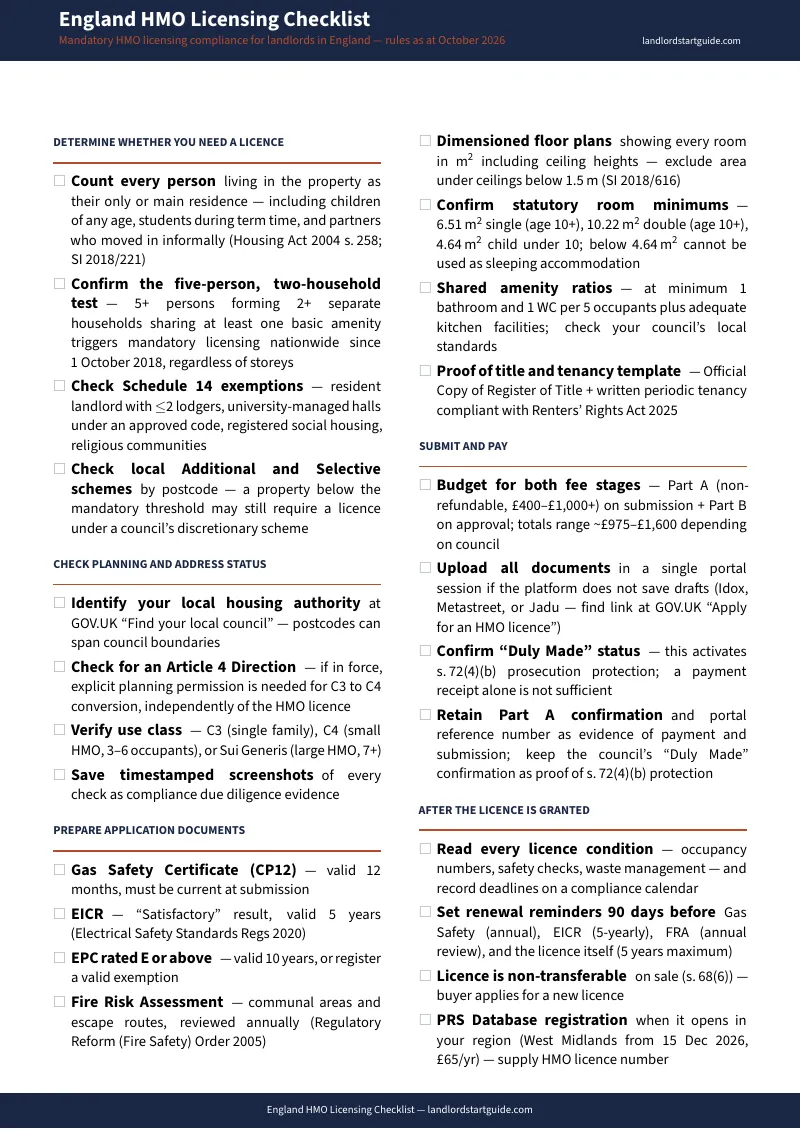
The free England HMO Licensing Checklist tells you what to verify — the five-person threshold, the document inventory, the council scheme check. It does not tell you how. It does not walk you through measuring rooms to the council's standard, sequencing your certificates so the portal doesn't reject the upload, calculating the two-part fee, or reading your licence conditions once the licence arrives.
Free council pages list the fee and link to the portal. They do not explain Part A versus Part B, do not flag the non-refundable portion, and do not provide a pre-submission audit so you know everything is ready before you open the form. One missing certificate means a rejected application and a forfeited administration fee that can run to £865.
The NRLA offers a general HMO course for £65 to £135 on top of a £125 annual membership. A letting agent charges £300+ VAT just for the application submission — excluding your council fee. This guide costs a fraction of either, covers the specific workflow end to end, and you own it permanently.
Full refund, no time limit
If the guide doesn't help, email [email protected] for a full refund. No time limit, no questions.
Your property may already need a licence. The penalties run from the day it became licensable, not from the day the council notices. The guide walks you through every step — from the occupancy count to the issued licence — so you can get compliant before the council writes.
Frequently Asked Questions
What if the rules change after I buy?
We update the guide when the rules change. Email us any time, even years later, and we'll send you the current edition free.