
You Know the Rules Changed. You Don't Know What You Can't Do Any More.
You've heard about the Renters' Rights Act. You've seen the headlines about bidding bans and advance-rent caps. But when a keen applicant says "I'll pay more," what exactly are you supposed to say? When a student with no UK guarantor asks to pay six months up front, can you take it? When three people apply for the same flat and one is on Universal Credit, how do you choose without crossing a line?
The penalties for getting it wrong start at £7,000 and climb to £40,000 for a repeat breach. Your letting agent's mistake counts as yours. And the rules you followed last year — fixed-term ASTs, three months' rent in advance, a polite "no DSS" — are now the rules that generate the fines.
The Letting Compliance Workflow
This isn't a legal textbook or a membership you'll forget to cancel. It's a step-by-step operational workflow that takes you from writing the advert to handing over the keys — in the order the law requires, with the exact forms, caps, deadlines and penalty ranges at each stage.
The guide is built around the Advert-to-Keys Compliance Sequence: a chronological process that eliminates the guesswork from advertising, viewings, applicant selection, holding deposits, agreement execution and first-rent collection. Every step is dated to the rules as at October 2026, with upcoming changes (like the PRS Database registration from December 2026) flagged separately so you know what applies now and what's coming.
What's Inside
- Advert-to-Keys Compliance Sequence — the full chronological workflow from writing a lawful advert through to collecting the first month's rent, with each step mapped to the specific statute that governs it
- Rental Bidding Ban Playbook — what Section 56 of the Renters' Rights Act actually prohibits, what you can and cannot say during viewings, and a verbal response script for handling unsolicited over-bids without breaking the law
- Holding Deposit vs. Advance Rent Decision Matrix — a structured reference distinguishing the one-week cap (Tenant Fees Act) from the one-month cap (Renters' Rights Act), with refund timelines, the 15-day deadline and grounds for lawful retention
- Applicant Selection Matrix — a printable scoring worksheet for evaluating applicants on objective criteria (income ratio, reference verification, move-in availability) so you can document non-discriminatory decisions and defend them if challenged
- Viewing Script — exact language for property viewings that keeps the conversation lawful: how to describe the asking rent, respond to offers above it, and handle questions about competing applicants
- Agent Instruction Form — a written compliance notice for any letting agent or tenant-find service acting on your behalf, putting the bidding ban, advertising rules and permitted-payments list in their hands before they market your property
- Fair Selection Walkthrough — step-by-step guidance on assessing applicants who receive Universal Credit or Housing Benefit, families with children, international applicants without UK guarantors, and other scenarios where blanket exclusions are unlawful
- Permitted Payments Reference — the complete list of what you can and cannot charge under the Tenant Fees Act 2019, with the default-fee cap, the late-payment interest rule and the penalties for each breach
- Two Worked Financial Examples — real-number walkthroughs of holding-deposit retention and advance-rent collection, showing exactly when money can move and what triggers a refund obligation
- Pre-Tenancy Document Checklist — every certificate, form and information sheet you must serve before or at the start of the tenancy (EPC, EICR, Gas Safety, Right to Rent, Information Sheet, Statement of Terms) with the consequence of missing each one
Who This Is For
- Private landlords in England who self-manage one or a few properties and need to advertise, select tenants and collect initial payments without an agent
- Accidental landlords letting a former home or an inherited property for the first time under the new rules
- Landlords who use a tenant-find service and need to verify that their agent is marketing the property lawfully
- Joint property owners where one partner manages the letting and the other needs a clear compliance record
Why Not Free Resources?
GOV.UK publishes every statutory rule. Shelter explains every tenant right. The deposit schemes explain every protection deadline. The problem is that a single compliant tenancy creation requires you to cross-reference rules from at least five different government portals — the Ministry of Housing (bidding ban, periodic tenancy framework), the Home Office (Right to Rent), the Ministry of Justice (court procedures), your local council (selective licensing) and the approved deposit schemes.
Free resources tell you what the law says. They don't give you a viewing script for when an applicant offers £50 above asking. They don't hand you a printable matrix for scoring three applicants without discriminating. They don't walk you through the exact sequence of holding deposit → agreement → first rent → deposit protection, with the caps and deadlines at each handoff. That operational layer — the part between knowing the rule and executing it correctly — is what the guide delivers.
Your Purchase Is Protected
Full refund, no time limit. If the guide doesn't help, email [email protected] and you'll get your money back. No forms, no questions.
Get the Checklist Free, or Get the Full Guide
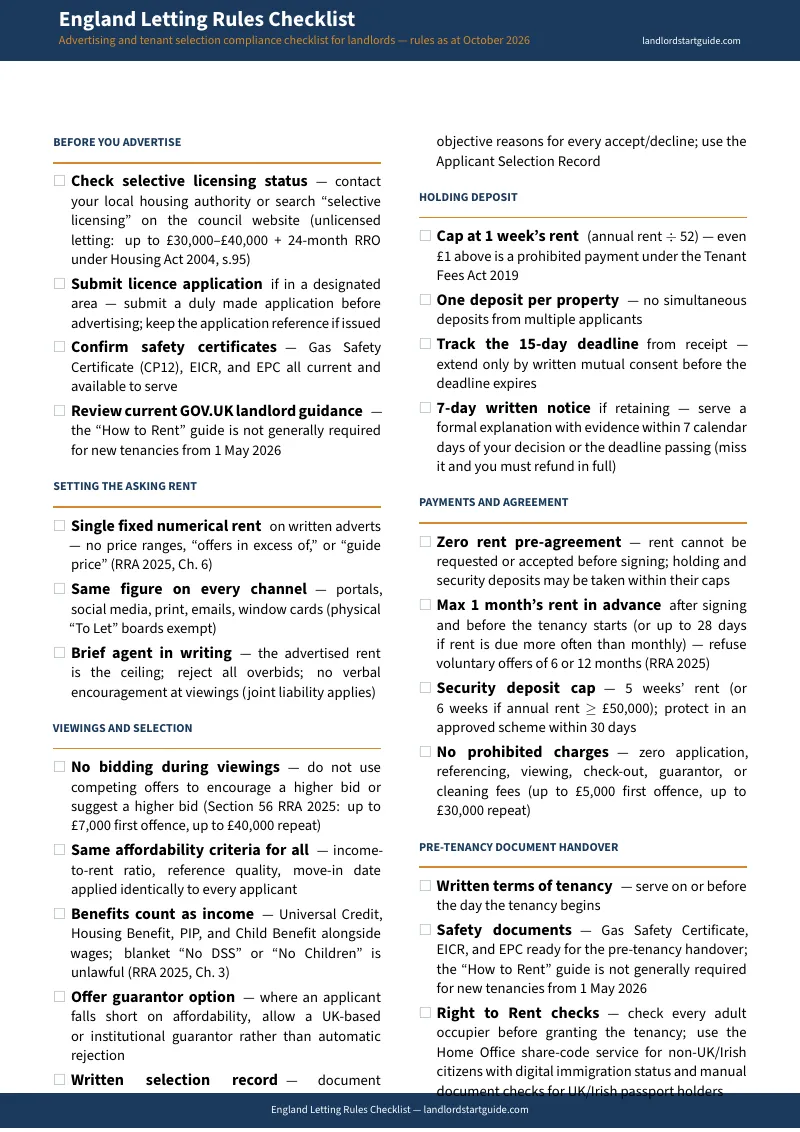
Download the free England Letting Rules Checklist — a dated, one-page summary of every step, form, fee and deadline — and start ticking off what you've already done. When you're ready for the full compliance workflow, the worked examples and the printable tools, the complete guide is — a one-time purchase, not a subscription.
Frequently Asked Questions
What if the rules change after I buy?
We update the guide when the rules change. Email us any time, even years later, and we'll send you the current edition free.