One wrong check could cost you £10,000. The rules changed on 1 October 2026.
You have a new tenant lined up. They hand you a passport, an expired BRP card, and a share code you are not sure how to use. The Code of Practice that took effect on 1 October 2026 overhauled how right to rent checks work in England — and the first-breach civil penalty for getting it wrong is now £10,000 per occupier. A repeat breach within three years doubles it to £20,000.
The government guidance is free and comprehensive, but it is scattered across four separate codes, user manuals, and statutory instruments. Assembling your own workflow means switching between pages, cross-referencing document lists, and hoping you have not missed a step. Most small landlords only discover the gap when they are staring at a share code that does not work or an expired card they are not sure they can accept.
The Landlord Verification Toolkit: every check, one workflow
The Right to Rent Checks in England guide replaces scattered government pages with a single dated process — four verification routes mapped to the applicant in front of you, with the record-keeping steps, follow-up deadlines, and agent liability checks built in. It is dated to the rules as at October 2026, referencing SI 2026/700 and the Data (Use and Access) Act 2025, so you can verify exactly which framework you are following.
What's inside
- Four-route verification decision map — manual document check, online share code, registered Right to Rent DVSP, or Landlord Checking Service. The guide walks you through which route to use based on the applicant's nationality and documents, so you do not waste time on the wrong process.
- List A and List B document reference — the acceptable documents for unlimited and time-limited right to rent, set out by group, with the rules on what counts as a valid original and what does not (expired BRPs, BRCs, and physical cards replaced by eVisas are covered explicitly).
- Share code step-by-step — how to request an 'R'-prefix Right to Rent code, enter it on the GOV.UK portal, read the result, and handle common errors like applicants sending Work or Status codes by mistake.
- Audit-ready record coversheet — a printable template to attach to every document copy. Fields for the verification date, verifier signature, identity-matching declaration, share code reference, and calculated destruction date (tenancy end plus one year), so your records survive a Home Office inspection without scrambling.
- Follow-up tracking log — for tenants on time-limited permission (List B), a calendar-based system to schedule re-checks 28 days before visa expiry, with escalation steps for pending extensions via the Landlord Checking Service.
- Agent responsibility checklist — if you use a letting agent, this checklist confirms whether your agreement genuinely transfers statutory right to rent liability under the October 2026 Code, or whether the small print leaves you exposed.
- Discrimination safeguards — the Equality Act rules for running checks on every adult occupier without selecting by nationality, plus the document-choice flexibility rules you must observe under the updated Discrimination Code of Practice.
- Seven worked scenarios — real-world situations: British citizen with a driving licence only, EU settled status holder with an expired BRC, student on a Tier 4 visa nearing expiry, asylum seeker with a pending claim, joint tenancy with mixed immigration statuses, mid-tenancy occupier turning 18, and a property sale with sitting tenants.
Who this is for
- Private landlords in England who self-manage one or a few properties and need to run checks themselves
- Accidental landlords letting out a former home, inherited property, or relocated residence
- Landlords using a let-only or tenant-find agent who want to verify that statutory liability has actually transferred
- HMO and house-share landlords who need to check every adult occupier, not just named tenants
- UK landlords living abroad who manage tenancies remotely
Why not just use the free government guidance?
The GOV.UK guidance is the authoritative source — and this guide links to it throughout. But the official information sits across at least four separate publications: the Landlord's Guide, the Code of Practice, the Document User Guide, and the online checking service. Each covers part of the process. None provides a single administrative workflow that takes you from "applicant arrives with documents" to "records filed, follow-up scheduled, statutory excuse established."
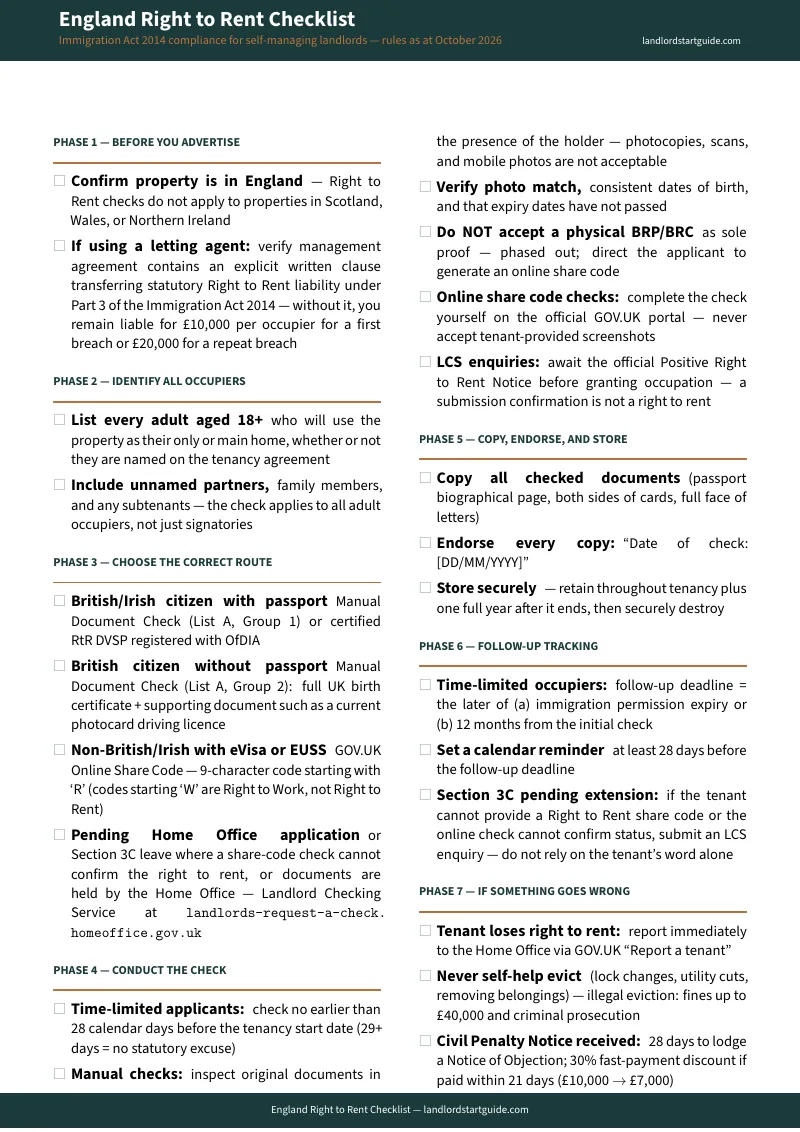
The free checklist you can download on this page covers what to do — the three steps, the document lists, the penalty figures. The full guide covers how — which route to use, how to run each check, what to record, when to follow up, and how to confirm your agent's liability status. For the cost of a few minutes' worth of a solicitor's time, you get a reusable process for every tenancy.
Satisfaction guarantee
Full refund, no time limit. If the guide does not help you run your checks with confidence, email [email protected] and we will refund you — no questions, no deadline.
Get started
Download the free England Right to Rent Checklist to see the process at a glance. When you are ready for the full verification toolkit — decision maps, audit coversheets, agent checklist, follow-up tracking, and worked scenarios — get the complete guide for .
Frequently Asked Questions
What if the rules change after I buy?
We update the guide when the rules change. Email us any time, even years later, and we'll send you the current edition free.