
Your gas engineer checks the boiler. Nobody checks the alarms.
Every private landlord in England has the same statutory duty: a working smoke alarm on every storey used as living accommodation, a carbon monoxide alarm in every room with a fixed combustion appliance (gas cookers excepted), and physical proof that every alarm was tested on the first day of the tenancy.
Most landlords assume the annual CP12 inspection handles this. It doesn't. The Gas Safety Regulations and the Alarm Regulations are two separate legal regimes, enforced by different bodies, with different penalties. A gas engineer who notes "CO alarm present" on the CP12 is recording an observation — not certifying compliance. The statutory duty to install, test and document alarm compliance sits with the landlord alone.
When a council officer asks for your records, "I thought my gas engineer did it" is not a defence. The fine is up to £5,000 per breach.
The Alarm Compliance System
This guide converts the scattered rules across SI 2015/1693, the 2022 amendments, GOV.UK booklets and local authority enforcement policies into a single, sequential compliance workflow — from the first alarm purchase to the day you hand records to a council officer.
It is not a summary of the law. It is the operational system that turns the law into records you can produce on demand.
Storey-by-Storey Placement Map
The Regulations require a smoke alarm on every storey used as living accommodation. "Storey" has a specific statutory meaning: converted lofts with habitable rooms count, integral garages used as utility spaces may count, and mezzanines within open-plan layouts need careful assessment under Regulation 2. The guide walks through every room type so you know exactly which storeys qualify and which rooms need a CO alarm.
The Day-1 Testing Protocol
Regulation 4(1)(b) requires that alarms are tested and confirmed in proper working order on the day the tenancy begins — not the day before, not during a pre-tenancy inspection, and not by email confirmation after the fact. The protocol in this guide captures alarm location, power source, manufacture date, sensor expiry date and physical test result in a single printable form, with signature blocks for both the landlord (or checking agent) and the incoming tenant.
This is the document that separates "I installed alarms" from "I can prove every alarm was tested and working on 14 October 2026 at 2pm, and the tenant signed to confirm it."
Fault-Response Workflow
The 2022 amendments added a new duty: when a tenant reports a faulty alarm during the tenancy, the landlord must repair or replace it "as soon as reasonably practicable." The Regulations do not define a fixed deadline, which means the standard you are held to depends on whether you can show you acted promptly and documented every step.
The workflow covers initial fault acknowledgement, battery replacement obligations, contractor scheduling, access-request notices for tenants who do not respond, and a post-repair retest sign-off. Every step leaves a dated record.
Hardware Lifecycle Tracker
A sealed lithium smoke alarm has a 10-year sensor life from the date of manufacture — not from the date you took it out of the box. Landlords routinely discover at an inspection that alarms installed three years ago were manufactured seven years ago and have already passed their effective expiry. The tracker logs manufacture dates, batch codes, installation dates and calculated replacement dates for every alarm in the property.
HMO vs Standard PRS Comparison
The national alarm rules are a baseline. If your property is licensed as an HMO, your council's licence conditions almost certainly require mains-powered interlinked alarm systems to BS 5839-6 (typically Grade D1 or LD2). The guide compares the two regimes side by side so you know when the national rules apply and when your council's conditions take over.
Enforcement and Tribunal Appeals
If a council serves a Remedial Notice, you have 28 days to comply. If you don't, the council can enter the property (with the tenant's consent), fit alarms at your expense and issue a Penalty Charge Notice of up to £5,000. You can appeal to the First-tier Tribunal (Property Chamber) within 28 days on four limited grounds. The guide explains the enforcement timeline, the appeal procedure and the evidence standards tribunals have upheld in recent decisions.
What You Get
- 43-page compliance guide — 14 chapters covering placement rules, Day-1 testing, in-tenancy fault management, hardware tracking, HMO comparisons and enforcement, dated to the rules as at October 2026
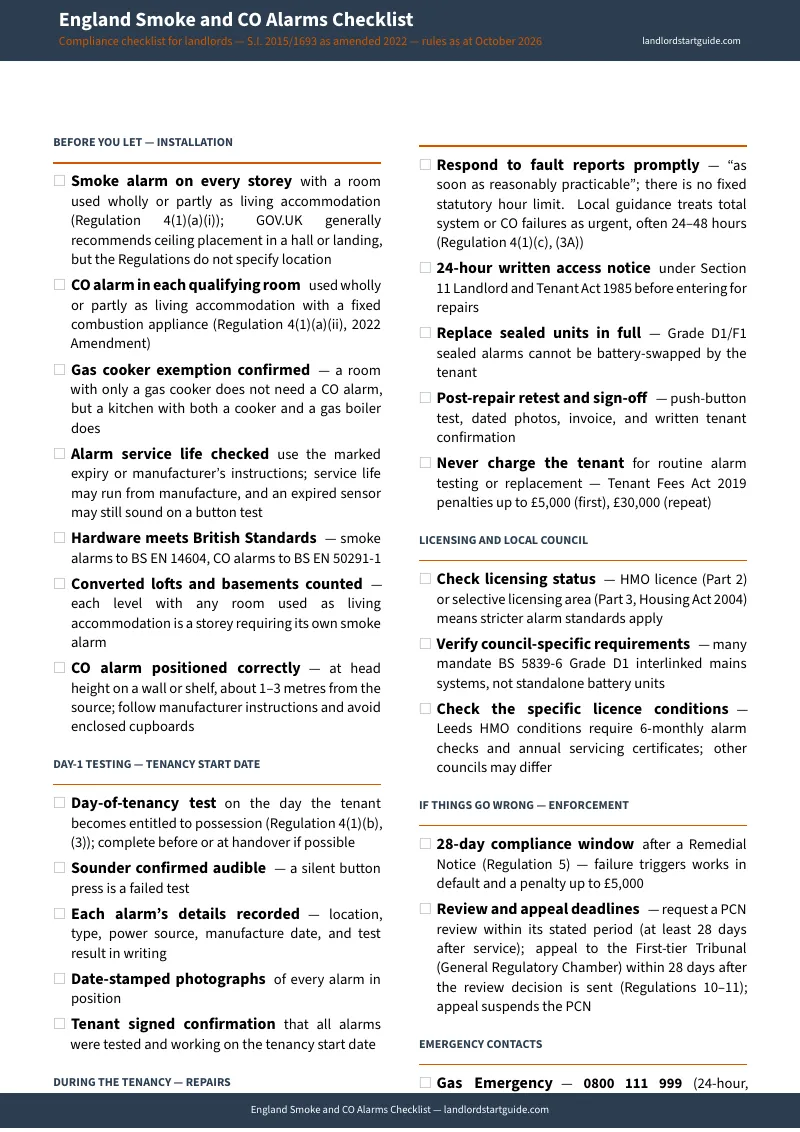
- Printable compliance checklist — 25-item checklist covering every statutory obligation, designed for use at a property check-in
- Day-1 tenancy testing form — dual-sign-off protocol with fields for alarm location, type, power source, manufacture date, sensor expiry and test result
- Fault-response log — structured audit trail for tenant reports, access requests, contractor visits and post-repair verification
- Hardware lifecycle tracker — manufacture-date-based replacement schedule for every alarm in the property
- Storey and appliance mapping worksheet — room-by-room planning tool to map combustion appliances and calculate the minimum alarm configuration before a new tenancy
- Agent verification checklist — for landlords using letting agents, checks whether the agent's check-in procedures capture the evidence the Regulations require
Who It's For
- Private landlords in England who self-manage one to a few rental properties
- Accidental landlords letting an inherited home or a property they can't sell
- Landlords transitioning from agent management who need to verify what was and wasn't being done
- Distant landlords who need an auditing benchmark for their local tradespeople or inventory clerks
Why Not Free Tools?
GOV.UK publishes the statutory booklets. They explain the law clearly. What they do not provide is a dated Day-1 testing form, a fault-response workflow, a hardware lifecycle tracker or any fillable document a landlord can produce during a council investigation. The official guidance itself notes that it is "not an authoritative interpretation of the law" and covers none of the operational steps between reading the rules and proving compliance.
Letting agent check-in reports typically record "alarms tested and working" — a single line that captures no manufacture dates, no sensor expiry, no batch numbers and no tenant signature. When a council officer asks for evidence of specific alarm installations, a generic inventory note does not meet the standard that recent tribunal decisions have required.
The NRLA provides comprehensive compliance guidance, but behind a £90–£105 annual membership — expensive for a landlord with one or two properties who needs to solve one specific compliance area.
This guide costs a fraction of a single letting agent check-in, covers every step the free guidance skips, and you keep it permanently.
Satisfaction Guarantee
Full refund, no time limit. If the guide doesn't give you what you need, email [email protected] and we'll refund you — no questions, no deadline.
Get Started
Download the free checklist to see the core requirements at a glance. When you're ready for the full placement rules, the Day-1 testing protocol, the fault-response workflow and the hardware tracker, get the complete guide for .
Frequently Asked Questions
What if the rules change after I buy?
We update the guide when the rules change. Email us any time, even years later, and we'll send you the current edition free.