Stoke-on-Trent has one active licensing scheme, two expired or proposed ones, and a wall of contradictory information online. This guide cuts through it.
You have been searching for whether your Stoke-on-Trent rental property needs a licence. You have found references to a selective licensing scheme in Fenton and Cobridge, something about additional HMO licensing proposals from August 2026, Article 4 density controls, and the national mandatory HMO rules — all mixed together on council pages, property forums, and search results that do not tell you which rules are actually in force today. The council's own website scatters the information across multiple sub-pages and PDF downloads, and the fee table only makes sense once you know about the two-stage payment split.
This is the Stoke-on-Trent Licensing Compliance System — a step-by-step guide that starts with "does my property actually need a licence right now?" and takes you all the way through to "licence granted, conditions understood, renewal tracked." It replaces the hours of research across council pages, legal PDFs, and conflicting forum threads with one clear, dated workflow you can follow from start to finish.
What's inside the guide
- Licence Decision Framework — answer three questions about your property (how many occupants, how many households, do they share amenities) and know in under five minutes whether you need a mandatory HMO licence, or whether your property falls outside all current licensing requirements. No more confusing active law with expired schemes or cabinet proposals.
- Active Law vs. Expired Schemes vs. Proposals — a clear explanation of what is actually in force (mandatory HMO licensing), what expired (Fenton and Cobridge selective licensing, 4 August 2019), and what is proposed but not yet law (additional HMO licensing, Article 4 Direction). Each section states the exact status and what it means for your property today.
- Pre-Submission Document Checklist — every document the council requires with your application (photo ID, Council Tax proof, gas safety certificate, EICR, fire alarm certificate, emergency lighting certificate, fire risk assessment, building control certificates), so you can assemble everything before you touch the council portal. Submitting an incomplete application wastes time and delays the process.
- Two-Stage Fee Breakdown — the exact fees for every property size, starting with the £428 Part 1 processing fee and the £467 Part 2 enforcement fee for up to six bedrooms (£895 total), through to the largest HMO brackets. Includes the £50 multi-property discount for subsequent applications within three months.
- Portal Application Walkthrough — step-by-step instructions for completing and submitting your application through the council's online system, including what happens after submission, when the Part 2 fee is due, and how the property inspection is scheduled.
- Fit-and-Proper Assessment — what the council evaluates when deciding whether you qualify to hold the licence, the common issues that cause applications to stall, and what "having control" and "managing" mean under Section 263 of the Housing Act 2004.
- Licence Conditions Decoded — the standard conditions that attach to a Stoke-on-Trent HMO licence, translated from council legal language into plain requirements: occupancy limits, safety certificates, property management standards, and what the council expects at each inspection.
- Local Amenity Standards — Stoke-on-Trent's room size requirements and shared amenity standards for HMOs, translated from the council's 2021 Amenity Standards document into clear measurements you can check against your floor plan before the inspection.
- Enforcement and Penalties — how civil penalties are calculated in Stoke-on-Trent, the starting points for different offence types, how smaller landlords may qualify for mitigating reductions, and how rent repayment orders work for both tenants and the council.
- Renters' Rights Act Impact Summary — how the 2025 Act changes the enforcement stakes for Stoke-on-Trent landlords: the abolition of Section 21 no-fault evictions, and the changes to civil penalty limits and rent repayment order periods for offences committed on or after 1 May 2026.
Who this guide is for
You are a private landlord who owns a rented home or shared house in Stoke-on-Trent and manages it yourself. You might have inherited the property, kept a former home when you moved, or made a buy-to-let investment. You do not have a compliance department, a retainer solicitor, or a full-service letting agent. You need to know what the council requires, in what order, and how to get it done without paying a letting agent £350–£750 to handle the application for you — because even if you do pay an agent, the legal responsibility under Section 72 of the Housing Act 2004 stays with you.
Why not just use the council's free information?
The rules are public. Nobody is hiding them. But Stoke-on-Trent's licensing information is scattered across multiple council web pages, the HMO Amenity Standards PDF, the Fire Safety for HMOs document, the Civil Penalties Policy, and the Private Sector Housing Enforcement Policy — none of which are organised in the order a landlord actually needs to follow. The council's own search function surfaces pages from the expired 2019 selective scheme alongside August 2026 cabinet consultation papers, making it genuinely difficult to tell what applies today. Landlords routinely spend hours researching and still come away unsure whether their property needs a licence at all.
This guide puts the entire process in one place, in the order you need to do things, with the common mistakes flagged before you make them. It is not legal advice, and it is not connected to the council. It is an independent compliance walkthrough, dated to the rules as at November 2026.
What's included
Your purchase includes five PDF downloads:
- The Full Guide (guide.pdf) — 14 chapters covering the licence decision framework, active law versus expired and proposed schemes, the application process, documents, fees, fit-and-proper checks, licence conditions, amenity standards, inspections, enforcement, penalties, appeal routes, and the Renters' Rights Act changes.
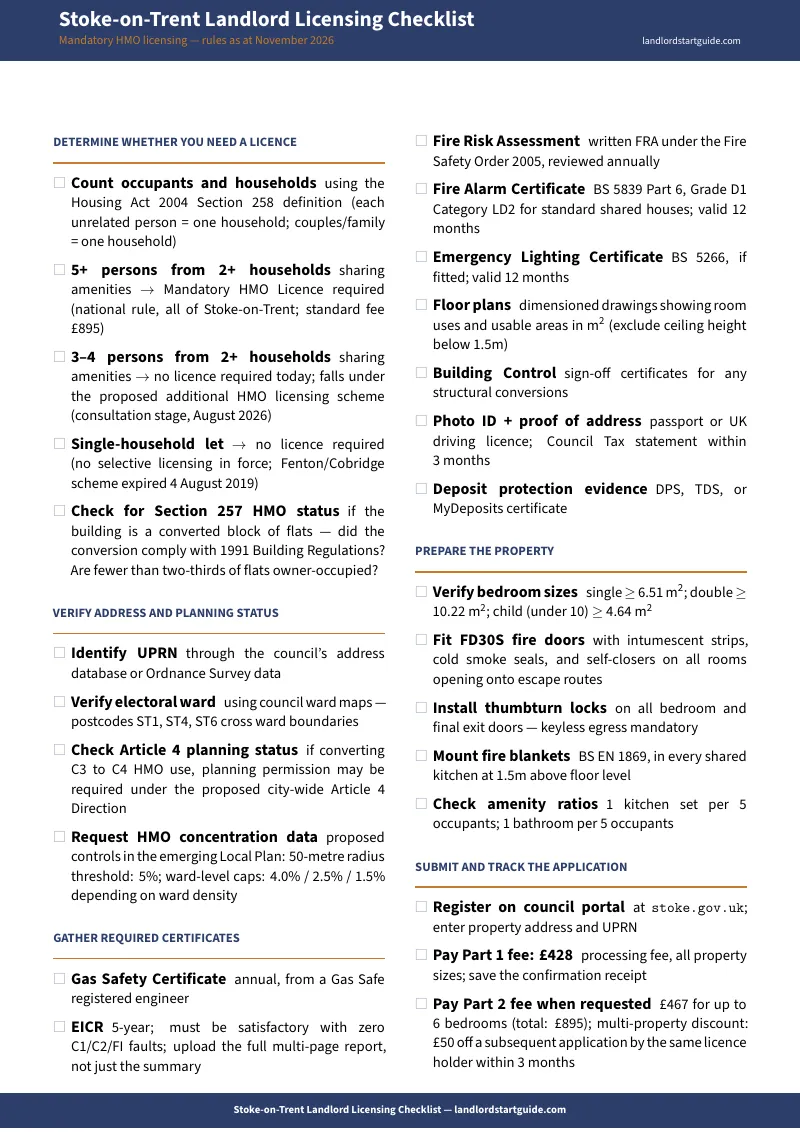
- The Compliance Checklist (checklist.pdf) — a dated checklist of every step, document, and deadline, organised by phase so you can tick items off as you go.
- Address and Occupancy Triage (licence-decision-worksheet.pdf) — a printable worksheet that walks you through the occupancy count, household structure, and exemption checks to determine whether your property needs a licence.
- Mandatory Document Audit (document-audit-checklist.pdf) — a fillable grid of every certificate and document the council requires, with columns for issue dates, expiry dates, and validation status, so you can verify your evidence package before submission.
- Two-Stage Fee and Renewal Tracker (fee-renewal-tracker.pdf) — the full fee schedule by property size, multi-property discount calculation, payment record, and a certificate renewal calendar.
Both files are yours to keep permanently. Full refund, no time limit — email [email protected] if it is not what you need.
Or start with the free checklist
Not sure yet? Download the free one-page Stoke-on-Trent Landlord Licensing Checklist — it covers the licence decision criteria, the required documents, the two-stage fees, and the key deadlines. No card required, no obligation.
Frequently Asked Questions
What if the rules change after I buy?
We update the guide when the rules change. Email us any time, even years later, and we'll send you the current edition free.