
One Wrong Step and You Start the Clock Again
You need to end a tenancy in Northern Ireland. Maybe you are selling the property, maybe a family member needs it back, maybe the tenancy is not working. Whatever the reason, the law requires you to serve a valid Notice to Quit — and the rules here are not England's rules.
Northern Ireland has no Section 21. No Section 8. No online possession portal. Private tenancies run under the Private Tenancies (Northern Ireland) Order 2006 and the Private Tenancies Act (Northern Ireland) 2022, with their own notice periods, their own written notice requirements, and their own court process. Use the wrong template from a UK-wide download site and the notice is void before it reaches the tenant.
Even landlords who know they are in a different jurisdiction make procedural mistakes that restart the entire timeline. The three most common:
- Wrong notice period — giving 4 weeks when the tenancy has passed 12 months (which requires 8 weeks) or passed 10 years (12 weeks). The tenant does not have to tell you the notice is invalid. They stay, and you start again.
- Missing compliance preconditions — serving notice without a current Landlord Registration, without a protected deposit, or without having served Prescribed Information within 35 days. Any of these can derail a County Court ejectment application.
- No proof of service — posting the notice by ordinary first-class mail or handing it over with no witness. If the tenant says they never received it, the County Court judge may dismiss the case outright.
The Northern Ireland Compliance Sequence
This guide is built around a named system: the NI Compliance Sequence. It puts every step in the order you actually need to do them — not grouped by topic, but arranged so that each step confirms a precondition the next step requires.
You do not jump straight to drafting a notice. You start with an audit of the duties the law says must already be in place. Then you calculate the notice period. Then you draft. Then you serve with proof. Then — only if the tenant does not leave — you follow the court route.
That sequence is what separates a notice that holds up in the County Court from one that gets thrown out on a technicality.
What You Get
- Tenancy classification matrix — work out whether you have a fixed-term, periodic, default six-month, or protected tenancy, and what each category means for how and when you can serve notice
- Pre-notice compliance audit worksheet — check Landlord Registration status (£70 fee, 3-year renewal), deposit protection (28-day rule after 1 April 2023), Prescribed Information (35-day rule), smoke/heat/CO alarms, EICR — each with the specific statutory reference so you can verify it yourself
- Notice period calculator with worked examples — three real-date scenarios showing how to count 4, 8 or 12 weeks from the service date, align the expiry with the rental period, and account for deemed receipt when using recorded delivery
- Written notice requirements — the five mandatory elements a valid Notice to Quit must contain, laid out in a structure you can follow line by line
- Proof of service log — a dated record sheet for recorded delivery, in-person with witness, or solicitor service, designed to print on A4 and file alongside your copy of the notice
- County Court possession process map — Ejectment Civil Bill filing, what happens at the hearing, the decree, and how the Enforcement of Judgments Office handles physical possession if the tenant still does not leave
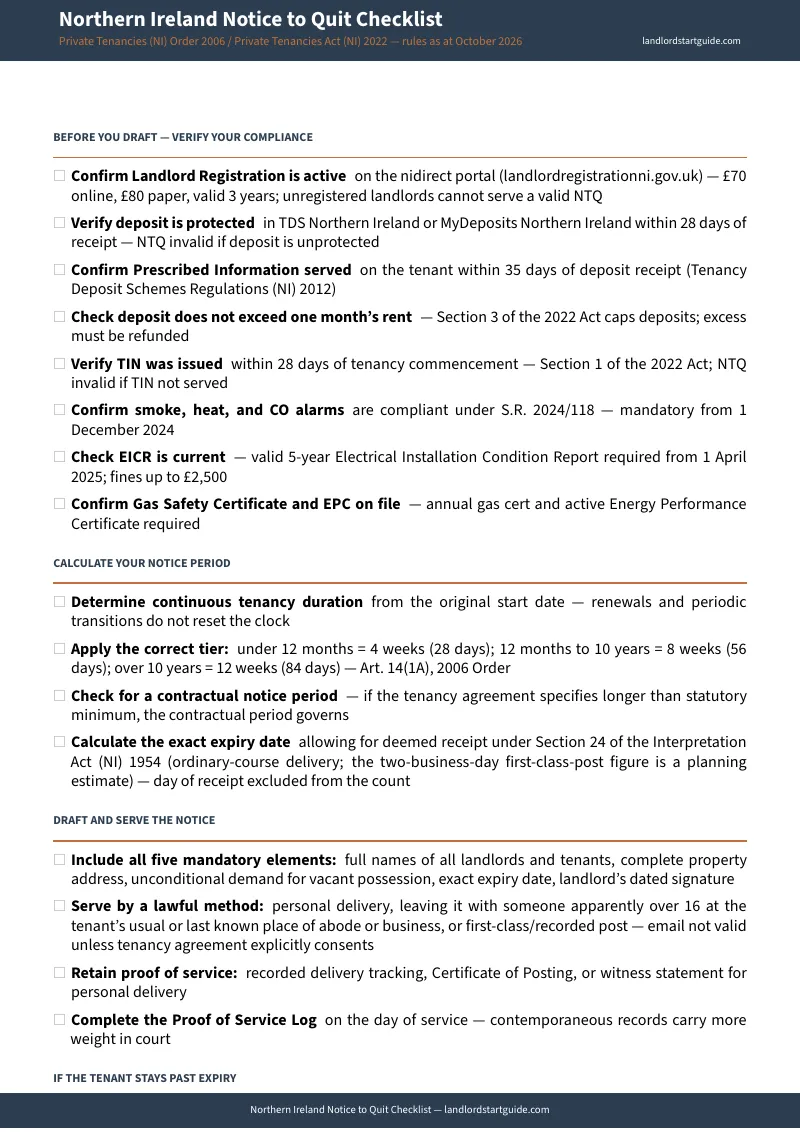
- One-page dated checklist — every step on a single page with tick boxes, spaces for dates, and the statutory references, so nothing gets missed and your file is ready for a solicitor if you need one
Who This Guide Is For
- Self-managing landlords with one or two properties in Northern Ireland who want to handle the notice process themselves rather than paying a letting agent
- Accidental landlords who kept a former home or inherited a property and now need to end the tenancy — possibly for the first time
- Landlords unsure whether online advice applies to NI or to England — the guide covers only Northern Ireland law and flags where English terminology does not apply
This guide does not give legal advice on any particular dispute or possession claim, does not suggest tactics against tenants, and is not affiliated with any council, tribunal, or government department. It explains the statutory requirements and the process.
Why Not Just Use the Free Government Pages?
The official pages on nidirect.gov.uk and Housing Rights are accurate. This guide does not hide anything they publish for free.
What those pages do not give you is a single, ordered workflow with printable worksheets, a date calculator, and a proof-of-service log. The statutory information is spread across multiple articles on multiple sites, with no cross-referencing between registration, deposits, notice periods, and court procedure. Assembling it yourself means tabbing between half a dozen pages and hoping you have not missed one of the preconditions that the County Court checks first.
The guide puts it in one place, in the right order, with the paperwork attached.
Satisfaction Guarantee
If the guide does not help, email [email protected] for a full refund, no time limit. No form to fill in, no questions to answer.
Get Started
Download the free checklist to see the steps at a glance — or get the full guide with the compliance audit worksheets, notice period calculator, proof-of-service log, and court process map.
Every rule in the guide is dated to October 2026. Where the Department for Communities has proposed changes that are not yet in force, the guide says so — you always know which rules apply right now.
Frequently Asked Questions
What if the rules change after I buy?
We update the guide when the rules change. Email us any time, even years later, and we'll send you the current edition free.