One wrong day on a notice. That's all it takes.
You serve the notice, count the days carefully, attach the right form — and SACAT throws it out anyway because your clear-day calculation was one day short. Or because you used Form 7 when the lease was fixed-term. Or because the signed sales agency agreement wasn't attached. You lose the $93.00 filing fee, the tenant stays, and you start the entire process again from the beginning.
Since 1 July 2024, South Australia has abolished no-grounds tenancy terminations entirely. Every notice must now cite a prescribed statutory ground, use the exact form, and attach specific documentary proof. The rules changed again in September 2025 and January 2026. Most of the information online hasn't caught up.
The Notice Compliance System
This guide gives you what CBS fact sheets and real estate blogs don't: a single, dated compliance workflow that takes you from choosing the correct prescribed ground through to a SACAT bailiff enforcing vacant possession — with every form, calculation, attachment, and deadline in the order you need them.
It is not a bundle of blank forms. It is not a summary of the old rules. It is a step-by-step system built on the Residential Tenancies Act 1995 as amended through October 2026, including the provisions that most online resources still get wrong.
What's inside
- Prescribed Grounds & Evidence Matrix — every lawful reason for ending a tenancy matched to its statutory form (Form 5, 7, or 9) and mandatory evidence attachments. Serve the wrong form or miss one attachment, and the notice is void before it reaches the tribunal.
- Clear-Day Service Protocol — the section 3(3) calculation that trips up more landlords than any other rule. The guide walks through personal delivery, postal delivery with Australia Post transit days, and email service, with worked examples. Fill in the Clear-Day Calculator with your actual dates before you write the termination date on the notice.
- Sale & Owner-Occupation Roadmap — the specific timeline for landlords selling a tenanted property or moving back in, including the September 2025 sales agency agreement provisions, section 47A/47C disclosure obligations, and the re-letting ban that prevents you advertising the property for 6 months after an owner-occupation notice.
- SACAT Enforcement Pathway — what happens when a tenant stays past the notice period. The guide maps every step: the Level 1 application ($93.00 standard, or $69.00 / $23.00 concession), the section 93 order for vacant possession, and the section 99 bailiff warrant. Self-help eviction is illegal and carries penalties up to $35,000 — this is the lawful alternative.
- Breach Termination Protocol — the specific process for rent arrears exceeding 14 days, repeated breaches, property damage, and other grounds that use Form 5, including the notice periods that differ from standard termination.
- 2024–2026 Reform Timeline — what changed in July 2024 (no-grounds abolished), September 2025 (evidence requirements tightened), and January 2026 (mandatory Form A1 for all rental applications), with the provisions that affect each notice type and the changes still coming.
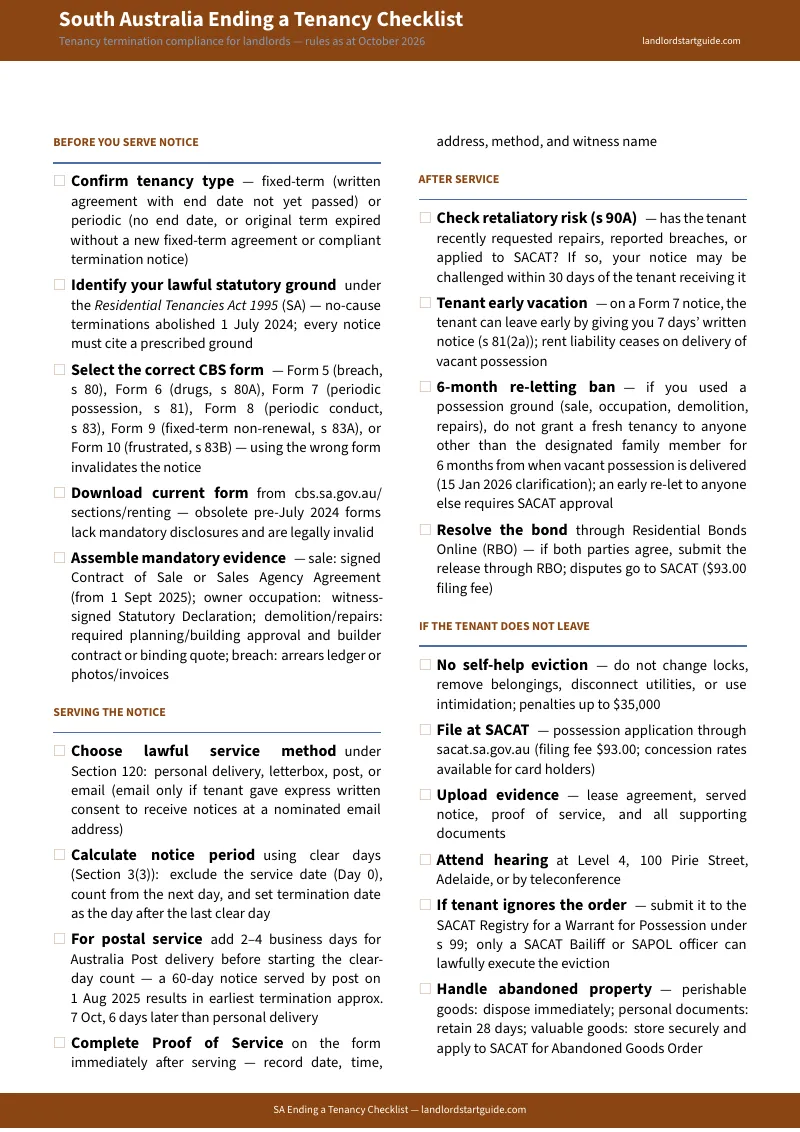
- Dated Compliance Checklist — a printable two-page checklist covering every step, form, attachment, and deadline for your specific termination scenario. Each item states the date of the rules it describes.
- Five fillable printables — the Termination Planner, Notice Service Record, Clear-Day Calculator, Evidence Checklist, and SACAT Application Checklist. Print them and write on them; they are the working record you take to CBS forms and, if needed, to SACAT.
Who this guide is for
Private landlords in South Australia who self-manage one or a few residential properties and need to end a tenancy lawfully. Whether you are selling the property, moving back in, managing a fixed-term expiry, or dealing with a serious breach, this guide gives you the compliance workflow for your situation.
It is written for landlords who want to do this themselves, correctly, without paying an agency $3,500–$5,500 a year or a solicitor $350–$600 an hour for what should be a standard administrative process.
Why not just use the free resources?
The Consumer and Business Services website publishes the statutory forms. SACAT publishes its fee schedule. The Law Handbook publishes the legal commentary. All of them are essential official sources, and the guide links to them throughout.
What none of them provides is a single chronological workflow. CBS distributes the information across separate fact sheets, statutory forms, and regulatory announcements. SACAT explains its fees but not the evidentiary requirements for each notice type. The Law Handbook is written for legal practitioners, not for a landlord who needs to know which form to fill in and what to attach to it.
The guide takes the information that exists across all of these sources and organises it into the sequence you actually follow — with the calculations done, the forms matched to grounds, and the common technical errors flagged before you make them.
What this guide does not do
It does not give legal advice on a particular dispute or possession claim. It does not offer tactics against tenants. It does not promise outcomes at SACAT. It explains what the law requires and how the process works — the forms, the deadlines, the calculations, and the enforcement pathway — so you can follow the correct procedure with confidence.
For contested cases or complex disputes, the guide directs you to the Legal Services Commission of South Australia's free advisory services and recommends qualified legal counsel.
The guarantee
Full refund, no time limit. If the guide doesn't give you what you need, email [email protected] and you'll get your money back. No forms, no time pressure, no questions.
Get the free checklist first
Not sure yet? Download the free South Australia Ending a Tenancy Checklist — a printable two-page summary of the steps, forms, fees, and deadlines. It covers the what. The full guide covers the how.
Or get the complete guide now for — less than a single SACAT filing fee, and a fraction of what an agency charges for one month of management.
Frequently Asked Questions
What if the rules change after I buy?
We update the guide when the rules change. Email us any time, even years later, and we'll send you the current edition free.