You know the rent needs to go up. You're not sure the notice will survive a review.
Your property taxes climbed, your insurance renewed higher, and the 3% cap means the margin for error is razor-thin. But New Brunswick's Residential Tenancies Act doesn't just limit how much you can raise the rent — it dictates exactly how you deliver the notice, what form it takes, and which procedural misstep gives a Residential Tenancies Officer the authority to void it entirely.
The government website lists the rules, but it doesn't connect them. The six-month notice period, the 12-month frequency clock, the separate document mandate under Section 11.1(2.03), the deemed-3% mechanism for non-compliant notices, the above-cap application path for capital expenditure — these interact in ways that a bullet-point summary doesn't explain. And the most dangerous trap isn't the cap arithmetic. It's the requirement that a rent increase notice must be served as a completely separate document from any lease renewal, receipt, or communication. Combine the notice with anything else, and a Residential Tenancies Officer is required by statute to set the entire increase aside.
The Notice Compliance System
This guide gives you a single structured process for every residential rent increase in New Brunswick: standard tenancies under the 3% statutory cap, above-cap applications for capital expenditure up to 9%, and mobile home sites with the uniformity requirement. You work through the steps in order — confirm your tenancy is covered by the RTA, check the 12-month clock, calculate the six clear calendar months of notice, draft the increase on a separate document, serve it by a lawful method, log your proof of service, and prepare for the 60-day tenant review window. Each step has a verification point so you can confirm compliance before the notice leaves your hands.
What's Inside
- Timeline calculation section — the six-month notice window is counted in clear calendar months, not days. This section factors in the 12-month frequency limit, the earliest-possible effective date for your tenancy, and the date-of-service rules so you can identify when to serve and when the increase can legally take effect.
- Separate document verification check — Section 11.1(2.04) requires officers to set aside any notice that wasn't served as a standalone document. The verification walks you through confirming the notice is physically and procedurally separate from every other communication, so you catch the most common invalidation trigger before it costs you six months.
- Proof-of-service log — a void notice usually fails on evidence, not arithmetic. The log covers personal delivery, registered mail, and other accepted service methods under Section 25 of the Act. You record the method, date, and evidence so you have a defensible file if the tenant submits an Application for Assistance within the 60-day window.
- Above-cap application guide (3% to 9%) — if you've made qualifying capital expenditure renovations, you can apply to the Tenant and Landlord Relations Office for an increase above the 3% cap. The guide walks you through the evidence assembly process, the application steps, and what a Residential Tenancies Officer will review.
- Mobile home uniformity audit — rent increases on mobile home sites must be uniform across all sites in the same community or section. This audit helps you verify uniformity before serving, so you don't expose yourself to a challenge on one unit that unravels the increase across the entire park.
- Tenant review compliance preparation — if your tenant files an Application for Assistance within 60 days, you need to demonstrate proper notice, the 12-month gap, cap compliance, and separate document service. This section lets you organise your evidence before the hearing, not during it.
- 7 standalone fillable worksheets — print and fill in for your specific tenancy: an eligibility checklist, a rent increase calculation worksheet, a notice timeline calculator, a service delivery log, an above-cap application checklist, a compliance file index, and a tenant review response planner. Each worksheet stands alone so you can bring it to the table without the full guide.
Who This Guide Is For
- Private landlords in New Brunswick who self-manage one or a few rental units and need to raise the rent within the statutory cap
- Landlords approaching a lease renewal who want to confirm the 3% cap applies and serve a notice that complies with the separate document mandate
- Landlords who have made capital expenditure renovations and need to apply for an above-cap increase up to 9%
- Owners of mobile home sites who need to apply the rent increase uniformly across a community or section
- Any New Brunswick landlord facing a tenant review application who wants to audit their compliance before the hearing
Why Not the Free Resources?
The government website lists the 3% cap and the six-month notice period — but it doesn't give you a timeline calculator that accounts for the 12-month frequency clock and the clear calendar month counting method working together. It publishes the rules about separate documents as a statutory clause without a pre-service audit that catches the mistake before it voids your increase. It hosts the Application for Assistance form but provides no compliance preparation guide for the landlord who needs to defend the increase at a hearing.
Document generators like LawDepot will produce a rent increase letter, but they don't verify your 12-month timing, don't log your proof of service, and can roll into a recurring monthly subscription. The New Brunswick Apartment Owners Association focuses on industry-level advocacy and government lobbying, not step-by-step compliance workflows for individual landlords. Full-service property managers charge 8–10% of gross monthly rent for ongoing management — effective if you want to hand off the entire tenancy, expensive if you just need to serve one notice correctly.
This guide is a one-time purchase. It covers what you need to serve a valid notice and defend it if challenged, with verification checks you complete for your specific tenancy. No subscription, no membership, no recurring fee.
Satisfaction Guarantee
Full refund, no time limit. If the guide isn't what you expected, email [email protected] and we'll refund you — no questions, no deadline.
Get Started
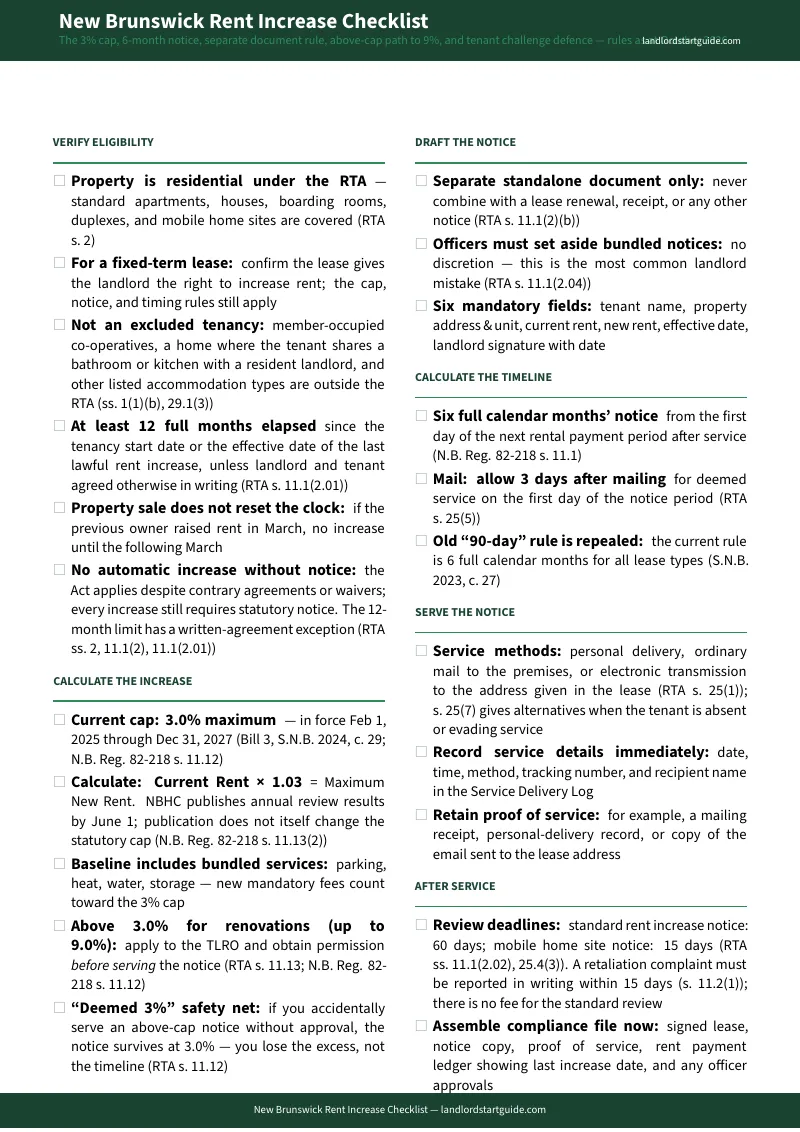
Download the free New Brunswick Rent Increase Checklist — a dated summary of the steps, forms, notice periods and deadlines. Ready for the full system? Get the complete guide for and serve a notice that holds up the first time.
Frequently Asked Questions
What if the rules change after I buy?
We update the guide when the rules change. Email us any time, even years later, and we'll send you the current edition free.