You Found the 3.1%. You Downloaded the TAL Form. You Still Can't Tell If Your Notice Will Survive a Challenge.
You know the TAL published a 3.1% baseline for 2026. You found the official modification notice form on tal.gouv.qc.ca. You even read a Reddit thread about how silence means acceptance after 30 days.
But now you're looking at the form and the questions start multiplying. Does the 3.1% already include your property tax increase — or do you add that on top? Your lease expires June 30 and it's mid-February: is the notice still within the 3-to-6-month window, or does the clock run from when the tenant opens the envelope? You served by email last year and the tenant never objected — does that count as valid service? And if the tenant writes back saying no, you have exactly one month to file at the TAL. What exactly do you file, how much does it cost, and what evidence do you need to bring?
The government gives you the form and the formula. What it doesn't give you is a system for getting every step right, in the right order, with the right proof.
The Lease Renewal Compliance System — From Calculation to TAL Filing, in One Workflow
Rent Increases in Quebec is a 13-chapter guide built for self-managing landlords who need to raise the rent lawfully under the reformed 2026 calculation method and can't afford to have the notice thrown out on a procedural error. It takes the rules scattered across the Civil Code of Québec, the TAL's published criteria, Gazette officielle no. 51, and five different government portals, and organizes them into a single compliance workflow — from calculating your building-specific increase through serving a legally defensible notice to filing a rent-fixing application if the tenant refuses.
This isn't a form-filling service or a property management subscription. It's a reusable reference system dated to the rules as at October 2026 that you work through once, then keep for every future renewal on every unit you manage.
What's Inside
- The 2026 Multi-Variable Calculation Breakdown — The TAL's published 3.1% is a starting point, not a ceiling. The guide walks you through the five components of the modernized formula: the CPI baseline, property tax variances, school tax changes, insurance premium adjustments, and capital expenditure amortization at the fixed 5% annual rate over 20 years. A printable Expense Allocation Worksheet lets you plug in your actual bills and arrive at your building-specific figure — the number that would survive a TAL hearing.
- Notice Form Walkthrough (TAL-806A-E) — The guide annotates every field on the official modification notice: what "current rent" means when you included a parking charge, how Section F (5-year new building exemption) interacts with Bill 31 disclosure requirements, and where the most common drafting errors void a notice before it reaches the tenant.
- Service Deadline Planner — The notice window runs from when the tenant receives the notice, not when you mail it. The guide maps the 3-to-6-month and 1-to-2-month windows for every lease duration, with worked examples for July 1 and non-July 1 leases, so you know the exact latest date your tenant must have the notice in hand.
- Proof-of-Service Protocol — Informal emails and text messages fail at the TAL. The guide covers the three legally defensible delivery methods — registered mail, bailiff service, and personal delivery with signed confirmation — with a printable Notice Service Tracking Log for recording tracking numbers, receipt dates, and filing the evidence.
- Tenant Refusal Response System — When a tenant refuses the increase, you have exactly one month to file a rent-fixing application at the TAL or lose the increase for the entire cycle. The guide walks through the filing process step by step: which form, which fee bracket ($59, $70, or $92 depending on current monthly rent), the 90-day evidence window, and the TAL Evidence Dossier Checklist for organizing invoices, tax bills, and insurance documents for the hearing.
- Section F and Section G Risk Map — Section F exempts buildings less than five years old from the standard calculation criteria, but Bill 31 added mandatory disclosure requirements that trip up landlords who think "exempt" means "no rules." Section G requires disclosure of the lowest rent paid in the past 12 months — and tenants are using it retroactively. The guide explains both traps and how to handle them.
- Annual Compliance Calendar — A month-by-month timeline for the standard July 1 renewal cycle (with instructions for adapting it to any lease expiry date) that maps every deadline: when to gather expense documents, when to serve notice, the tenant response window, the TAL filing deadline, and the evidence submission period.
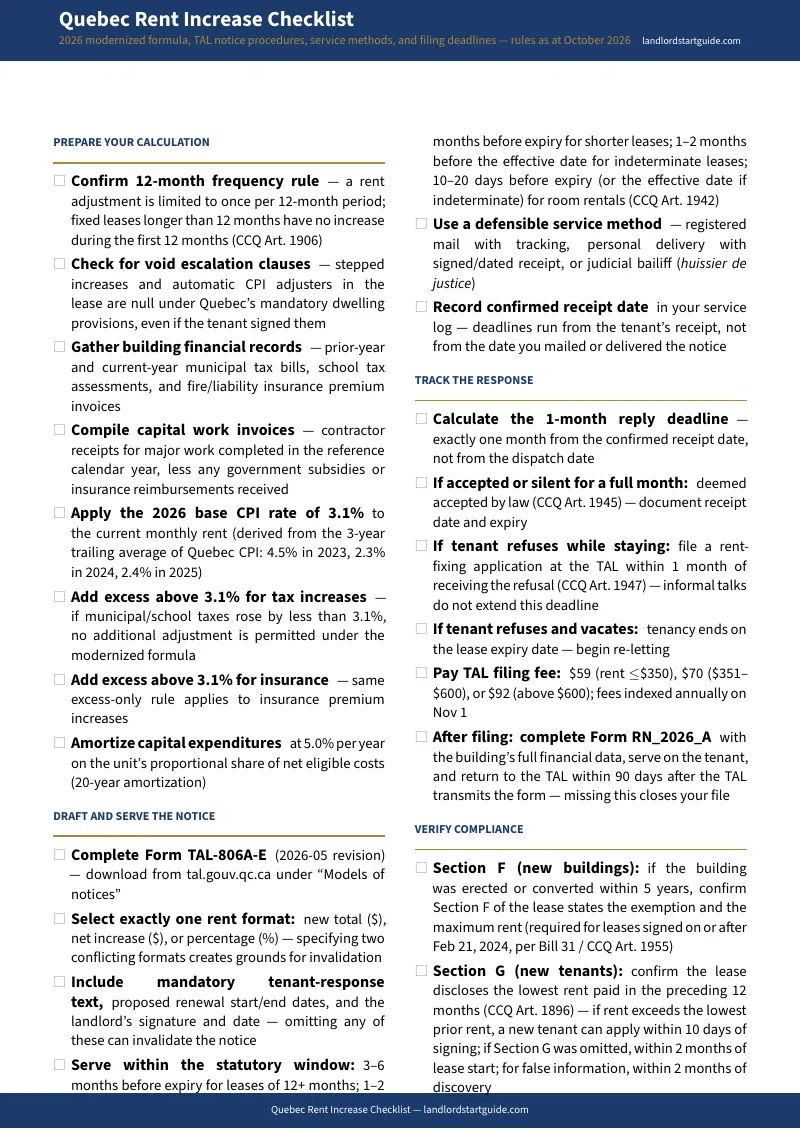
- Printable Compliance Checklist — A 25-item dated checklist covering the entire renewal sequence from expense gathering through notice service, tenant response, and TAL filing. Print it, work through it, and keep it as your compliance record.
Who This Is For
- Self-managing landlords with one to a few units who handle their own notices and don't retain a property management agency or notary for routine renewals
- Duplex and triplex owner-occupiers who need to calculate increases that account for shared-building expenses across multiple units
- Accidental landlords renting out an inherited property or a former home and issuing their first Quebec rent increase
- Non-francophone landlords working through French-first TAL forms and government portals who need clear English-language procedural guidance
Why Not Just Use the Free Resources?
The free resources are genuinely good — and the guide links to all of them. The TAL publishes the forms and the annual percentages. Éducaloi offers clear legal summaries. LégisQuébec has the full statutory text. The Centres de Justice de Proximité provide free legal orientation sessions.
The problem isn't that the information doesn't exist. It's that it's scattered across a dozen sources in two languages, written in statutory language, and nowhere does anyone walk you through the sequence: how to calculate your building-specific increase (not just the headline 3.1%), which service method will actually hold up, how to log the tenant's response period, and what happens — step by step — when you need to file at the TAL.
A notice that arrives one day outside the 3-to-6-month window is void. A notice served by email with no formal tracking is indefensible. Missing the one-month TAL filing deadline after a tenant refusal locks your rent at the old rate for an entire year. On a unit renting at C$1,500/month, even a modest 4% increase you never collect is C$720 lost over the year — because you counted the days wrong or didn't know the filing deadline existed.
The Expense Allocation Worksheet, Service Deadline Planner, and 25-item Compliance Checklist exist to make those scenarios impossible.
Satisfaction Guarantee
Full refund, no time limit. If the guide doesn't help you serve a lawful rent increase notice, email [email protected] and we'll refund every penny.
Not Affiliated with the TAL or Quebec Government
This is an independently published educational guide. It is not affiliated with, endorsed by, or connected to the Tribunal administratif du logement, the Government of Quebec, or any municipality. It does not constitute legal advice. All official forms remain freely available from the TAL at tal.gouv.qc.ca.
Get the Checklist Free — or Get the Full System
Download the free Quebec Rent Increase Checklist to see the steps at a glance. When you're ready for the full compliance system — the 2026 Expense Allocation Worksheet, Service Deadline Planner, Proof-of-Service Log, TAL Evidence Dossier Checklist, and the complete 13-chapter guide — get the full guide for and work through it at your own pace.
Frequently Asked Questions
What if the rules change after I buy?
We update the guide when the rules change. Email us any time, even years later, and we'll send you the current edition free.