The deadline passed. The rules changed. Your old agreement might already be wrong.
On 1 May 2026, every fixed-term AST in England converted automatically into an assured periodic tenancy. No signature needed, no agent appointment, no paperwork — it happened by operation of law. But the conversion also voided your fixed-term end date, your break clauses, your contractual rent review formula, and any rent period longer than monthly. If your written agreement still contains those clauses, it is partly unenforceable and you may not know it.
Then came the Information Sheet. Every landlord with an existing written tenancy had until 31 May 2026 to serve the government's Renters' Rights Act Information Sheet on each named tenant — the actual PDF attachment or a printed hard copy, not a web link — with proof of delivery retained. Missing the deadline exposes you to a local authority civil penalty of up to £7,000. And emailing a link to the GOV.UK page does not count: the statutory requirement is direct delivery of the document itself.
GOV.UK publishes the Information Sheet and the law. What it does not publish is a compliance system: a way to audit your existing agreement, work out which clauses are now void, prove you served the right documents to the right tenants by the right method, and track the new Section 13 rent increase process that replaces whatever contractual formula you were using before. That is the gap this guide fills.
The Tenancy Transition Compliance Kit: paperwork audit, delivery proof, and rent mechanics in one place
This guide gives self-managing landlords in England a single, dated reference for moving existing and new lettings onto the assured periodic tenancy framework. It covers what the law changed, what your obligations are, and what the penalties look like if you get it wrong — with the practical tools that government pages leave out.
Written for private landlords who manage one or two properties without an agent or a solicitor on retainer. No legal training required. Every chapter states the date of the rules it describes, and the guide explains requirements and process — it is not legal advice.
What's inside
- AST-to-APT Transition Decision Map — a printable worksheet that categorises your tenancy into one of three routes: existing written AST (automatic conversion, serve Information Sheet), unwritten or verbal agreement (provide full Written Statement of Terms), or new tenancy from 1 May 2026 onward (written terms before the tenant agrees). No more guessing whether you need to re-sign.
- Tenancy Conversion Audit Register — one row per tenancy for the pre-1 May type, the route you are on, the document served, the method, the date, and any gap still open.
- Multi-Tenant Proof-of-Delivery Log — a printable compliance register with individual tenant service verification fields, mode-of-service certification (physical hand delivery, recorded post, or direct PDF email attachment), and a landlord sign-off designed for retention in tax and audit records. Built for the way local authorities actually enforce the £7,000 penalty.
- Written Statement of Terms Audit Checklist — a structured inventory of the 16 mandatory S.I. 2026/324 fields alongside prohibited clauses (fixed-term end dates, contractual rent review formulas, notices to quit). Audit your existing agreement clause by clause without paying a solicitor or a letting agent to re-draft it.
- Section 13 Rent Increase Planner — the statutory rent increase process that replaces contractual rent review clauses, with the 52- and 53-week timing check, two-month notice calculation, and record-keeping steps. The 49-page guide walks the same process through a completed Form 4A example.
- Joint Tenancy Notice Tracker — under the periodic regime, a single joint tenant can end the entire tenancy with two months' notice. The tracker logs notice validity, rent-period alignment, and the options remaining for tenants who want to stay.
- New Letting Compliance Sequencer — the post-1 May 2026 setup order on one sheet: advertise at a fixed rent, Right to Rent, Written Statement before signing, rent only after signing, deposit protection within 30 days.
- Agent Delegation Checklist — if you use a letting agent for some or all compliance tasks, the checklist sets out where statutory liability remains with you as the landlord, what proof of delivery to demand from the agent, and the questions to ask before paying for a contract "update" you may not need.
- Penalty Regime Reference and Implementation Roadmap — in the guide: the two-tier civil penalty structure (up to £7,000 for a first offence, up to £40,000 for a repeat), and the three-phase Renters' Rights Act rollout (Phase 1 live from 1 May 2026; Phase 2 PRS Database and Landlord Ombudsman targeted late 2026 to 2028; Phase 3 Decent Homes / Awaab's Law later).
Who this is for
- Private landlords in England who need to move existing lettings onto the assured periodic tenancy framework — whether you let a former home, an inherited property, or a buy-to-let
- Self-managing landlords with one or two properties who handle compliance themselves, without a letting agent on a management contract
- Accidental landlords who let a property through circumstance and need to understand what the 2026 changes mean for an agreement they signed years ago
- Landlords who use a let-only agent for tenant placement but retain day-to-day tenancy administration — and want to verify what the agent claims about statutory compliance
- Landlords who missed the 31 May 2026 Information Sheet deadline and need a late-service compliance protocol
Why not use free resources?
GOV.UK publishes the Information Sheet, the legislation, and a tenant-facing overview. That is not the gap. The gap is that a self-managing landlord trying to comply must:
- Download the Information Sheet PDF and work out whether emailing a web link counts (it does not)
- Determine whether their existing written agreement converted automatically or needs to be replaced (it converted — but the free guidance does not explain what to do with the voided clauses still sitting in the document)
- Audit their tenancy terms against the new prohibited-clause rules, which are scattered across multiple sections of the amended Housing Act 1988
- Build their own proof-of-delivery record that would satisfy a local authority enforcement check — because no government template exists
- Navigate the Section 13 Form 4A rent increase process that replaced their contractual rent review, using a form published without a worked example
Advice charities like Shelter and Citizens Advice are funded to help tenants, not landlords. The NRLA charges £99 a year for a membership subscription. Letting agents charge £50 to £150 for an administrative fee to serve the Information Sheet — and you remain legally liable if they serve it by bulk email without individual delivery proof.
This guide assembles everything into one printable compliance system for less than a letting agent's administrative fee.
Satisfaction guarantee
Full refund, no time limit. If the guide does not deliver what you expected, email [email protected] and you will receive a complete refund.
Get started
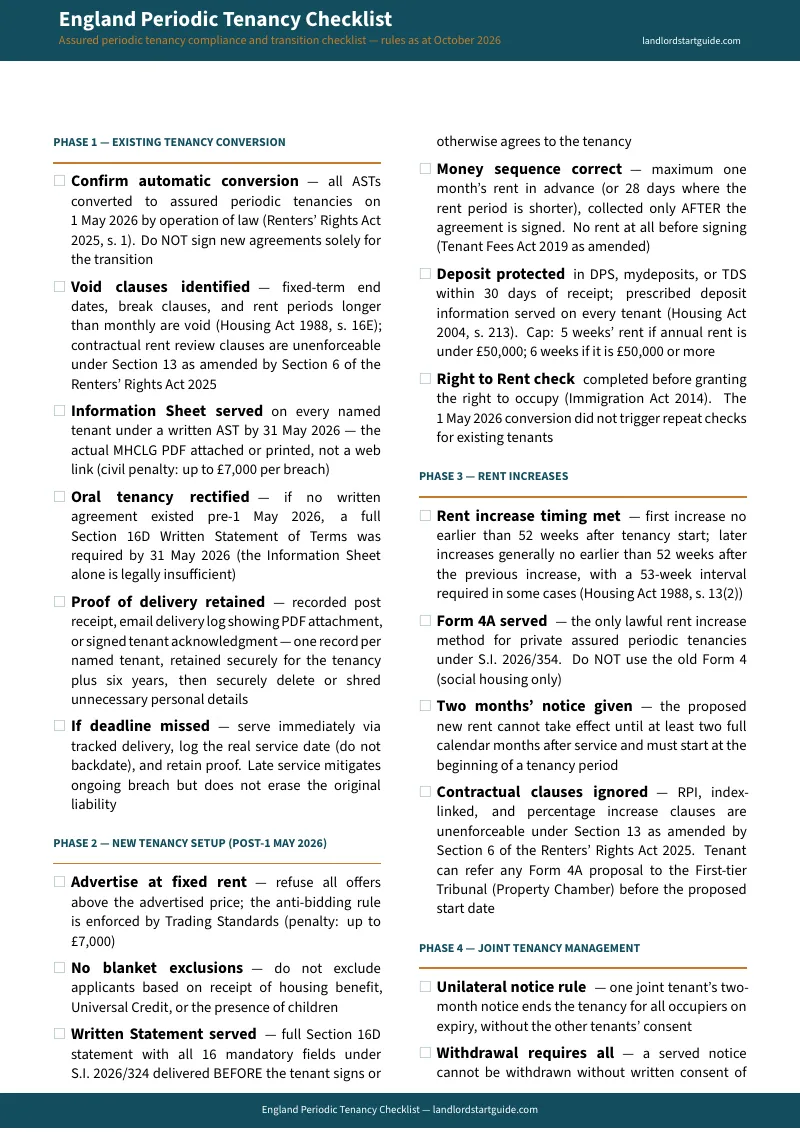
Download the free two-page checklist to see the compliance steps at a glance. When you are ready for the transition decision map, the delivery log, the Written Statement audit checklist, and the Section 13 planner, the complete kit is available for .
Get the Assured Periodic Tenancies Guide →
Frequently Asked Questions
What if the rules change after I buy?
We update the guide when the rules change. Email us any time, even years later, and we'll send you the current edition free.