You know you need a licence. You just can't work out which one — or whether three sharers in a joint tenancy counts as an HMO.
Since 1 May 2026, Hackney Council has run three separate property licensing schemes at the same time — selective licensing across 17 wards, additional HMO licensing for smaller shared houses borough-wide, and mandatory HMO licensing for larger shared houses borough-wide. The council's information is scattered across portal pages, Google Docs fee tables, designation notices and an address checker that frequently fails on converted flats. The penalty for getting it wrong is a civil financial penalty of up to £40,000 per offence, or a Rent Repayment Order where your tenant claims back up to 24 months of rent.
You've probably spent an evening bouncing between council pages, trying to work out whether three working professionals in a two-bedroom flat form one household or three, whether your property falls in one of the 17 selective wards or the four that are exempt, what "Part A" and "Part B" fees mean, which documents the portal will actually ask for, and whether that non-refundable Part A fee (£555 for selective, £840 for an HMO licence) is recoverable if you apply for the wrong scheme. The answers are out there — but nobody has put them in one place, in order.
The Hackney Licensing Pre-Flight System
This guide is a complete pre-flight system for Hackney's three licensing schemes — from working out which licence your property needs to tracking the conditions for the full five-year term. It replaces the hours of council-page research with a single, step-by-step reference you can print and work through before you open the portal.
It is not legal advice, not a council publication, and not connected with any government body. It is an independent guide that organises the public rules into the order you need them.
Which licence? — answered in one decision framework
A step-by-step framework that asks about the number of occupants, the number of households, the building type, and any exemptions — and tells you whether you need a mandatory HMO licence (5+ persons, 2+ households, borough-wide), an additional HMO licence (3–4 persons, 2+ households, borough-wide, Section 257 converted blocks excluded), a selective licence (single household or two sharers, in a designated ward), or no licence at all. Includes the household-counting rules that catch landlords out: three individual sharers on a joint tenancy form three households, not one.
Every document, in the order the portal asks for it
Gas Safety Certificate, Electrical Installation Condition Report with no outstanding C1 or C2 deficiency codes, Energy Performance Certificate rated A to E, measured floor plans with room dimensions in square metres and the 1.5-metre headroom line for rooms under sloping roofs, fire safety evidence for HMOs, and every fit-and-proper-person disclosure — laid out in a document-preparation sequence so you can assemble the file before you log in to the portal. No more submission timeouts because a certificate was buried in your email.
Room measurements the council will actually accept
Hackney strictly enforces usable floor space during inspections. Any floor area where the ceiling height is below 1.5 metres — common in Victorian attic conversions across Stoke Newington, Stamford Hill and Clapton — must be excluded entirely from the bedroom's usable area. En-suite shower pods, chimney breast projections, and narrow entry corridors behind door swings are also deducted. Standard estate agent floor plans calculate gross internal area and will fail the inspection. The guide explains the deduction rules with worked examples so you can measure the rooms yourself before the council does.
Fees, the Part A / Part B split, and every discount you can claim
The full fee structure for all three schemes — selective at £925 (£555 Part A, £370 Part B), additional HMO and mandatory HMO at £1,400 (£840 Part A, £560 Part B) — with the EPC B discount (£100 off Part B), the EPC C discount (£50 off Part B), the LLAS/NRLA accreditation discount (£100 off Part B), and the multi-dwelling discount (£100 off Part A for the second and subsequent units). The guide explains which discounts stack, which part of the fee each one applies to, and two worked examples showing the final amount a landlord actually pays.
Licence conditions and five-year tracker
What the council expects for the full licence term: annual gas safety renewals, smoke and carbon monoxide alarm testing, EICR cycles, occupancy limits, periodic property inspections, waste management obligations, anti-social behaviour reporting, and tenancy deposit compliance. The tracker gives you the dates and the paperwork, so a routine inspection or a licence renewal doesn't arrive without warning.
The non-transferability trap when selling
A Hackney property licence is non-transferable. When you sell a licensed rental property, the licence terminates on completion. The buyer must submit an entirely new application and pay a new Part A fee. If the conveyancer overlooks this, the buyer operates unlicensed from day one — exposed to the full penalty regime and RRO liability. The guide explains the rule, the timeline, and what to include in sale documentation.
Enforcement: what actually happens if you let without a licence
Civil penalties of up to £40,000 per offence under the Housing Act 2004, prosecution with unlimited fines, Rent Repayment Orders of up to 24 months' rent for offences from 1 May 2026, banning orders, and the national database of rogue landlords — explained plainly, with the evidence that constitutes a statutory defence and what a pending application does and does not protect you from.
Who this is for
- Private landlords with a rented home or shared house in Hackney who need to work out whether the property needs a licence, which one, and how to apply.
- Small or accidental landlords self-managing one or two properties who want to handle the application themselves instead of paying an agent £350–£1,200 — because the licence holder, not the agent, is legally responsible for the declarations.
- Landlords whose agent handles the application but who want an independent checklist to verify the submission before it goes in.
- Owners of Victorian conversions who need the room-measurement deduction rules before submitting floor plans.
Why not just use the council's website?
The council's website is free and you should use it — you need a portal account to submit the application anyway. What the council does not give you is a single reference that puts all three schemes side by side, tells you which one applies to your property, explains the household-counting rules that determine whether a shared flat is an HMO, lists the documents in the order the portal asks for them, walks you through the headroom deduction the inspector will apply, calculates the fee after stacking all eligible discounts, and tracks the conditions for five years. That is what this guide does.
Compared to a letting agent's licensing service (typically £350–£1,200 on top of the council fee), or a PropTech compliance subscription at £49–£149 per year, this is a one-off purchase for a fraction of the cost — and you keep full control of your application and your data.
What you get
- The full guide — 15 chapters covering all three Hackney licensing schemes, the decision framework, application process, documents, fees, discounts, conditions, inspections, enforcement, planning permission, non-transferability, wider duties and key resources (48 pages, PDF, print-ready).
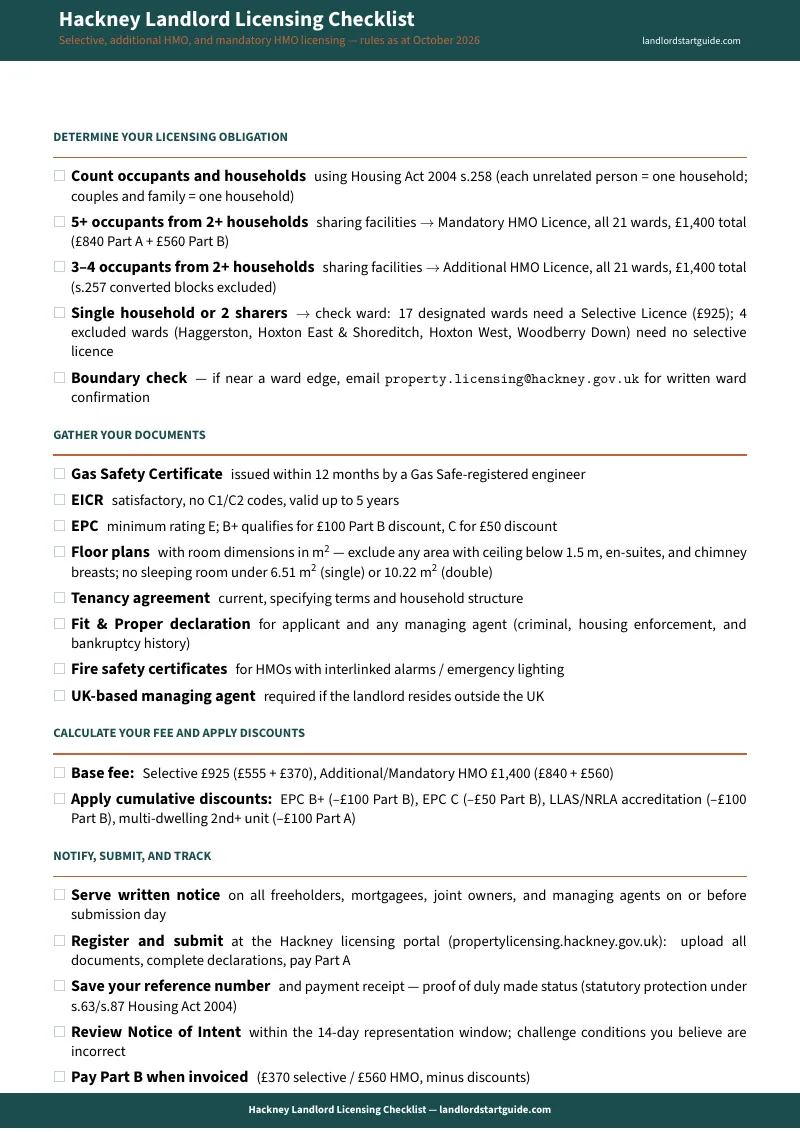
- The dated compliance checklist — a 23-item summary of the steps, forms, fees and deadlines you can print and work through.
- Scheme decision worksheet — work through the occupancy and household test to identify which licence your property needs.
- Room measurement worksheet — record each room's gross dimensions, headroom deductions and net usable area before submitting floor plans.
- Pre-submission document tracker — log every certificate, expiry date and portal reference in one place before opening the portal.
- Fee calculation worksheet — calculate the exact amount after all eligible discounts (EPC, accreditation, multi-dwelling).
- Inspection preparation checklist — walk the property room by room before the council visits, covering HHSRS hazard categories.
- Compliance diary — track ongoing conditions, safety renewals and inspection dates through the full five-year term to 30 April 2031.
All files cover the rules as at October 2026, with direct links to the council pages for ongoing verification.
Satisfaction guarantee
If the guide doesn't help, email [email protected] for a full refund, no time limit. No form to fill in, no questions.
Get started
Download the free checklist to see how the guide is structured. If you want the full pre-flight system — the decision framework, the document tracker, the room measurement worksheet, the fee calculator, the inspection walkthrough and the five-year compliance diary — get the complete kit for .
Frequently Asked Questions
What if the rules change after I buy?
We update the guide when the rules change. Email us any time, even years later, and we'll send you the current edition free.