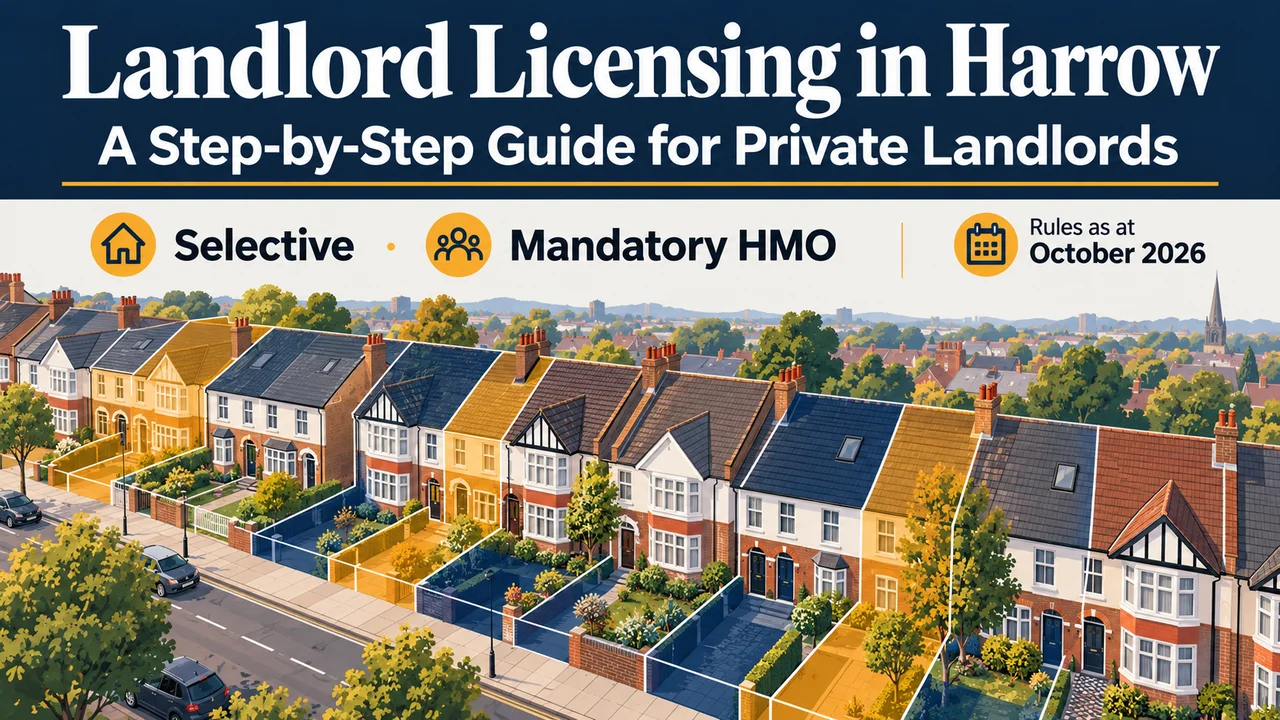
You know Harrow has licensing schemes. You just can't work out which one applies to your property.
Harrow now runs selective licensing across six wards — Edgware, Roxeth, Greenhill, Marlborough, Wealdstone North and Wealdstone South — rolled out in three stages between May and September 2026, plus mandatory HMO licensing borough-wide. The additional HMO scheme expired in August 2026 and no replacement was in force by October 2026. The council's information is spread across multiple web pages, legacy scheme notices, the MyHarrow portal and ward-map PDFs. The penalty for getting it wrong is a civil penalty of up to £40,000, or a Rent Repayment Order where your tenant claims back up to two years of rent.
You have probably spent an evening bouncing between council pages, trying to work out whether your property falls inside a designated selective ward, whether the expired additional HMO scheme still matters, what the two-tier fee split means, and which documents the portal will reject if they are missing. The answers are on public websites — but nobody has put them in one place, in the order you actually need them.
The Harrow Licensing Route Map
This guide is a complete route map through Harrow's licensing schemes — from working out which licence your property needs (or whether it needs one at all) to tracking the conditions for the full five-year term. It replaces the hours of council-page research with a single, step-by-step reference you can print and work through.
It is not legal advice, not a council publication, and not connected with any government body. It is an independent guide that organises the public rules into the order you need them.
Which licence? — answered in one decision tree
A structured decision tree that asks about your property's ward, the number of occupants, the number of households and any exemptions — and tells you whether you need a selective licence (single-household lets in the six designated wards), a mandatory HMO licence (5+ persons forming 2+ households, borough-wide), or no licence at all. It explains why the additional HMO scheme no longer applies and what happens to properties that held one. No more guessing which scheme to start with.
Ward-by-ward selective licensing coverage
Harrow's selective licensing does not cover the whole borough — it applies only in six named wards, each with its own commencement date. The guide lists every ward, its effective date and its designation boundary, and explains how to verify a property's ward using the council's address-checking tools. Landlords with properties near a ward edge get a boundary-checking procedure rather than a vague postcode lookup.
The expired additional HMO scheme explained
Harrow's borough-wide additional HMO licensing scheme expired on 5 August 2026. A renewal consultation ran from December 2025 to February 2026, but no replacement designation was active by October 2026. The guide explains what this means for landlords who held an additional licence, whether selective licensing now applies to their property instead, and the status of Section 257 converted buildings that fell under the scheme.
Every document, in the order the portal asks for it
Gas Safety Certificate (CP12), Electrical Installation Condition Report (EICR), Energy Performance Certificate, dimensioned floor plans showing room areas in square metres, Anti-Social Behaviour management plans, and every fit-and-proper-person disclosure — laid out in a document-preparation matrix so you can assemble the file before you open the MyHarrow portal. No more submission timeouts because you did not have the EICR to hand.
Two-tier fees broken down
Harrow's selective licence fee is £786, split into a £686 Part 1 administration fee paid at submission and a £100 Part 2 management fee paid before the licence is issued. The mandatory HMO fee is £1,900. The guide maps the exact amounts, explains which part is non-refundable, what triggers the Part 2 invoice, and how the fee compares to other London boroughs.
Article 4 Direction — the planning firewall
Harrow's borough-wide Article 4 Direction removed permitted development rights for converting a dwelling into a small HMO (3–6 occupants). Holding a property licence does not grant planning permission. The guide establishes a clear operational firewall between Housing Act 2004 licensing and Town and Country Planning Act rules, so you do not spend money on a licensing application for a conversion that does not have planning consent.
Licence conditions and five-year tracker
What the council expects for the full licence term: annual gas safety renewals, smoke and CO alarm testing, occupancy limits, waste management records, tenant referencing and written-statement obligations. The post-grant tracker gives you the dates and the paperwork, so a routine inspection or a licence renewal does not catch you off guard.
Who this is for
- Private landlords with a rented home or shared house in Harrow who need to work out whether the property needs a licence, which one, and how to apply.
- Small or accidental landlords self-managing one or two properties who want to handle the MyHarrow application themselves instead of paying an agency £500–£1,200 on top of the council fee.
- Landlords whose property sits near a ward boundary who need to confirm whether it falls inside a designated selective licensing area.
- Resident landlords with lodgers who need to check whether the household arrangement triggers HMO definitions under Section 254 of the Housing Act 2004.
Why not just use the council's website?
The council's website is free and you should use it — you need a MyHarrow account to submit the application anyway. What the council does not give you is a single reference that puts the six selective wards, mandatory HMO rules and the expired additional scheme side by side, tells you which one applies to your property, lists the documents in the order the portal asks for them, breaks down the two-tier fee structure, explains the Article 4 planning firewall, and tracks conditions through the licence term. That is what this guide does.
Compared to a fixed-fee licensing agency (typically £500–£1,200 on top of the council fee), this is a fraction of the cost — and you keep full control of your application and your data.
What you get
- The full guide — 12 chapters covering all licensing schemes that have applied in Harrow, the application step by step, documents, the two-tier fees, licence conditions, enforcement and the Article 4 planning firewall (41 pages, PDF, print-ready).
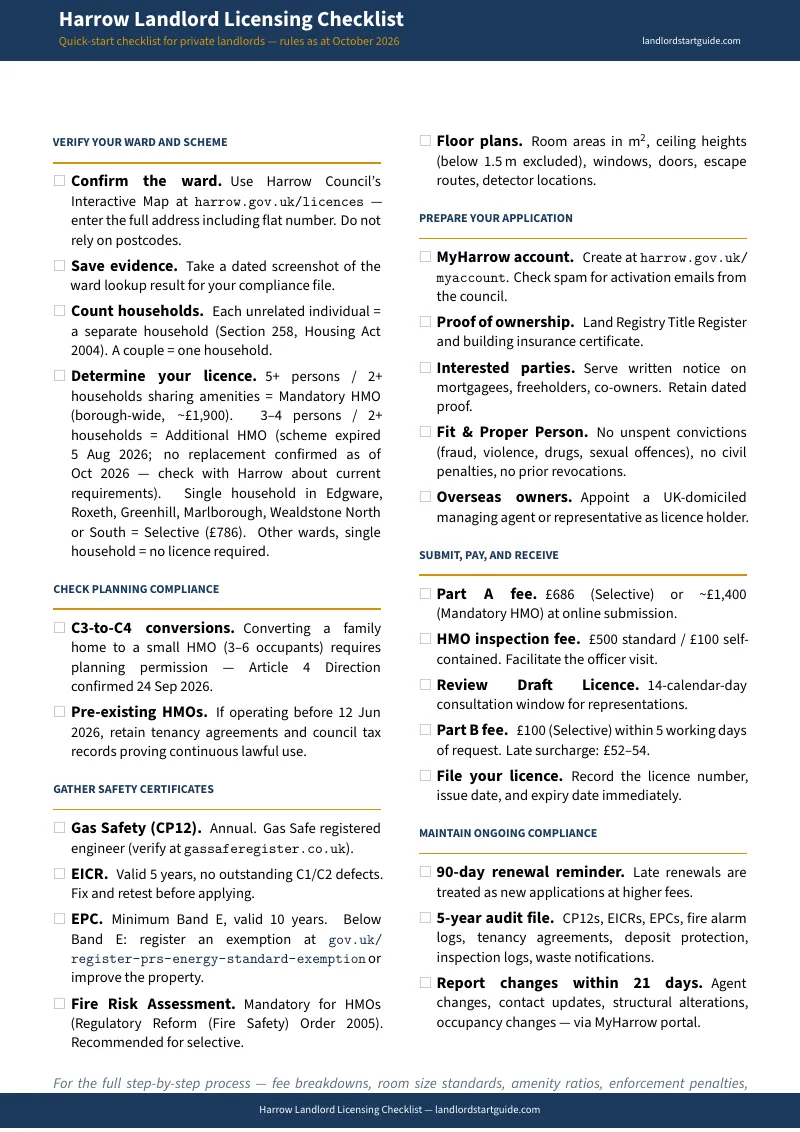
- The dated compliance checklist — a 24-item summary of the steps, forms, fees and deadlines you can print and work through.
- 5 standalone printable tools — a scheme decision worksheet, a pre-submission document checklist with spaces for certificate references and expiry dates, an application progress tracker from submission to final grant, a five-year compliance audit log for ongoing conditions, and a renewal countdown planner with scheme expiry dates and 90-day alerts.
Both files cover the rules as at October 2026, with direct links to the council pages for rechecking.
Satisfaction guarantee
If the guide doesn't help, email [email protected] for a full refund, no time limit. No form to fill in, no questions.
Get started
Download the free checklist to see how the guide is structured. If you want the full route map — the ward decision tree, the document matrix, the two-tier fee breakdown and the five-year compliance tracker — get the complete guide for .
Frequently Asked Questions
What if the rules change after I buy?
We update the guide when the rules change. Email us any time, even years later, and we'll send you the current edition free.