You know Havering has licensing schemes. You just can't work out which one applies to your property — or how much it will cost.
Havering now runs three property licensing schemes at the same time: selective licensing in seven wards (from 18 March 2026), additional HMO licensing borough-wide, and the national mandatory HMO licence. The council's information is spread across designation PDFs, cabinet decision reports, ward maps and the online portal. The penalty for getting it wrong is a civil penalty of up to £40,000, a Rent Repayment Order where your tenant claims back up to 24 months of rent, or a block on Section 21 notices that leaves you unable to end a tenancy.
You have probably spent an evening trying to work out whether your property falls inside one of the seven selective wards, whether a house share with three occupants needs an additional HMO licence or a mandatory one, what the two-stage fee split means, and which documents the portal will reject if they are missing or out of date. The answers exist across council pages, statutory instruments and designation notices — but nobody has put them in one place, in the order you need them.
The Havering Licensing Compliance System
This guide is a complete compliance system for every licensing scheme Havering runs — from identifying which licence your property needs to tracking conditions through to the scheme expiry on 17 March 2031. It replaces the hours of council-page research with a single, step-by-step reference you can print and work through at your own pace.
It is not legal advice, not a council publication, and not connected with any government body. It is an independent guide that organises the public rules into the order you need them.
Which licence? — answered in one decision tree
A structured decision tree that asks about your property's ward, the number of occupants and the number of households — and tells you whether you need a selective licence (single-household lets in the seven designated wards), an additional HMO licence (3–4 persons from 2+ households, borough-wide), a mandatory HMO licence (5+ persons from 2+ households, borough-wide), or no licence at all. No more guessing which scheme to start with, and no risk of paying the wrong Part A fee.
The seven selective licensing wards mapped
Havering's selective licensing does not cover the whole borough — it applies only in Beam Park, Harold Wood, Rainham & Wennington, Rush Green & Crowlands, Squirrels Heath, St Albans and St Edwards. The guide explains the designation boundaries and how to verify a property's ward, so landlords with properties near a ward edge do not assume a selective licence applies when the property sits just outside the boundary — or miss a licence requirement because they assumed the scheme did not reach their street.
Borough-wide additional HMO licensing explained
Havering's additional HMO scheme covers the entire borough — all 20 wards — for properties occupied by three or four people forming two or more households, and for Section 257 converted buildings (older blocks of self-contained flats that do not meet the 1991 Building Regulations standard). The guide explains the occupancy test, the Section 257 definition, and how additional licensing interacts with the selective and mandatory schemes.
Every document, in the order the portal asks for it
Gas Safety Certificate (less than 12 months old), Electrical Installation Condition Report (EICR within 5 years), Energy Performance Certificate, scaled floor plans showing room dimensions, and the Fit and Proper Person declaration — laid out in a pre-submission checklist so you can assemble the file before you open Havering's online portal. The guide covers acceptable file formats and explains the £117.10 paper surcharge for landlords who do not apply online.
Two-stage fees with every discount route
Havering splits each licensing fee into Part A (application processing, non-refundable) and Part B (licence grant). The guide breaks down all three schemes: £950 selective (£570 + £380), £1,400 additional HMO (£840 + £560), and £1,329 mandatory HMO (£1,063 + £266 for up to five lettings, scaling to £2,130 for 20+). It maps every discount — £100 off Part B with approved accreditation (NRLA, LLAS, Propertymark, Safeagent), £75 off selective and additional Part B with an EPC rating of C or above — and explains that mandatory HMO applications carry no accreditation discount.
Article 4 Direction — the planning firewall
Havering's borough-wide Article 4 Direction removed permitted development rights for converting a dwelling into a small HMO (3–6 occupants). Holding a property licence does not grant planning permission, and the council states that licensing fees are non-refundable even if planning permission for an HMO conversion is later refused. The guide establishes a clear firewall between Housing Act 2004 licensing and planning rules.
Enforcement and financial penalties
Civil financial penalties of up to £40,000 per property. Rent Repayment Orders covering up to 24 months of rent. Section 21 notice restrictions. Proceeds of Crime Act confiscation. The guide covers what the council can do if a property is unlicensed, and explains the statutory defence that a pending application creates under Housing Act 2004 s95(3) and s72(4).
Licence conditions and five-year tracker
What the council expects for the full licence term: annual gas safety renewals, smoke and carbon monoxide alarm testing, occupancy limits, waste management and tenant referencing obligations. The post-grant tracker gives you the dates and the paperwork through to the scheme expiry on 17 March 2031, so a routine inspection or a licence renewal does not catch you off guard.
Who this is for
- Private landlords with a rented home or shared house in Havering who need to work out whether the property needs a licence, which one, and how to apply.
- Small or accidental landlords self-managing one or two properties who want to handle the council portal application themselves rather than pay an agency or consultant hundreds of pounds on top of the council fee.
- Landlords whose property sits near a ward boundary who need to confirm whether it falls inside one of the seven selective licensing areas or is covered only by the borough-wide additional scheme.
- Owners of converted buildings or individual flats in older blocks who need to check whether Section 257 rules pull the property into additional HMO licensing.
- Landlords who received a council letter or letting agent compliance notice and need to submit a valid application quickly, before enforcement action starts.
Why not just use the council's website?
The council website is free and you should use it — you need a portal account to submit the application anyway. What the council does not give you is a single reference that puts Havering's three licensing schemes side by side, tells you which one applies to your property, lists the documents in the order the portal asks for them, maps every discount you qualify for, and tracks conditions through the five-year licence term. Council information is scattered across designation PDFs, cabinet reports and static ward maps with no combined workflow.
A single wrong-scheme submission forfeits the Part A fee — £570 for selective, £840 for additional — with no refund. Compared to a fixed-fee licensing consultant (typically £300–£500 on top of the council fee), this guide costs a fraction of the price — and you keep full control of your application and your data.
What you get
- The full guide — 13 chapters covering all three licensing schemes in Havering, the application step by step, documents, the two-stage fees with discount routes, licence conditions, enforcement, the Article 4 planning firewall, and upcoming national changes (44 pages, PDF, print-ready).
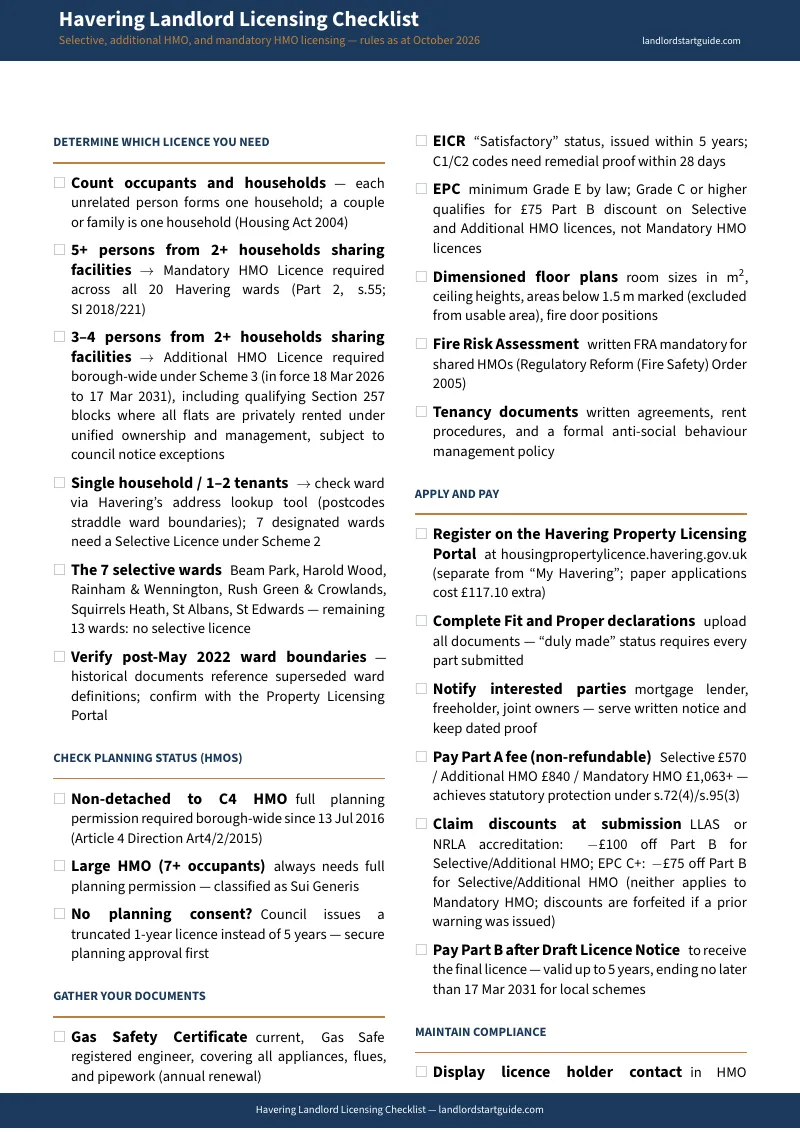
- The dated compliance checklist — a 25-item summary of the steps, forms, fees and deadlines you can print and work through.
- 6 standalone printable tools — a ward and scheme decision worksheet, a portal document preparation checklist with spaces for certificate references and expiry dates, a fee and discount calculator, fit and proper person declaration notes, a licence condition compliance tracker for the five-year term, and an agency communication log.
Both files cover the rules as at October 2026, with direct links to the council pages for rechecking.
Satisfaction guarantee
If the guide doesn't help, email [email protected] for a full refund, no time limit. No form to fill in, no questions.
Get started
Download the free checklist to see how the guide is structured. If you want the full route map — the ward decision tree, the document matrix, the two-stage fee breakdown with every discount and the five-year compliance tracker — get the complete guide for .
Frequently Asked Questions
What if the rules change after I buy?
We update the guide when the rules change. Email us any time, even years later, and we'll send you the current edition free.