You protected the deposit. But can you prove it?
Every self-managing landlord in England knows the 30-day rule. Protect the deposit in an authorised scheme within 30 days of receiving it, or face penalties of one to three times the deposit value under Section 214 of the Housing Act 2004.
But here is what catches landlords out: protecting the deposit is only half the job. You also need to serve the full Prescribed Information package — every required data field, the scheme's explanatory leaflet, served on the tenant and any third-party payer — within that same 30-day window. And you need proof that you did it.
A scheme registration certificate is not proof of service. Emailing a PDF is not proof of service. A tenant's word that they received it is not proof of service. When a Section 214 claim lands, the court asks for a dated, documented trail — and most self-managing landlords do not have one.
The Deposit Compliance Sequence
This is not a summary of the rules you can already find on GOV.UK. It is a step-by-step execution sequence — the Receipt-to-Service Audit Trail — that takes you from the moment deposit funds arrive in your account through scheme registration, Prescribed Information service, mid-tenancy changes, and end-of-tenancy return, in the chronological order the law requires.
The guide is built around a single principle: compliance is a chain, and one weak link breaks it. Every chapter connects to the next. Every worksheet feeds the one that follows. When you reach the end of a tenancy and a deduction dispute lands on your desk, the evidence you need is already organised — because you built it at each step, not scrambled to reconstruct it after the fact.
What's inside
- 30-day compliance timeline — the full execution order from deposit receipt to confirmed service, with exact calendar calculations so you never count from the wrong date
- Deposit cap calculator — work out the five-week and six-week caps under the Tenant Fees Act 2019, including what happens when rent crosses the £50,000 annual threshold mid-tenancy
- Prescribed Information field-by-field index — every data field required by the 2007 Order, mapped to your tenancy agreement's deduction clauses, with notes on the fields that tenants most commonly challenge
- Scheme comparison: DPS, mydeposits, and TDS — custodial versus insured, current fees (including mydeposits' July 2026 membership restructure), and the operational differences that affect which scheme works for your situation
- Proof-of-service log — a dated record template that captures when, how, and to whom you served each document, built to the evidentiary standard a court applies under Section 214
- Agent handover checklist — a structured audit for landlords taking management back from a letting agent, covering scheme transfers, unverified service dates, and missing Prescribed Information
- Dispute evidence framework — organise check-in inventories, check-out reports, invoices, and fair-wear depreciation calculations so your evidence file meets scheme ADR standards before you raise the dispute
- Renters' Rights Act transition notes — how the May 2026 conversion to assured periodic tenancies changes your deposit protection duties for existing and new tenancies
Who this guide is for
- First-time landlords receiving a deposit for the first time and needing to get the full sequence right from day one
- Self-managing landlords who handle compliance themselves instead of paying 8–12% monthly management fees
- Landlords leaving an agency who need to audit the paperwork before they inherit gaps in the compliance chain
- Landlords with periodic tenancies navigating mid-tenancy tenant changes, rent increases, or joint-tenant variations without breaking their protection
Why not just use the free scheme templates?
The three authorised schemes — DPS, mydeposits, and TDS — all provide free Prescribed Information templates when you register a deposit. Those templates generate the certificate. They do not:
- Log proof that you served the full package (certificate, Prescribed Information, scheme leaflet) on every required party within 30 days
- Calculate whether your deposit amount complies with the Tenant Fees Act cap
- Audit the fields in the Prescribed Information against your specific tenancy agreement
- Provide a framework for organising check-in evidence that meets adjudicator standards
- Walk you through what happens when a tenant changes, rent increases, or you switch from an agency to self-management
Free templates tell you what to fill in. The guide shows you how to build the complete compliance chain — and more importantly, how to prove you did.
The cost of getting this wrong
A Section 214 claim for failing to protect a deposit or serve the Prescribed Information correctly carries penalties of one to three times the deposit value. For a deposit of £1,500, that is £1,500 to £4,500 — plus the court orders you to return the full deposit regardless of any damage to the property. The penalty does not require the tenant to prove loss. It is strict liability: the court checks whether the landlord complied with the statute, and if not, awards compensation.
The guide costs a fraction of one penalty claim. It is a one-time purchase — not a subscription, not a membership, not a software licence.
What this guide is not
This is a compliance guide, not legal advice. It explains the statutory requirements and the processes — the steps, deadlines, forms, and evidence standards. It does not advise on possession claims, coach tactics against tenants, or represent anyone in a dispute. It is an independent publication with no connection to HM Government, any local authority, or any of the three deposit protection schemes.
The guide is dated to the rules it describes (rules as at October 2026) and clearly separates current law from upcoming changes. It is not a subscription service — you receive the edition current at purchase.
Satisfaction guarantee
Full refund, no time limit. If the guide does not help you, email [email protected] and we will refund your purchase in full.
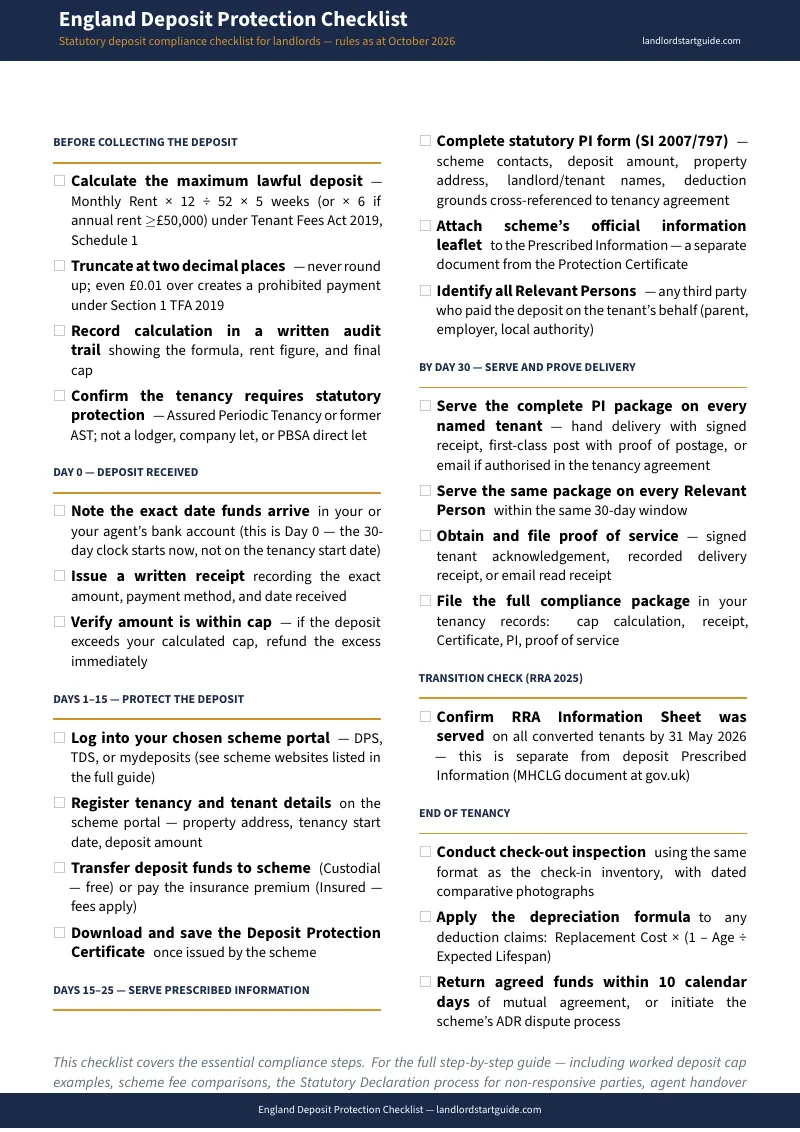
Get the full guide — the complete compliance sequence, 6 printable worksheets and logs, Prescribed Information index, and dispute evidence framework. Or start with the free deposit protection checklist to see the structure before you commit.
Frequently Asked Questions
What if the rules change after I buy?
We update the guide when the rules change. Email us any time, even years later, and we'll send you the current edition free.