Your tenant just asked for a pet — and the clock is already running
Since 1 May 2026, blanket "no pets" clauses in English tenancy agreements are unenforceable. Section 16A of the Housing Act 1988, inserted by the Renters' Rights Act 2025, implies a term into every private assured tenancy that a tenant may keep a pet with the landlord's written consent — and that consent cannot be unreasonably withheld.
The moment you receive a written request, a 28-day statutory response clock starts. Miss it, and you are in breach. Refuse without objective grounds, and the tenant can apply to the County Court for a specific performance order compelling you to allow the pet — with costs awarded against you. Attempt to charge a pet deposit above the 5-week statutory cap, and you face a civil penalty of up to £5,000 under the Tenant Fees Act 2019.
GOV.UK publishes the rules, but it does not publish a workflow. The deadline calculations, the extension triggers, the freeholder consent sequence, and the written decision templates are not on any government website. They are scattered across legislation, tribunal guidance, and deposit scheme FAQs — or they do not exist at all.
The 28-Day Compliance System: every deadline, decision, and document in one workflow
This guide replaces the scavenger hunt with a single, dated compliance system built for self-managing landlords in England. It maps the entire pet request process — from the day you receive the letter to the day you file the written decision — into a printable reference you can work through step by step, without paying a letting agent or a solicitor for routine compliance.
Written in plain English, dated to the rules as at October 2026. It is not legal advice.
What's inside
- Statutory Deadline Calculator — the full 28-day timeline, with worked examples showing exactly how to calculate extension dates for information requests (s. 16A(2)) and superior landlord consent (s. 16A(3)), including scenarios where both extensions overlap
- Reasonable Refusal Framework — objective criteria the law treats as reasonable grounds for refusal (property size, documented medical allergies with clinical evidence, HMO licensing restrictions, headlease prohibitions) and the grounds that fail the statutory test (personal preference, speculative damage, blanket policies, previous tenant history)
- Leasehold Consent Workflow — a step-by-step sequence for flat owners: reviewing headlease covenants, drafting the freeholder consent application, notifying the tenant of the statutory extension, and handling the freeholder's response within the adjusted deadline
- Written Decision Template Suite — pre-drafted response letters covering four outcomes: consent with behavioural conditions, consent subject to freeholder rules, a formal information request, and a written refusal with objective grounds
- Financial Compliance Matrix — the Tenant Fees Act deposit cap (5 weeks' rent for annual rent under £50,000, 6 weeks at or above), why mandatory pet insurance is a prohibited fee, what voluntary insurance arrangements are lawful, and how to structure the check-in inventory for deposit dispute adjudication
- Assistance Animal Decision Tree — how to distinguish a disability assistance animal under the Equality Act 2010 from a standard pet request, and why standard refusal grounds do not apply
- Pet Request Decision Log — a dated record of every communication, deadline, extension trigger, and written decision for your compliance file, ready for tribunal or Ombudsman review
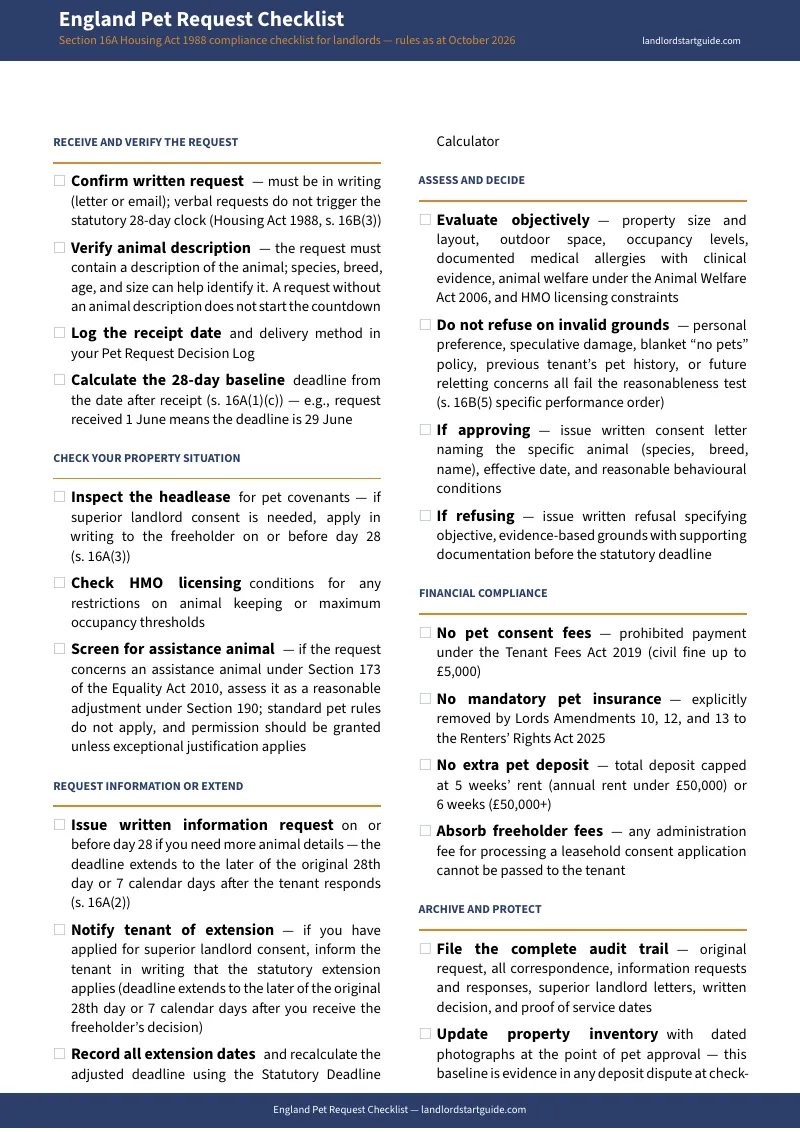
- Compliance Checklist — a printable two-page checklist covering every step from receiving the request to archiving the audit trail, with the statutory references for each item
Who this is for
- Private landlords in England who have received a tenant's pet request (or expect one) and need to know how the process works
- Self-managing landlords with one or a few properties who handle compliance themselves, without a letting agent
- Accidental landlords — you inherited a property, kept a former home, or ended up letting through circumstance — navigating the post-Renters' Rights Act framework for the first time
- Owners of leasehold flats where the headlease restricts or prohibits pets, who need to coordinate freeholder consent within the statutory deadline
Why not use free resources?
The government publishes the law for free. That is not the gap. The gap is that a landlord who receives a pet request must:
- Calculate the 28-day deadline from the exact date of receipt, then recalculate if an extension applies — and the extension rules interact in ways GOV.UK does not explain
- Work out whether the freeholder consent route pauses the tenant clock (it does not — it extends it, and the mechanics are in the statute, not on any guidance page)
- Draft a written refusal that meets the statutory reasonableness standard, without a template or any worked example of what passes and what fails at tribunal
- Verify that no financial arrangement they propose — a higher deposit, mandatory insurance, a consent fee — constitutes a prohibited payment under the Tenant Fees Act
- Build an audit trail strong enough to survive a First-tier Tribunal challenge or an Ombudsman complaint, from a standing start with no forms
The NRLA charges £85 to £110 a year for a membership that includes pet policy guidance and template letters. Letting agents charge £100 to £300 per event — and that excludes freeholder negotiations. Cheap Etsy templates are UK-wide, undated, and regularly conflate English and Scottish rules.
This guide assembles the complete workflow for less than an hour of a letting agent's time — as a one-time purchase you keep and reuse.
Satisfaction guarantee
Full refund, no time limit. If the guide does not deliver what you expected, email [email protected] and you will receive a complete refund.
Get started
Download the free checklist to see the steps at a glance. When you are ready for the full deadline calculator, the refusal framework, the leasehold consent workflow, and the printable planning tools, the complete guide is available for .
Get the Tenant Pet Requests Guide →
Frequently Asked Questions
What if the rules change after I buy?
We update the guide when the rules change. Email us any time, even years later, and we'll send you the current edition free.