
You collect the certificates. But could you prove compliance at the tribunal?
You have a Gas Safety Record in a drawer. An EICR somewhere in your email. The smoke alarms were upgraded — you think — two years ago. And the new damp and mould investigation deadlines? You heard something changed in October 2026 but you are not sure what it means for you in practice.
If a tenant applies to the First-tier Tribunal today with a Form A, can you produce a dated file showing that every element of the repairing standard is met — the alarms, the gas, the electrics, the water, the heating, the food preparation space, the common parts — with the contractor reports to back each one up? Most self-managing landlords cannot. They have the certificates but not the system.
The rules are spread across more than ten government pages, the Housing (Scotland) Act 2006, the Tolerable Standard, three sets of safety regulations, and the Investigation and Commencement of Repair (Scotland) Regulations 2026 that came into force this October. You could spend a weekend compiling them. Or you could follow them in order, in an afternoon.
The Repairing Standard Compliance System
This is not a summary of mygov.scot. It is a structured compliance system that walks you from "what does the repairing standard actually require?" through to "my property file is audit-ready and I know what to do when something goes wrong" — covering every element, every safety check, every contractor verification step, and every statutory deadline in the order you meet them.
Where the government guidance gives you legal definitions, this guide gives you operational steps: what to check, what to ask your contractor, what to keep, and how long you have.
What's Inside
- Every element of the repairing standard mapped out — structure, water supply, sanitary fittings, food preparation space, fixed heating, fire safety, electrical safety, and the March 2024 additions (RCD protection, lead pipes, secure common doors), each with what the tribunal checks and what counts as a fail
- Interlinked alarm compliance — the Tolerable Standard room-by-room rules, which rooms need smoke detectors, which need heat detectors, why they must interlink, how to verify the interlink works, and the battery test logging protocol
- Gas safety verification — the annual Gas Safety Record, the 28-day tenant distribution rule, what to check on the certificate before you pay the engineer, and the record-keeping requirements that survive a tribunal challenge
- Electrical safety audit framework — the five-year EICR cycle, PAT testing for landlord-supplied appliances, RCD protection requirements under the March 2024 additions, and the contractor report audit checklist so you verify the work before you file the certificate
- The Awaab's Law damp and mould action system — the 10-3-5 day framework from the October 2026 regulations: investigate within 10 working days, serve a written summary within 3, commence works within 5, with a timeline log designed to prove compliance if the tenant escalates
- Water safety and legionella — domestic risk assessment, tap temperature checks, cold water tank inspections, lead pipe testing obligations under the 2024 additions, and when you need a specialist versus when a self-assessment is sufficient
- EPC and energy efficiency — the current operative Band E minimum, what it requires in practice, and the clear distinction between today's law and the proposed 2028 Band C target so you do not spend capital on requirements that are still under consultation
- Tenement and common parts protocol — shared roofs, close doors, stairwell lighting, the Tenement Management Scheme, contacting unresponsive co-owners, the council's Section 50 Missing Shares power, and the "reasonable steps" record to prove you did everything within your control
- Tribunal defence preparation — what happens when a tenant submits Form A, the Repairing Standard Enforcement Order (RSEO), the landlord's Form B right-of-entry application, and how to assemble the dated evidence file the tribunal expects
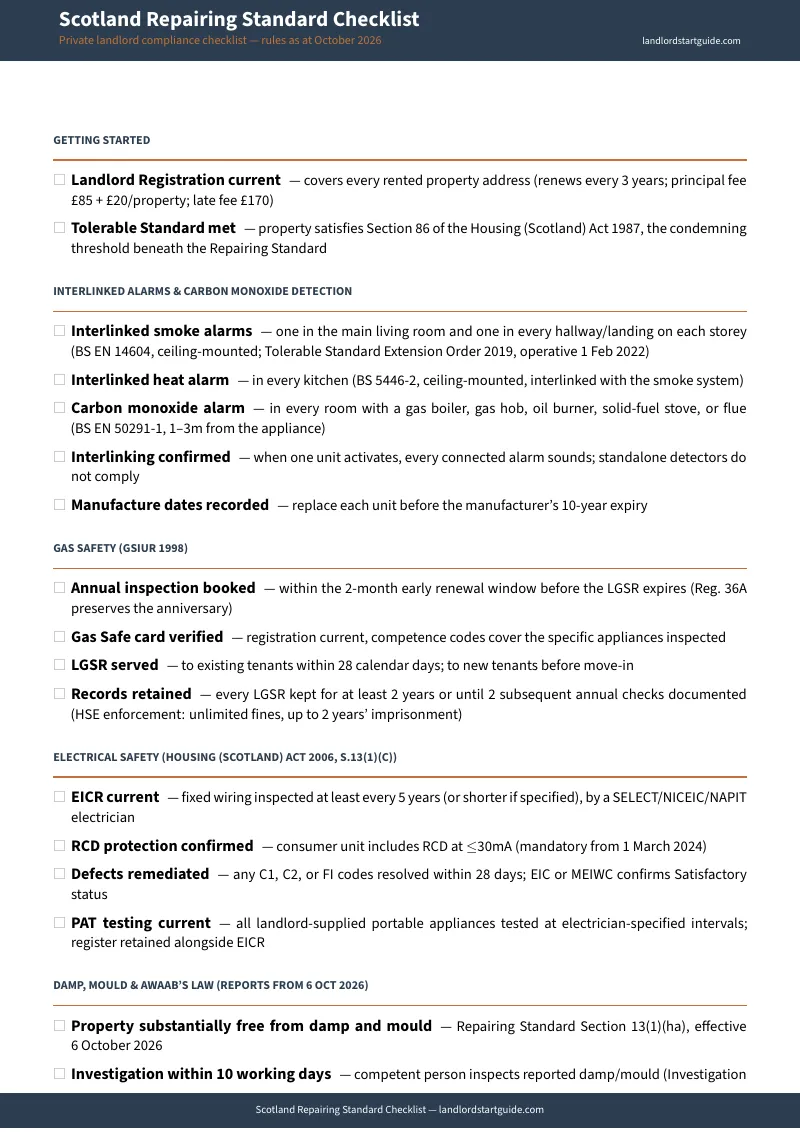
- 25-item dated compliance checklist — every repairing standard obligation in one printable document, dated to the rules as at October 2026, with contractor verification checkpoints and certificate expiry tracking
Who This Is For
- Self-managing landlords who collect certificates from trades but have never assembled them into a structured compliance file — and who would not know what was missing until a tenant or council officer asked
- Accidental landlords letting a former home or inherited property who need to understand what compliance involves beyond "get a gas check and some smoke alarms"
- Landlords approaching a deadline — an EICR renewal, a Gas Safety Record expiry, or a triennial landlord registration where the safety declarations assume your records are in order
- Flat owners in shared tenements who need to coordinate common repairs with other owners and prove they took reasonable steps when co-owners refuse to act
- Landlords using a letting agent who want an independent audit framework — because under Scottish law, the property owner is personally liable for non-compliance, not the agency
- Anyone who received a damp or mould complaint and needs to understand the new October 2026 investigation and repair timelines before the statutory clock runs out
Why Not Just Use the Free Government Pages?
You should. The Scottish Government guidance, the mygov.scot pages, and the First-tier Tribunal forms are all free and should be consulted. This guide does not replace them.
What those pages do not give you is a system. They tell you that an EICR must be renewed every five years but not how to verify that the electrician actually tested the RCD trip times. They explain the 28-day gas safety distribution rule but not what to check on the certificate before you pay the invoice. They publish the new damp investigation timelines but not a dated log to prove you met them. And the Tolerable Standard alarm requirements, the March 2024 additions, the common parts rules, and the tribunal enforcement process are on separate pages that never connect into one operational sequence.
The Scottish Association of Landlords covers compliance across a range of topics — behind a £115+/year membership. A letting agency compliance audit runs £100–£300, and the agency still expects to convert you to a fully managed contract. This guide costs a fraction of either, covers the repairing standard specifically, and you keep it permanently.
What You Get
- guide.pdf — the full guide covering every element of the repairing standard, the safety checks it requires, contractor verification steps, the Awaab's Law timelines, and tribunal enforcement, dated to October 2026
- checklist.pdf — the 25-item dated compliance checklist as a standalone printable, with contractor verification checkpoints
- compliance-calendar.pdf — a 12-month tracker for every certificate expiry, inspection due date, and alarm replacement milestone
- contractor-verification-checksheet.pdf — a one-page audit tool to verify your LGSR, EICR, or PAT report before you pay the invoice
- damp-mould-response-log.pdf — the Awaab's Law 10-3-5 timeline tracker with fields for investigation findings, statutory deadlines, and exceptional circumstances
- common-parts-communication-log.pdf — a tenement shared-repair evidence log for co-owner correspondence and Section 50 escalation
- tenant-access-request-record.pdf — tracks every access notice, tenant response, and the escalation path to a Form B tribunal application
- pre-tenancy-safety-handover.pdf — a move-in sign-off sheet confirming alarms, certificates, and property condition at each tenancy start
- annual-compliance-review.pdf — a yearly self-audit covering every repairing standard element, designed to catch gaps before they become tribunal applications
All 9 files are yours permanently. No subscription, no recurring fee, no membership portal to maintain.
Satisfaction Guarantee
Full refund, no time limit. If the guide does not help you, email [email protected] and you get your money back. No form, no questions.
The repairing standard does not wait for you to learn it. Every week without a structured compliance file is a week where a tenant complaint, a council inspection, or a tribunal application finds you unprepared. The guide is ready now. Your property file can be, too.
Get the Scotland Repairing Standard Guide →
Already have the free checklist? Upgrade to the full guide for the complete compliance system, contractor verification checklists, and Awaab's Law timeline logs.
Frequently Asked Questions
What if the rules change after I buy?
We update the guide when the rules change. Email us any time, even years later, and we'll send you the current edition free.