You received the deposit. Now what?
A tenant hands you a deposit alongside their first rent payment. You know it needs to go into an approved scheme, but the clock is already ticking — and the rules are not as simple as "just lodge it."
You have 30 working days (not calendar days) to lodge the money with one of three approved custodial schemes and serve the tenant a specific package of prescribed information. Miss either deadline, and the tenant can apply to the First-tier Tribunal for Scotland for a penalty of between one and three times the deposit — strict liability, no excuses accepted.
Most landlords know the broad outline. What trips them up is the detail: how to count working days when Scottish public holidays intervene, how to prove the tenant actually received the prescribed information, what to do when a joint tenant leaves mid-tenancy and the scheme record needs updating, and how to assemble evidence at checkout that will survive a scheme adjudicator's scrutiny.
The Deposit Compliance System
This is not a summary of the law — it is a chronological compliance system that walks you through every step from the moment you receive deposit money to the day you return it or defend a deduction.
Where government websites scatter the rules across multiple portals and approved schemes only explain their own portal, this guide puts the whole process in one dated document with auditable checklists at every stage. You will know exactly what to do, when to do it, and how to prove you did it.
What's Inside
- Working-day deadline calculator — count the 30-working-day window correctly, including Scottish public holidays, so you never accidentally run over
- Scheme selection comparison — SafeDeposits Scotland, Letting Protection Service Scotland, and mydeposits Scotland side by side: registration steps, payment methods, and portal differences
- Prescribed information protocol — the exact items you must serve, how to serve them, and how to create an auditable proof-of-delivery record that stands up at tribunal
- Joint tenant variation record — step-by-step instructions for when a tenant leaves or is replaced mid-tenancy, including how to update the scheme and re-serve information without breaking compliance
- Checkout evidence log — structure your end-of-tenancy inspection, cross-reference against the check-in inventory, categorise fair wear and tear, and build an evidence file that scheme adjudicators actually accept
- Deduction itemisation guide — how to propose deductions, what documentation each category requires, and how to handle the scheme's dispute process without losing by default
- Tribunal penalty reference — what happens if a tenant applies under Rule 103, the factors tribunals weigh, and how systematic record-keeping from day one is your best protection
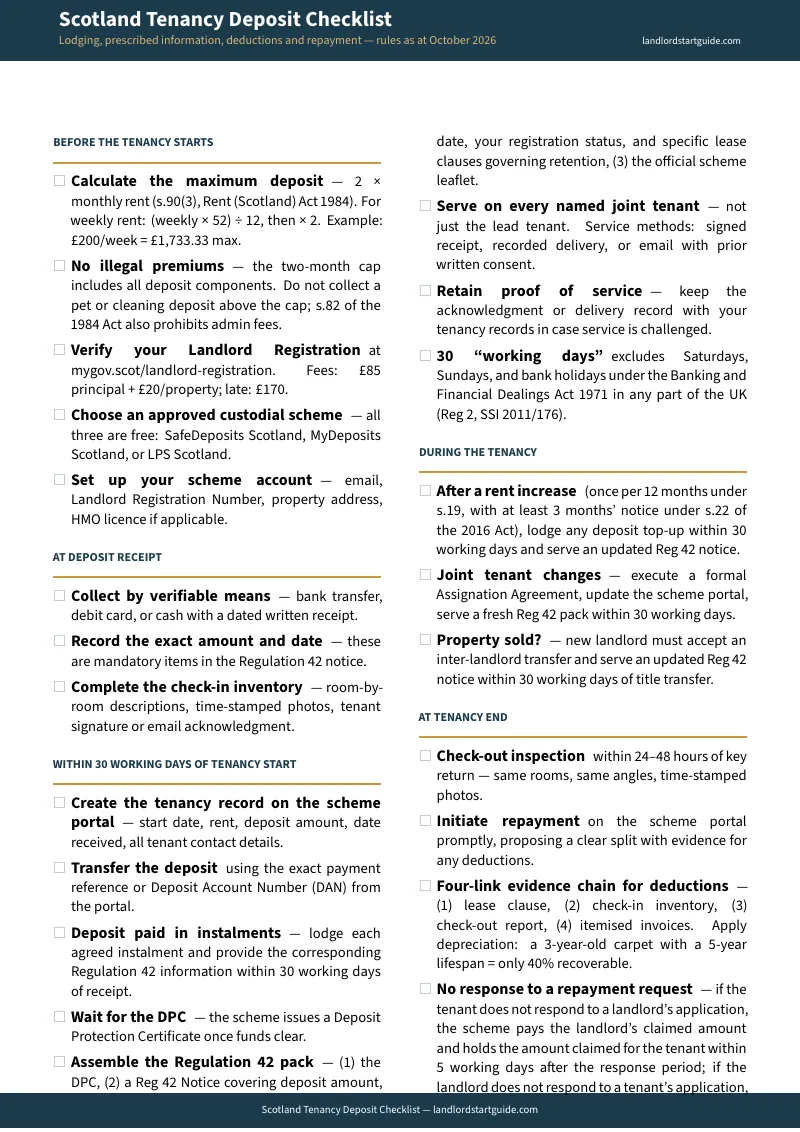
- Dated compliance checklist — a printable, phase-by-phase checklist covering the deposit's entire lifecycle, from receipt to return
Who This Guide Is For
- Private landlords in Scotland who self-manage one or two properties and need to handle deposit compliance themselves
- Accidental landlords who inherited a property or relocated and are letting for the first time
- Landlords who use a letting agent but want to verify the agent has actually complied — because the tribunal penalty falls on you, not the agent
- Landlords with a tenant already in place who want to check their records are watertight before a checkout or dispute
Why Not Just Use the Free Resources?
The Scottish Government, the three approved schemes, and housing charities all publish useful information — and we link to them throughout the guide. The problem is not that the information does not exist. The problem is that it is scattered across a dozen websites, written from different perspectives (schemes explain their portal, charities explain tenant rights, the government explains the statute), and none of it connects into a single operational workflow.
A landlord who reads MyGov.scot will learn the 30-working-day rule. They will not learn how to build a signed proof-of-service file, manage a joint tenant departure without invalidating their protection, or structure a checkout report to survive adjudication. That is the work this guide does — it takes every fragment and puts it in order, with the compliance tools you actually need at each stage.
The Alternative Costs More
The Scottish Association of Landlords charges £135 per year for a membership that includes a compliance helpline. A full-service letting agent charges 8% to 15% of the monthly rent plus one-off fees for tenant-find and inventory. This guide is a one-time purchase — no subscription, no ongoing percentage — and it equips you to handle deposit compliance independently, for this tenancy and every one after it.
Satisfaction Guarantee
Full refund, no time limit. If the guide does not help, email [email protected] and you will get your money back.
Get Started
Download the free Scotland Tenancy Deposit Checklist to see the deadline calculator, scheme links, and prescribed information items — or get the full guide for the complete compliance system, evidence templates, and mid-tenancy procedures.
The price of non-compliance is up to three times the deposit. The price of this guide is .
Frequently Asked Questions
What if the rules change after I buy?
We update the guide when the rules change. Email us any time, even years later, and we'll send you the current edition free.