
One Rounding Error Voids the Entire Increase
You calculated the percentage, filled out the form, and mailed the notice. But the Rental Office rejects it — you rounded up to the nearest dollar, or the notice landed a day late, or you raised rent on a new tenant without checking the unit's lawful base. The tenant keeps paying the old amount, and you restart a three-month clock you thought was already running.
Prince Edward Island's rent increase rules are straightforward once you see them in order, but the PEI Rental Office scatters them across form download pages, rate announcement PDFs, and separate statutory guides. The annual allowable guideline, the unit-attached rent control, the Form 8 requirements, the three-month notice window, the Section 100 mailing deeming buffer, and the above-guideline Form 9/10 route are all governed by different sections of the Residential Tenancy Act — and getting any one of them wrong voids the increase entirely.
The PEI Rent Compliance Sequence
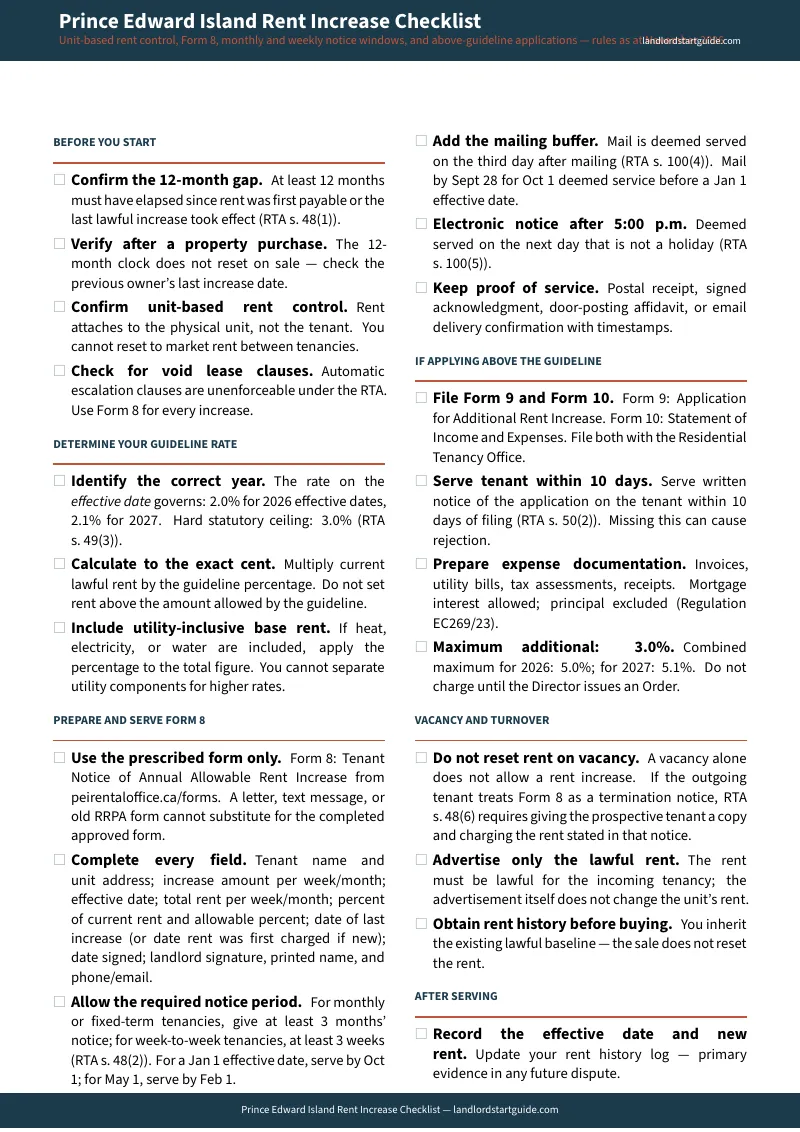
This guide puts the entire process in the order you complete it: a single workflow from verifying your unit's lawful base rent through to building a service record that holds up if the tenant files a Form 2A dispute. Instead of cross-referencing multiple government pages, IRAC decisions, and raw statutory text, you follow one dated sequence with the cent-exact calculation math and calendar timing already worked out.
It covers the in-force 2026 rules (2.0% annual allowable guideline) and the published 2027 rate (2.1%, effective for increases taking effect January 1, 2027 onward), with worked examples showing how the three-month notice window and the Section 100 mailing deeming rule interact.
What's Inside
- Cent-exact calculation matrix — step-by-step formula for applying the 2026 (2.0%) and 2027 (2.1%) guidelines precisely to the cent, because rounding up even a few dollars creates an illegal increase a tenant can challenge at the Rental Office
- Historical base rent log — a template for tracking the lawful rent attached to each unit across tenancy changes, because PEI's rent control follows the unit, not the tenant, and raising rent on a new tenant above the lawful base exposes you to repayment orders under Form 2A
- Form 8 field-by-field walkthrough — every field explained with the common errors that get notices rejected, including the prescribed-form mandate that invalidates notices served on generic letterhead or legacy forms from the repealed Rental of Residential Property Act
- Notice service calendar with mailing deeming buffer — worked calendar examples showing the latest date you can serve notice for a specific effective date, incorporating the three-day mailing deeming rule under Section 100 that catches landlords who mail the notice without building the buffer into their timeline
- Above-guideline increase framework (Form 9 and Form 10) — the expense categories the Director evaluates, the three-year financial comparison, the statutory cap on combined increases, and the mandatory ten-day deadline for serving Form 9 on the tenant after filing with the Rental Office
- Unbundling rules — why shifting utility costs to tenants without a tribunal order counts as an illegal rent increase under the Act, and the proper process for changing included services
- Dispute preparation — what happens when a tenant files a Form 2A dispute, what evidence the Rental Office expects at a hearing, and the IRAC appeal route
- 5 printable worksheets — a rent increase history log, a notice service calendar with the Section 100 mailing deeming buffer, a Form 8 completion checklist, an above-guideline expense organizer for Form 10, and a 10-day service countdown tracker for Form 9 applications
Who This Is For
You're a private landlord in Prince Edward Island — you own a house, an apartment, or a secondary suite and you manage it yourself. You're not paying 5–10% of gross rent to a property management company, and you don't have in-house compliance staff. You need to raise the rent, and you need it done right the first time.
This guide is not for corporate property managers, not for tenants, and not for landlords looking for tactics against tenants. It covers the lawful process for increasing rent under the Residential Tenancy Act — the steps, the forms, the deadlines, and the calendar math.
Why the Free Resources Aren't Enough
The PEI Rental Office website hosts every prescribed form for free, and you should download Form 8 from there regardless. What the government portal does not provide is an integrated workflow. The annual allowable guideline is on one page, the mailing deeming rules are on a separate service information sheet, the above-guideline application forms have no line-by-line filling instructions, and the unit-attached rent control rule is stated without a template for tracking base rents across ownership transfers. You're left to cross-reference them yourself, calculate the cent-exact math on your own, and hope you haven't missed a step that voids the increase months later.
The free checklist covers what to do — the steps, forms, and deadlines at a glance. The full guide covers how — with worked examples, cent-exact calculation tables, the Form 8 walkthrough, and preparation worksheets for each filing.
Satisfaction Guarantee
Full refund, no time limit. If the guide doesn't help, email [email protected] and we'll refund you — no questions, no deadline.
Get Started
Download the free Prince Edward Island Rent Increase Checklist to see every step at a glance. When you're ready for the full process — the cent-exact calculation matrix, the Form 8 walkthrough, the calendar math with mailing deeming buffers, and 5 printable worksheets — get the complete guide for .
Frequently Asked Questions
What if the rules change after I buy?
We update the guide when the rules change. Email us any time, even years later, and we'll send you the current edition free.