
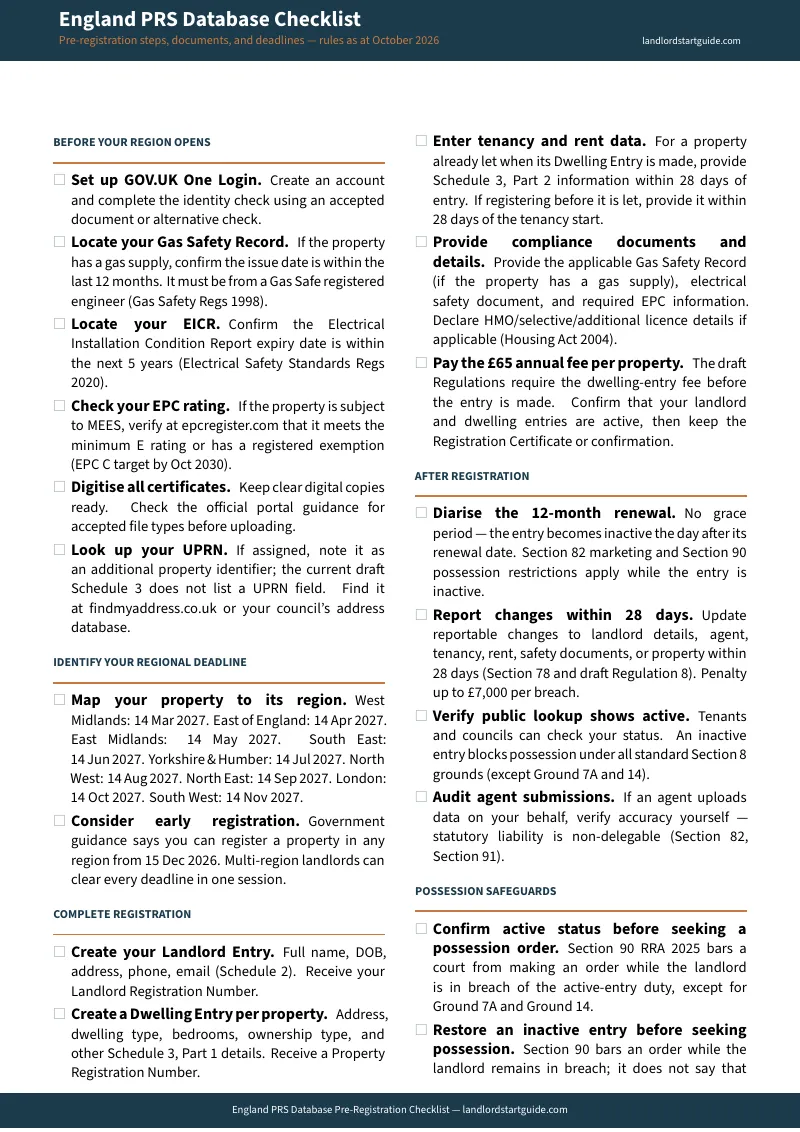
The database opens in December 2026. An unregistered landlord cannot serve a valid possession notice.
The Private Rented Sector Database is the biggest change to landlord record-keeping since deposit protection. Every private residential landlord in England must create a personal Landlord Entry, register each rented property as a Dwelling Entry, pay the £65 annual fee per property, and keep every record updated within 28 days of any change — or face civil penalties of up to £7,000 per offence, an absolute bar on Section 8 possession notices, and Rent Repayment Orders of up to 24 months' rent.
The registration portal opens region by region from 15 December 2026 (West Midlands first, London in July 2027, South West last in August 2027). Councils will cross-reference the database against council tax records to identify unregistered properties automatically. There is no grace period, no extension, and no exemption for landlords who did not know.
The Registration Readiness System: one document, every step, every deadline
This is not a summary of the Renters' Rights Act. It is a Registration Readiness System — a single, dated reference that takes you from "I know I need to register" to "every property is registered, every document is uploaded, and my 28-day update schedule is locked in." It organises the entire process into the order you will actually do it, with the documents, the forms, the fees, and the audit trail to prove compliance if a council investigates.
You get 13 chapters, a 25-item dated compliance checklist, and 8 standalone printable worksheets — a document readiness audit, registration tracker, 28-day update log, agent delegation checklist, fee calculator, regional deadline planner, entity structure decision tree, and regulatory separation chart — all in one download, not scattered across GOV.UK, legislation.gov.uk, and 40 different council websites.
What is inside
- The registration duty and the possession bar — who must register, what properties are in scope, the hard legal link between database compliance and the right to serve Section 8 notices, and the consequences of letting an entry lapse
- Entity structures and exemptions — how to set up your Landlord Entry as a sole owner, joint owner, limited company SPV, or trust, which entities are exempt, and how to avoid duplicate fees on jointly owned properties
- The 9-region rollout timetable — every regional window from West Midlands (December 2026) to South West (August 2027), when voluntary registration opens, and how to plan your submission around the mandatory deadline for your region
- Step-by-step registration walkthrough — creating a GOV.UK One Login account, completing the Landlord Entry, adding Dwelling Entries, uploading safety certificates, and making the final submission — in the exact order the portal presents them
- The fee structure with worked examples — the free Landlord Entry, the £65 per-property Dwelling Entry fee, portfolio alignment for renewal dates, and worked cost calculations for 1, 3, and 6 properties
- 28-day update obligations — which changes trigger the 28-day clock (safety certificates, rent amounts, tenancy changes, agent appointments), how to log them, and the penalties for missing the window
- Data access tiers — what tenants, councils, and the public can see on your entry, and what remains restricted to enforcement officers
- Enforcement penalties — the £7,000 and £40,000 civil penalty tiers, the absolute possession bar, 24-month Rent Repayment Orders, and how councils escalate from warning to prosecution
- Parallel regulatory schemes — a side-by-side separation chart showing how the national database interacts with selective licensing, additional licensing, HMO licensing, the Landlord Ombudsman, deposit protection, and EPC/MEES requirements
- Letting agent audit checklist — which tasks an agent can do on your behalf, which tasks you must do personally, and a verification log for managed properties so you can audit without duplicating work
- Five practical scenarios — a new letting, a mid-tenancy registration, a jointly owned property, a property managed by an agent, and a portfolio with mixed regional deadlines — each walked through end to end
- 8 standalone printable worksheets — document readiness audit, registration and renewal tracker, 28-day update log, agent delegation audit, fee calculator, regional deadline planner, entity structure decision tree, and regulatory separation chart — print what you need, fill in your details, and file with your tenancy records
Who this is for
- Self-managing landlords in England with one property or a small portfolio who want to handle registration themselves without paying an agent £100–£250 per property
- Accidental landlords who kept a former home or inherited a property and have never registered anything with a national database before
- Landlords using a letting agent who want an independent audit tool to verify what the agent is actually doing versus what they say they are doing
- Joint owners, SPV directors, and trust landlords who need to understand how the two-tier entry system applies to their ownership structure
Why not free resources?
Every statutory text, every government guidance page, and every official form is free — and always will be. This guide links to all of them.
The problem is not access. The problem is assembly and verification. The Renters' Rights Act runs to 271 pages. The draft PRS Database Regulations 2026 are a separate statutory instrument. The rollout dates are announced in MHCLG policy papers. The fee structure is in one regulation, the update obligations in another, and the possession bar in a third. Local council sites describe their own selective licensing schemes but blur the line with the national database — and forums are full of landlords who think a selective licence exempts them from registration.
A self-managing landlord researching how to register a jointly owned property has to navigate the Act, the draft regulations, the GOV.UK portal guidance, the NRLA interpretation, and the LandlordZONE forum discussion — then work out the correct structure, the fees, and the deadlines. The Registration Readiness System puts all of that in a single document, in execution order, with the worksheets to track it.
Dated to the rules it describes
Landlord law in England is changing in stages. This guide carries a clear "rules as at" stamp and separates every duty into three categories: in force under Phase 1 of the Renters' Rights Act (since 1 May 2026), enacted under the draft PRS Database Regulations 2026, and announced but not yet commenced. When the portal opens or the regulations are amended, you can see at a glance which chapters are live and which are still pending.
Full refund, no time limit
If the guide does not help you register your properties correctly, email [email protected] and we will refund you in full. No form, no deadline, no questions.
The free checklist gives you the steps. The full guide gives you the process, the documents, the deadlines, the worksheets, and the audit trail — everything a private landlord in England needs to be registered and compliant before the database becomes mandatory in your region.
Frequently Asked Questions
What if the rules change after I buy?
We update the guide when the rules change. Email us any time, even years later, and we'll send you the current edition free.