One wrong line on Form 3A and the judge throws it out
Section 21 is gone. Since 1 May 2026, every private tenancy in England is periodic and the only route to possession is Section 8 — a system built for contested claims, where tenant defence strategies focus almost entirely on tearing apart the notice you served.
A ground number in the wrong format. A deemed service date calculated one day short. A deposit that was protected on day 31 instead of day 30. Any of these gets your possession claim dismissed, and you start again: fresh notice, fresh notice period, fresh court filing fee.
The government publishes Form 3A for free, but the form is blank. The statutory ground wording you must transcribe into Question 4.2 is in a separate PDF. The deemed service rules are in the Civil Procedure Rules. The deposit and licensing checks that must pass before you serve are scattered across five different government websites. Miss one prerequisite and the court dismisses your claim before it reaches a hearing.
The Notice Compliance System: everything assembled in the order you need it
This guide replaces the scavenger hunt with a single, dated workflow. It maps every post-1 May 2026 possession ground, every notice period, every prerequisite check, and every service rule into one printable reference — so you can verify your notice is valid before you serve it, not after a judge tells you it is not.
Written for private landlords in England who manage one or two properties themselves, the guide assumes no legal training. It explains what the law requires and how the process works, in plain English, dated to the rules as at October 2026.
What's inside
- Complete ground-by-ground matrix — every mandatory and discretionary ground in Schedule 2 after the Renters' Rights Act, with the exact notice period, evidence requirements, and restrictions for each. No more cross-referencing legislation and guidance notes.
- Pre-formatted statutory ground text — the full wording the law requires you to copy into Question 4.2 of Form 3A, ready to transcribe. GOV.UK publishes this in a separate lookup PDF; the guide puts it where you need it, ground by ground.
- Pre-Notice Compliance Audit Worksheet — a dated checklist of every prerequisite that must be satisfied before you serve: tenancy deposit protection, prescribed information, property licensing, the Government Information Sheet, and (from December 2026) PRS Database registration. A single failed deposit or (once live) database check bars a possession order on most grounds.
- Form 3A Completion Checklist — a field-by-field check against the live GOV.UK form, including Question 4.2 (full statutory ground wording) and the earliest court proceedings date.
- Service Log and Deemed Service Calculator — write-in tables for postal and hand delivery that tell you when the notice is deemed served and when the earliest court application date falls, plus a proof-of-service record (method, date, time, witness, tracking) for each named tenant.
- Re-Letting Restriction Log — if you serve Ground 1 (moving back in) or Ground 1A (selling), the law bans you from marketing or re-letting the property for 12 months from the earliest court application date on the notice. The log records that window so you do not breach it accidentally and face a civil penalty of up to £7,000.
- Court Filing Checklist — what happens if the tenant does not leave after the notice expires: which court form to use (N5 paper filing or Possession Claim Online), when PCOL is restricted to rent grounds only, the filing fees, and the trial-bundle documents to file.
Who this is for
- Private landlords in England who need to end an assured periodic tenancy — whether you are selling the property, moving a family member in, or dealing with rent arrears or a tenancy that is not working
- Self-managing landlords with one or two properties who handle notices and compliance themselves, without a letting agent
- Accidental landlords — you inherited a property, kept a former home, or ended up letting through circumstance — and need to navigate the post-Section 21 framework for the first time
- Landlords who used Section 21 before and need to understand why the Section 8 process is fundamentally different
Why not use free resources?
The government publishes the forms and the law for free. That is not the gap. The gap is that a landlord completing Form 3A must:
- Download the blank form from GOV.UK
- Find a separate PDF of statutory ground wording and transcribe it word for word into Question 4.2 — a miscopied phrase makes the notice defective
- Check deposit protection status across three different scheme websites, then verify prescribed information was served within 30 days
- Look up whether the property needs a selective, additional, or HMO licence on the local council's register
- Calculate deemed service under Civil Procedure Rules to work out the earliest court application date
- Confirm whether Possession Claim Online accepts the ground or whether a paper N5 filing is required
Advice charities like Shelter and Citizens Advice are funded to help tenants, not landlords. The NRLA charges £125 a year for a membership subscription. Letting agents charge £150 to £350 plus VAT for a single notice — and that excludes court filing fees or representation if the tenant defends.
This guide assembles everything into one printable workflow for the cost of less than an hour of a letting agent's time.
Satisfaction guarantee
Full refund, no time limit. If the guide does not deliver what you expected, email [email protected] and you will receive a complete refund.
Get started
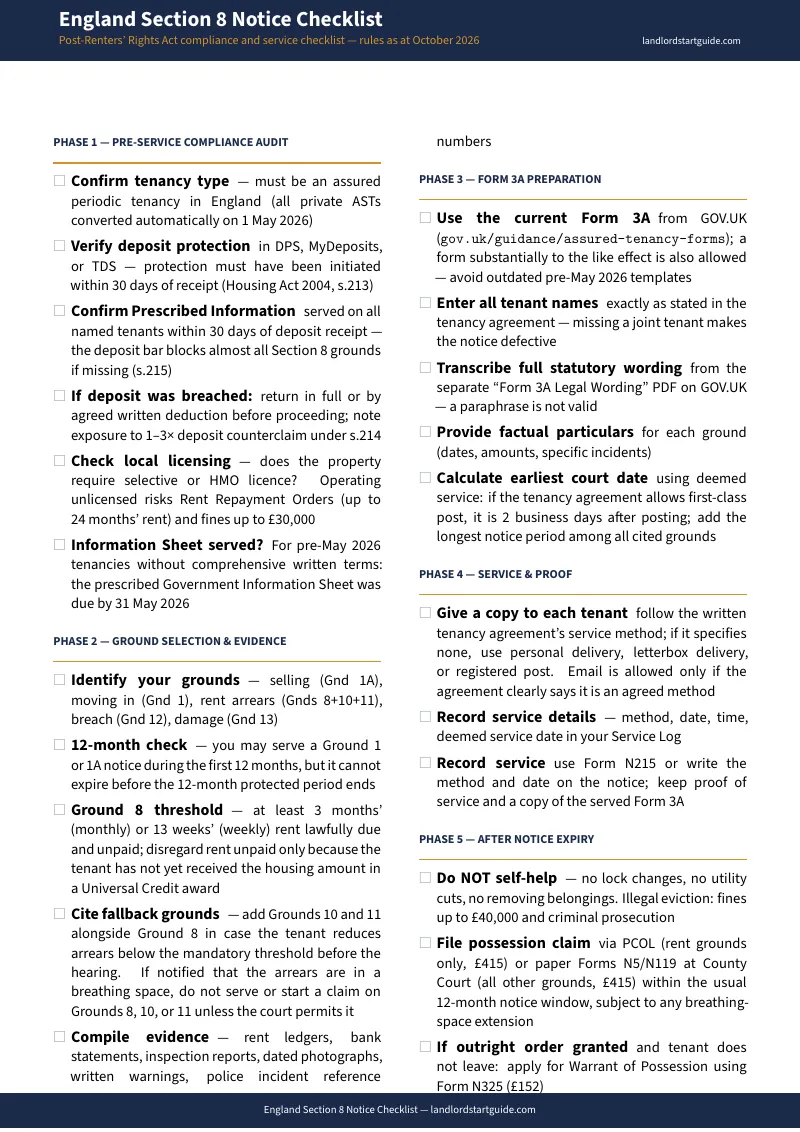
Download the free checklist to see the steps at a glance. When you are ready for the full ground-by-ground breakdown, the Form 3A checklist, the service calculator, and the printable logs, the complete kit is available for .
Get the Section 8 Notice Guide →
Frequently Asked Questions
What if the rules change after I buy?
We update the guide when the rules change. Email us any time, even years later, and we'll send you the current edition free.