The Bond Lodgement Deadline That Catches Every Self-Managing Landlord
You collected the bond. You issued the receipt. And then life happened — a busy fortnight, a confusing government portal, an assumption that "it'll be fine for now." In South Australia, that assumption carries a maximum fine of $25,000 and a $1,200 on-the-spot expiation fee for late lodgement. The law gives private landlords exactly 14 days to transmit the bond to Consumer and Business Services via Residential Bonds Online. No extensions. No grace period.
And that's just the lodgement deadline. Between the bond cap calculation (which changes at the $800 weekly rent threshold), the 48-hour receipting rule, the Regulation 4 condition report, tenant direct lodgement rights, and the end-of-tenancy claim process — there are dozens of statutory steps where a missed detail or confused deadline can cost you thousands in penalties or a lost bond claim at SACAT.
The Bond Compliance System: Every Step in the Right Order
The Rental Bonds in South Australia guide is a complete bond compliance system for self-managing landlords — not a summary of the law, but an operational framework that puts every step, form, deadline and decision in the order you actually encounter them.
Where free government pages tell you what the rules are, this guide shows you how to follow them: with worked calculations, portal walkthroughs, printable tracking worksheets and a Refund and SACAT Evidence Checklist for end-of-tenancy claims. It reflects South Australian law as at October 2026, including every reform since the 2024 amendments.
What's Inside
- Bond Cap Calculation Worksheet — fill-in formula for the four-week and six-week caps at the $800 weekly rent threshold, plus the 48-hour receipt and 14-day lodgement dates (demanding more than the cap is an offence with a $25,000 maximum fine)
- Lodgement Confirmation Checklist — receipt contents, RBO transmission, confirmation-email archive and CBS Bond Number, so the 14-day window is never missed
- RBO portal walkthrough — step-by-step field explanations for creating your account, lodging a bond, verifying tenant direct lodgements and linking historical paper bonds
- Condition Report Evidence Index — Regulation 4 inspection-sheet dates, room-by-room photo catalogue and interim maintenance log, so the baseline stands up at SACAT
- Refund and SACAT Evidence Checklist — mutual release through RBO versus a contested claim, the 14-day Notice of Claim window, and the evidence bundle structure that tribunals expect
- Tenant Variation and Bond Transfer Log — co-tenant changes, ownership transfers and bond top-ups, so the CBS record stays accurate in RBO without releasing security prematurely
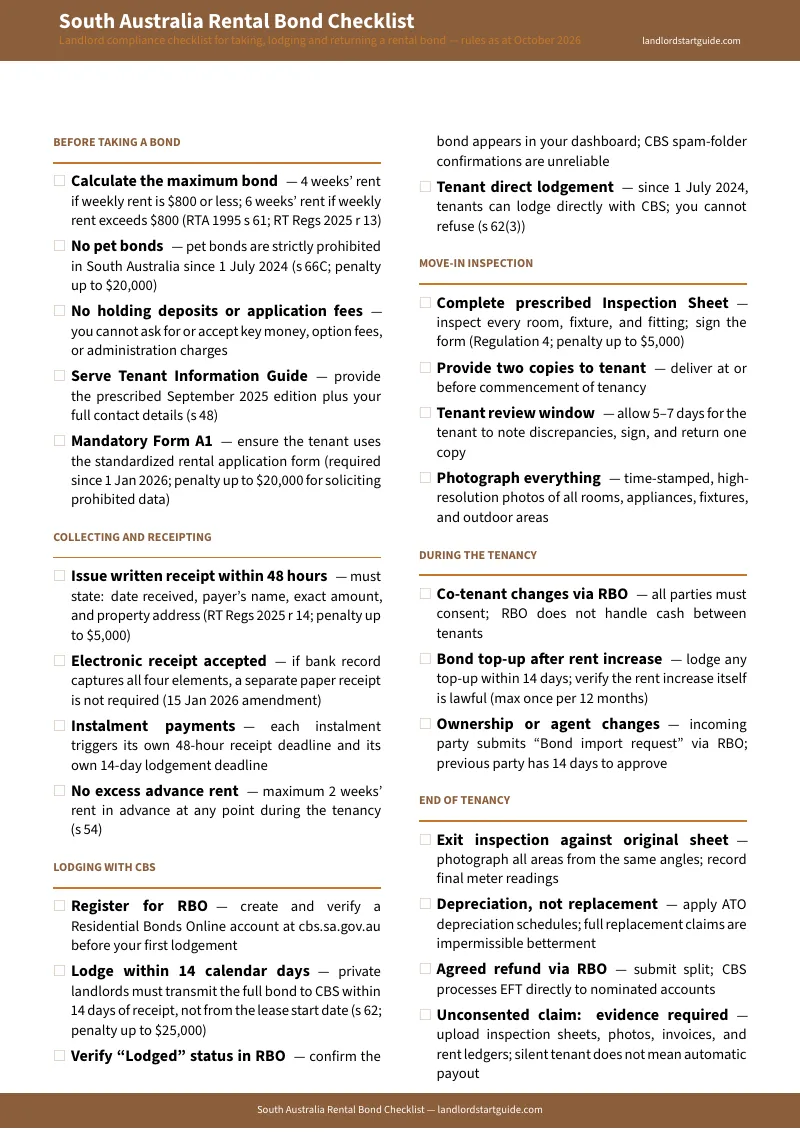
- Printable compliance checklist — every statutory step on two dated pages, from collection to final refund, so nothing falls through the cracks
- Penalty reference table — every bond-related offence, its maximum judicial fine and expiation fee, cross-referenced to the Residential Tenancies Act 1995 section numbers
Who This Is For
This guide is for private landlords in South Australia who manage their own rental property — whether you've inherited a house, you're renting out a former home, or you've bought your first investment property. If you handle the bond yourself instead of paying an agent 6–9% of your gross rent, this is the compliance system that keeps you on the right side of the law.
It's especially useful if you're navigating the bond process for the first time, if you've recently switched from using an agent to self-managing, or if you need to refresh your process after the 2024–2026 reforms changed the rules.
Why Not Just Use the Free Government Pages?
The CBS website and SA.GOV.AU renting pages are accurate — and free. Nobody is hiding the law. But those resources are designed as reference material, not as an operational system. The bond cap rules are on one page. The receipting obligations are on another. The RBO portal has its own help section. The condition report requirements are buried in the Regulations. And the SACAT dispute process is on an entirely separate website.
What's missing is the operational sequence that connects all of it — a single document that tells you what to do first, what to do next, and exactly how long you have at each step. The guide fills that gap with dated worksheets, worked calculations, and a compliance checklist that tracks every deadline from collection to final refund.
Forum after forum, private landlords report the same problems: a bond record that doesn't appear in RBO because the confirmation email went to spam; a SACAT claim dismissed because the condition report wasn't signed by both parties; a penalty notice because they confused the 48-hour receipt deadline with the 14-day lodgement deadline. These aren't problems of access to information — they're problems of operational sequence and documentation discipline. That's what this guide solves.
Satisfaction Guarantee
Full refund, no time limit. If the guide isn't what you expected, email [email protected] and we'll refund you — no questions, no deadline.
Get Started
Download the free South Australia Rental Bond Checklist to see the steps at a glance. When you're ready for the full system — worked examples, portal walkthroughs, tracking worksheets and the Refund and SACAT Evidence Checklist — get the complete guide for .
Frequently Asked Questions
What if the rules change after I buy?
We update the guide when the rules change. Email us any time, even years later, and we'll send you the current edition free.